A heading is an angle measured clockwise from north, which raises an immediate question: which north. Charts are drawn around the geographic pole, a magnetic compass points somewhere else, and the compass in a particular aircraft has small errors of its own. The same direction of flight can therefore be written as three slightly different numbers, called the true, magnetic and compass headings.
Converting between them is addition and subtraction. Most mistakes come from applying a correction in the wrong direction, so the sign convention deserves more attention than the arithmetic.
Two norths
True north is the direction of the geographic North Pole, the point where the Earth’s rotation axis meets the surface. The meridians printed on a chart run toward it, so a course measured on a chart with a plotter is a true course.
Magnetic north is the direction in which a compass needle settles, following the horizontal part of the Earth’s magnetic field at that location. The field is generated deep inside the planet and is irregular, so this direction generally does not coincide with true north, and the difference is not the same everywhere.
Variation: the angle between them
The angle between true north and magnetic north at a given place is the magnetic variation, also called declination. It is labelled east when magnetic north lies east of true north and west when it lies to the west. Charts show it with isogonic lines joining points of equal variation; the line along which variation is zero is called the agonic line.
Variation differs from place to place and drifts slowly with time as the Earth’s field changes. A value from an old chart, or from memory, may no longer be right. That is why this article uses made-up values only: the variation for a real location has to be read from a current chart or a current magnetic model.
The conversion rule
AviationCalc treats easterly variation as positive and westerly variation as negative. With that convention one pair of formulas covers every case:
True heading = magnetic heading + easterly variation
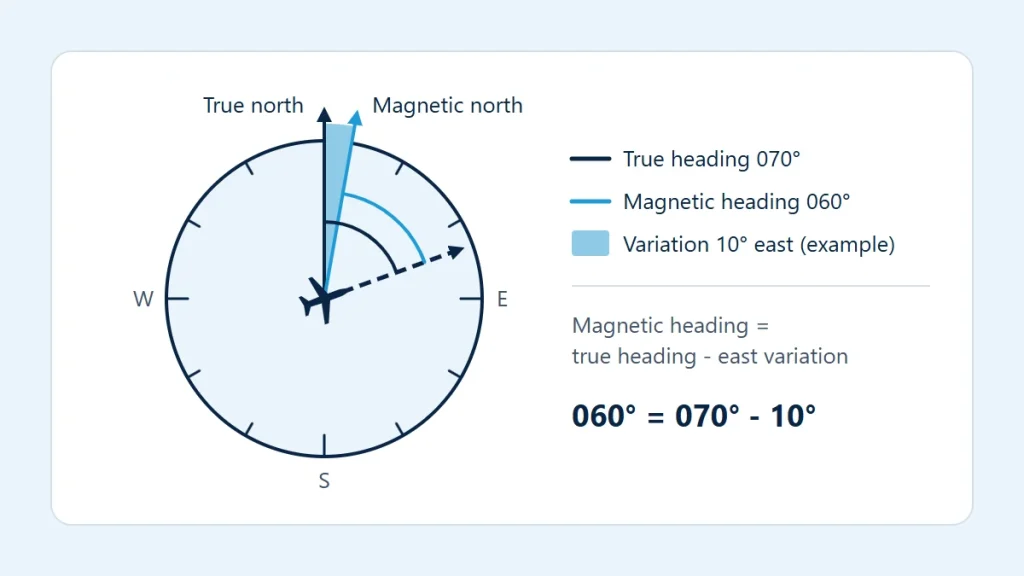
Magnetic heading = true heading − easterly variation
Going from true to magnetic, easterly variation is subtracted and westerly variation is added. The memory aid for that direction is “east is least, west is best”. Going the other way, from magnetic to true, the signs reverse. If the result falls below 001° or above 360°, add or subtract 360° to bring it back onto the compass.
An example with round numbers
Suppose a true heading of 070° and a variation of 10° east. These values are for illustration and belong to no real place. The diagram at the top of this page shows the same case.
- Magnetic heading = 070° − 10° = 060°.
- With 10° west variation instead, magnetic heading = 070° + 10° = 080°.
- Working backwards, a magnetic heading of 060° with 10° east gives a true heading of 060° + 10° = 070°.
Near north the wrap-around matters. A true heading of 005° with 10° east variation gives −5°, which is written as 355° magnetic. A true heading of 355° with 10° west gives 365°, which is 005° magnetic. The true heading and magnetic heading calculator handles the wrap automatically and shows each step.
Deviation and the compass heading
A compass installed in an aircraft is also affected by the aircraft itself: steel parts, electrical equipment and avionics create local fields that pull the needle slightly. This error is the deviation. Unlike variation it belongs to the individual aircraft, changes with the heading being flown, and is recorded on a compass correction card kept near the instrument. The same sign convention applies:
Magnetic heading = compass heading + easterly deviation
Continuing the illustration, suppose the card showed a deviation of 2° west on this heading. The full chain is then:
| Step | Correction applied | Result |
|---|---|---|
| True heading | Starting value | 070° |
| Magnetic heading | Subtract 10° east variation | 060° |
| Compass heading | Add 2° west deviation | 062° |
The calculator accepts any one of the three headings as the starting point and returns the other two. The deviation field is optional; left empty, the compass heading equals the magnetic heading. Any deviation you enter must come from the correction card of the aircraft in question.
Which reference is used where
Much of the confusion comes from the fact that aviation uses both references side by side. As a general pattern:
- Courses measured from chart meridians are true.
- Winds in written weather reports and forecasts, including winds aloft, are given relative to true north.
- Runway numbers are based on the magnetic direction of the runway.
- Winds read out by a control tower or an airport’s recorded broadcast are normally magnetic, so that they compare directly with the runway.
- The magnetic compass, and a heading indicator set from it, read magnetic.
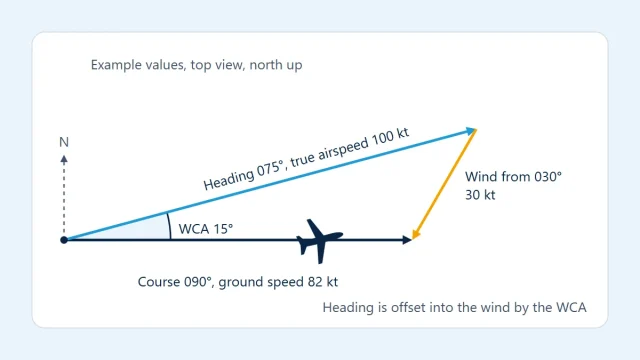
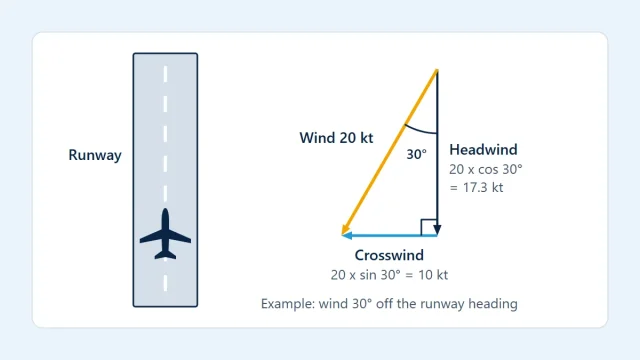
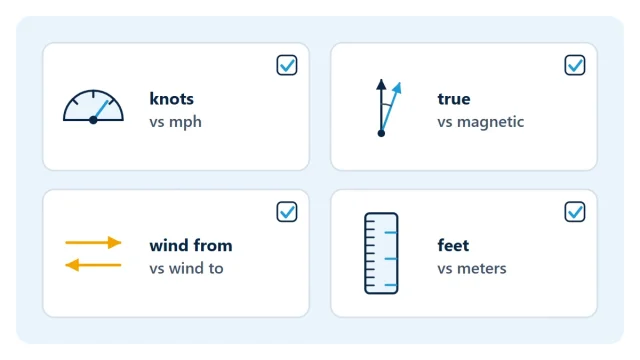
The practical consequence is an order of work. A wind triangle is solved in true, using a true course and the forecast wind, as described in wind correction angle explained and worked by the wind correction angle calculator. Variation is applied afterwards to the resulting true heading. Near the runway the opposite holds: a tower wind and a runway heading are both magnetic and can be compared directly, which is the situation covered in how to calculate crosswind components. Mixing a true wind with a magnetic runway heading, or the reverse, is one of the errors listed in common aviation calculation mistakes.
Limits of the arithmetic
The formulas are exact, so the result is only as good as the inputs. Variation is a single number on this page, while along a real route it changes from one end to the other, and long legs may need different values in different sections. Variation also changes over the years, and published runway numbers and navigation aids are updated from time to time to follow it. A magnetic compass has further errors that the simple chain ignores: it reads accurately only in steady, level, unaccelerated flight, and it becomes unreliable close to the magnetic poles.
Real navigation needs variation from current official charts, deviation from the aircraft’s own compass card, the procedures in the aircraft flight manual (POH/AFM) and the applicable regulations. Use the calculator to practice the conversion and check your sign convention, not as a source of headings to fly.