Wind rarely blows straight down a runway. Whatever its direction, it can be split into two parts at right angles to each other: one acting along the runway and one acting across it. The part across the runway is the crosswind component, and it is the number that tells you how much sideways drift has to be dealt with during takeoff and landing.
Finding it takes one subtraction and one multiplication. This guide covers the exact trigonometry, a worked illustration, and the mental shortcuts pilots use, with a comparison that shows how far those shortcuts sit from the exact values.
One wind, two components
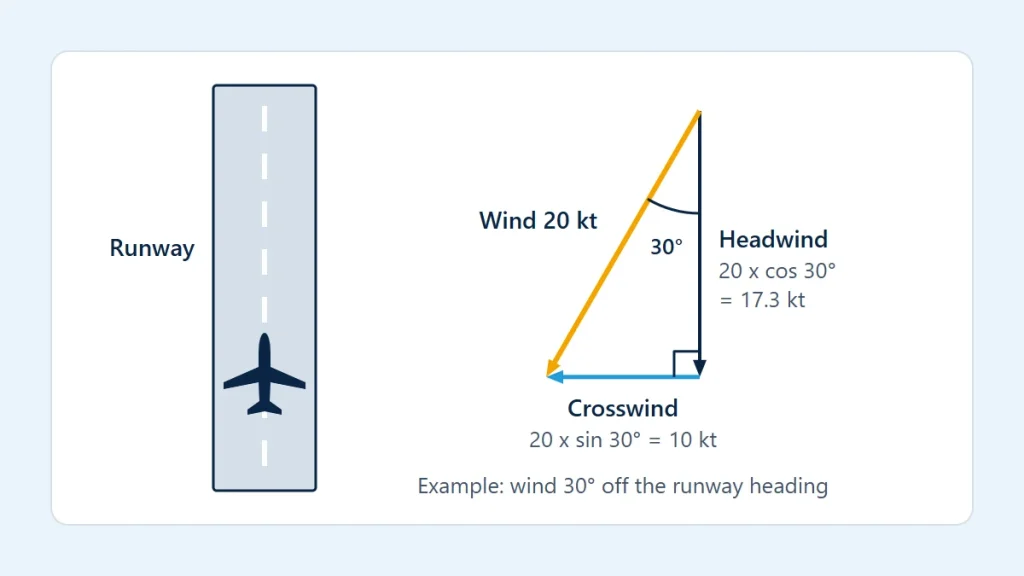
Picture the wind as an arrow pointing in the direction the air is moving. Lay that arrow over the runway and it forms the long side of a right-angled triangle. The side parallel to the runway is the headwind (or tailwind) component. The side perpendicular to it is the crosswind component. The diagram at the top of this page shows that triangle for a 20 kt wind that is 30° off the runway heading.
Crosswind = W × sin(angle)
Headwind = W × cos(angle)
W is the wind speed and the angle is the difference between the wind direction and the runway heading. Sine grows quickly at small angles and flattens out near 90°, which is why a wind only 30° off the runway already delivers half of its speed as crosswind.
Finding the angle
Wind direction is always given as the direction the wind blows from. A wind of 300° is coming from the west-northwest and moving toward the east-southeast. With that convention fixed, the steps are:
- Take the runway heading. A runway number is the heading rounded to the nearest 10° with the last digit dropped, so runway 27 points roughly 270°.
- Subtract the runway heading from the wind direction.
- If the result is outside the range −180° to 180°, add or subtract 360° to bring it back inside.
- Read the sign: a positive angle means the wind is from the right, a negative angle means it is from the left.
- Multiply the wind speed by the sine of the angle for the crosswind and by the cosine for the headwind. A negative headwind is a tailwind, which happens whenever the angle is more than 90° either side.
Both directions must use the same north reference. Runway numbers are based on magnetic north, and winds read out by a control tower or an automated airport broadcast are normally magnetic as well, while winds in written weather reports and forecasts are normally referenced to true north. Where the local variation is large, mixing the two shifts the angle. True heading vs magnetic heading explains the difference.
A worked illustration
Suppose the runway heading is 270° and the wind is reported as 300° at 20 kt. These are round example values, not data for any airport or aircraft.
- Angle = 300° − 270° = 30°, positive, so the wind is from the right.
- Crosswind = 20 × sin(30°) = 10.0 kt from the right.
- Headwind = 20 × cos(30°) = 17.3 kt.
Now turn the same runway around. On the reciprocal heading of 090° the angle becomes −150°. The crosswind is still 10.0 kt, but it comes from the left, and the along-runway part is a 17.3 kt tailwind. The crosswind is the same size in both directions; only the headwind part changes sign. You can reproduce both cases in the crosswind component calculator.
Mental shortcuts and how close they are
Two popular shortcuts replace the sine with a simple fraction. The clock method treats the wind angle as minutes on a clock face: 15° is a quarter of the hour, so use a quarter of the wind speed; 30° is half; 45° is three quarters; 60° or more counts as all of it. The sixths rule is the same idea in 10° steps: one sixth of the wind speed for every 10° of angle, up to six sixths at 60°. Both amount to “angle ÷ 60, never more than 1”.
They are approximations. The table compares them with the exact sine, as a percentage of the wind speed.
| Wind angle | Shortcut fraction | Shortcut | Exact (sine) |
|---|---|---|---|
| 10° | 1/6 | 17% | 17.4% |
| 15° | 1/4 | 25% | 25.9% |
| 20° | 1/3 | 33% | 34.2% |
| 30° | 1/2 | 50% | 50.0% |
| 40° | 2/3 | 67% | 64.3% |
| 45° | 3/4 | 75% | 70.7% |
| 50° | 5/6 | 83% | 76.6% |
| 60° | all | 100% | 86.6% |
| 70° | all | 100% | 94.0% |
| 90° | all | 100% | 100.0% |
Up to 30° the shortcut is within about one percent of the wind speed, slightly on the low side. Between 30° and 90° it reads high, and the gap is widest at 60°, where the shortcut says all of the wind and the exact answer is 86.6%. For illustration, an 18 kt wind at 40° gives 12 kt by the shortcut and 11.6 kt by the sine. The shortcut is a quick cross-check on a calculated figure, not a replacement for it.
Gusts
A gust arrives from roughly the same direction as the steady wind, so its components come from the same formula with the gust speed in place of W. If the example wind were gusting to 30 kt, the crosswind in the gusts would be 15.0 kt and the headwind 26.0 kt. The calculator has an optional gust field that reports these peak values alongside the steady ones. Treat the result as a range: the component moves between the steady and the gust value as the wind speed fluctuates.
What the number does not tell you
The calculation is pure geometry. It assumes one steady wind direction and speed over the whole runway, which real wind does not provide: it veers, backs, changes with height above the ground, and is disturbed by terrain, trees and buildings. A reported wind is also a sample taken at one sensor some time ago.
The result is not a verdict on whether a takeoff or landing is acceptable. AviationCalc does not compare it with any limit, because crosswind and tailwind limits come from the aircraft flight manual (POH/AFM) and the operator, and they depend on the aircraft, the runway surface and the applicable regulations. Real operations need the current official wind report for the airport and the aircraft’s own documentation.