Point an aircraft straight at its destination in a crosswind and it will not arrive there. The air mass carries it sideways the whole time, so its path over the ground curves or slides downwind of the intended line. The fix is to aim slightly into the wind so that the sideways push of the wind is cancelled. The size of that offset is the wind correction angle, usually shortened to WCA.
Holding the nose off to one side like this is often called crabbing, because the aircraft moves over the ground in a direction different from the one it is pointing.
Three directions that are easy to confuse
- Course is the line you intend to follow over the ground, measured clockwise from north.
- Heading is the direction the nose points.
- Track is the path actually made good over the ground. When the correction is right, track equals course.
In still air, heading and course are the same. With a crosswind they differ by the WCA:
Heading = course + WCA
The WCA is positive when the correction is to the right and negative when it is to the left. The correction is always toward the side the wind comes from.
The wind triangle
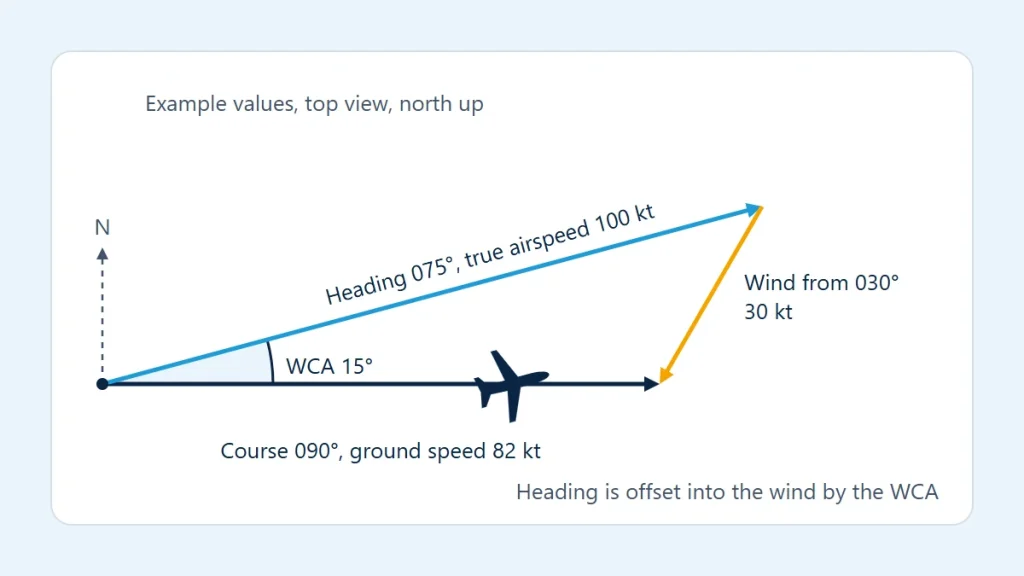
Three velocities are involved, and each has a speed and a direction. The aircraft moves through the air along its heading at its true airspeed (TAS). The air moves over the ground in the direction the wind is blowing, at the wind speed. Add those two arrows tip to tail and the result is the aircraft’s movement over the ground: along the course, at the ground speed.
The diagram at the top of this page draws that triangle to scale. The blue heading arrow is angled into the wind, the amber wind arrow carries its tip back onto the course line, and the navy arrow that closes the triangle is the ground speed. The angle between the heading and course arrows is the WCA.
The formula
For the aircraft to stay on the course, the part of its airspeed that points across the course has to equal the crosswind component of the wind. That condition gives:
WCA = asin(W × sin(wind direction − course) ÷ TAS)
Ground speed = TAS × cos(WCA) − W × cos(wind direction − course)
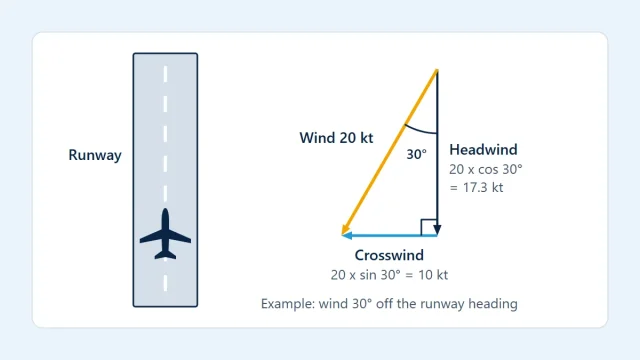
W is the wind speed, and wind direction is the direction the wind blows from. W × sin(angle) is the crosswind on the course and W × cos(angle) is the headwind; both are explained in how to calculate crosswind components. The course and the wind direction must share the same north reference. Forecast winds aloft are given relative to true north, so the natural choice is a true course, which produces a true heading.
Working through the diagram’s numbers
For illustration, take a true course of 090°, a true airspeed of 100 kt and a wind from 030° at 30 kt.
- Wind angle = 030° − 090° = −60°. Negative means the wind is from the left of the course.
- Crosswind = 30 × sin(−60°) = −26.0 kt, that is 26.0 kt from the left.
- WCA = asin(−26.0 ÷ 100) = −15.1°, a correction of 15.1° to the left.
- True heading = 090° − 15.1° = 074.9°, or 075° to the nearest degree.
- Ground speed = 100 × cos(−15.1°) − 30 × cos(−60°) = 81.6 kt.
Two effects reduce the ground speed here. The wind has a headwind part of 15 kt, and turning the nose 15.1° off the course means slightly less of the airspeed acts along it. The wind correction angle calculator returns the same four results: the angle, the true heading, the ground speed and the crosswind on the course. Move the wind to 150°, the mirror image on the other side of the course, and the angle becomes 15.1° to the right with the same 81.6 kt ground speed.
What makes the angle larger or smaller
The WCA depends on the ratio of crosswind to true airspeed, not on either number alone. A faster aircraft needs less correction for the same wind, and a slower one needs more. The table uses a wind at right angles to the course, so the whole wind is crosswind.
| True airspeed | Direct crosswind | Exact WCA | Ground speed |
|---|---|---|---|
| 100 kt | 10 kt | 5.7° | 99.5 kt |
| 100 kt | 20 kt | 11.5° | 98.0 kt |
| 100 kt | 30 kt | 17.5° | 95.4 kt |
| 200 kt | 30 kt | 8.6° | 197.7 kt |
Notice the last column. Even a wind with no headwind part at all costs a little ground speed, because the aircraft is not pointed straight along the course.
A common mental estimate is WCA ≈ 60 × crosswind ÷ TAS. For the first three rows it gives 6°, 12° and 18°, against exact values of 5.7°, 11.5° and 17.5°. It is an approximation that replaces the arcsine with a straight line, so it overstates the angle a little and the error widens as the angle grows.
From true heading to the heading you fly
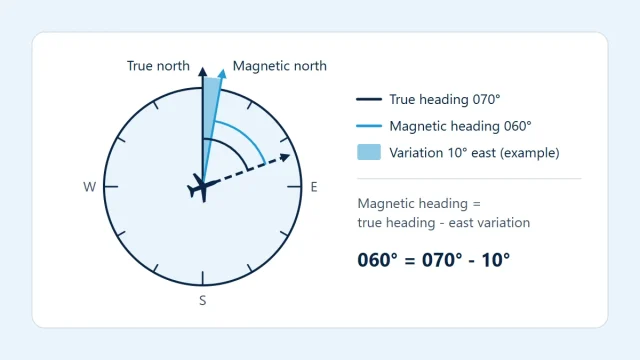
The triangle yields a true heading. A magnetic compass and a heading indicator set from it read relative to magnetic north, so the local magnetic variation is applied next, followed by the compass deviation for that aircraft if a compass heading is wanted. True heading vs magnetic heading walks through that conversion, and the true heading and magnetic heading calculator does the arithmetic. Keep the steps separate: wind first, variation second.
Where the triangle stops being enough
The formula assumes a single steady wind and a constant true airspeed along a straight leg. Real wind changes with altitude, along the route and over time, and the forecast value is an estimate for an area, not a measurement at the aircraft. A heading worked out in advance is therefore a starting point that is adjusted in flight by comparing the track made good with the intended course.
The formula also has a hard edge: if the crosswind part of the wind is greater than the true airspeed, no heading can hold the course, and the calculator rejects the input instead of returning an angle. Near that edge the answer is very sensitive to small changes in wind.
Real flight planning needs current official weather information and charts, true airspeed taken from the aircraft flight manual (POH/AFM) for the planned conditions, and the applicable regulations. The calculator on this site is for learning the relationship, not for planning a flight.