True Heading and Magnetic Heading Calculator
This calculator converts one heading into the other two references used in navigation. Start from a true heading measured against geographic north, a magnetic heading measured against magnetic north, or a compass heading read from the instrument, and it applies magnetic variation and compass deviation to give all three.
The conversion matters because courses measured on a chart are usually true, runway numbers are generally based on magnetic direction, and the compass in the panel has small errors of its own. Working through that chain in the right order, with the right sign at each step, is a classic source of arithmetic slips, so seeing all three values side by side is a good check on your own working.
How to use this calculator
- In Heading you know, choose True heading, Magnetic heading or Compass heading.
- Type that value in Heading, from 0 to 360°.
- Enter Magnetic variation as a plain positive number and set Variation direction to East or West.
- If you want the compass step included, enter Compass deviation and set Deviation direction. Leave the deviation blank and it is taken as 0.
Variation and deviation are both typed without a sign; the East or West selector carries the direction. Variation belongs to a place and a date, so take it from a current chart for the location. Deviation belongs to one aircraft and one heading, and comes from that aircraft's compass correction card. Many cards are written as a heading to steer rather than as degrees east or west: if the card tells you to steer a compass heading smaller than the magnetic heading, the deviation is east.
Formula
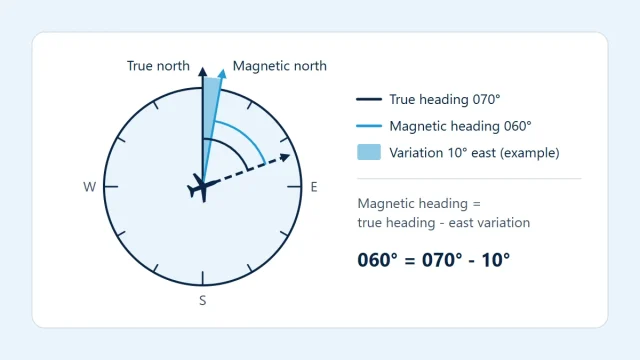
magnetic = true − easterly variation (or + westerly variation)
compass = magnetic − easterly deviation (or + westerly deviation)
results are wrapped into the range 001° to 360°
What the variables mean
- true
- heading measured from true (geographic) north
- magnetic
- heading measured from magnetic north
- compass
- heading shown by the aircraft's magnetic compass
- variation
- angle between true and magnetic north at the location, from a current chart
- deviation
- compass error for that heading, from the aircraft's compass correction card
Worked example
These example values are illustrative round numbers, not data for any particular aircraft. Select "Fill in the example" in the calculator to load them.
Inputs
- Heading you know: True heading
- Heading: 85°
- Magnetic variation: 12°
- Variation direction: West
- Compass deviation: 2°
- Deviation direction: East
Working
- Magnetic = true − easterly variation = 85.0° − (−12.0°) = 097°.
- Compass = magnetic − easterly deviation = 97.0° − (2.0°) = 095°.
Result
- True heading: 085°
- Magnetic heading: 097° (Variation 12.0° W)
- Compass heading: 095° (Deviation 2.0° E)
Reading the result
Three rows come back: True heading, Magnetic heading and Compass heading. The row that matches your starting point repeats what you typed. Beside the magnetic row is the variation that was applied, and beside the compass row the deviation. Headings are written as three digits and wrapped through north, which is shown as 360° rather than 000°. With west variation the magnetic heading is the larger number; with east variation it is the smaller one. If you left the deviation blank, the compass and magnetic headings are identical.
Assumptions and limitations
- Variation is applied as true = magnetic + easterly variation, with west treated as negative.
- Deviation is applied as magnetic = compass + easterly deviation, using the single value you enter; the calculator does not hold a deviation card and cannot pick the right line for the heading.
- No magnetic model or location lookup is involved, so the variation is only as current as the chart you read it from.
- Compass errors that appear while turning, accelerating or flying in turbulence are not part of the conversion.
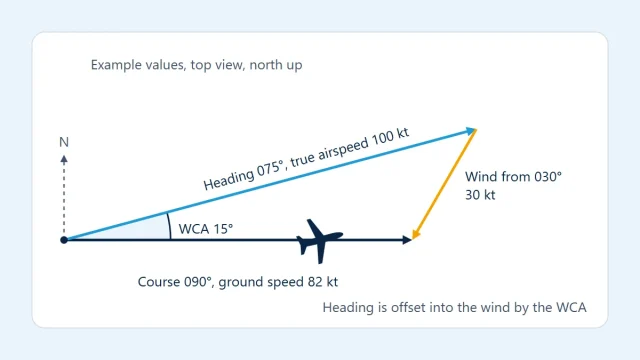
- Wind is not considered: the calculator converts a heading, and turning a course into a heading needs a wind correction angle first.
- Results are rounded to a tenth of a degree and wrapped into the range 001° to 360°.
Common mistakes
- Adding easterly variation when going from true to magnetic, when it has to be subtracted (east is least, west is best).
- Keeping the same operation after reversing the direction of the conversion: going from magnetic back to true, easterly variation is added.
- Reading variation from an old chart or from a point far from the route, when the isogonic lines have since moved.
- Using the deviation printed for a different heading on the correction card, or a card that belongs to another aircraft.
- Treating a true course as a true heading and leaving the wind correction angle out of the chain.
- Forgetting to wrap through north, for example writing 367° instead of 007° after adding 12° to 355°.
References
- Federal Aviation Administration, Pilot's Handbook of Aeronautical Knowledge (FAA-H-8083-25).
- NOAA National Centers for Environmental Information, Magnetic Field Calculators.
- Federal Aviation Administration, Aeronautical Information Manual.
These public sources explain the formulas and definitions used here. Citing them does not mean they have reviewed, endorsed or certified AviationCalc.
Related calculators
Wind Correction Angle Calculator
Wind correction angle, true heading and ground speed for a course and wind.
Aviation Navigation
Ground Speed Calculator
Find ground speed from true airspeed, course and wind using the wind triangle.
Flight Speed and Distance
Crosswind Component Calculator
Split a reported wind into crosswind and headwind components for a runway heading.
Wind Calculations
Flight Distance Calculator
Great-circle distance and initial true course between two latitude and longitude points.
Flight Speed and Distance
Guides that explain this calculation
Aviation Navigation
True Heading vs Magnetic Heading
True, magnetic and compass headings differ by variation and deviation. Learn the sign convention and follow a worked conversion with example values.
Aviation Navigation
Wind Correction Angle Explained
Why an aircraft has to point into a crosswind to hold its course, how the wind triangle gives the angle, and how airspeed changes the answer.
Aviation Navigation
Common Aviation Calculation Mistakes
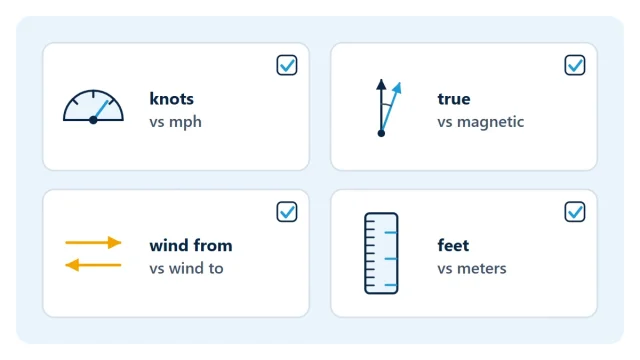
Unit mix-ups, true versus magnetic, wind from versus to, and airspeed used as ground speed: the common errors, with the size of each shown.