Wind Correction Angle Calculator
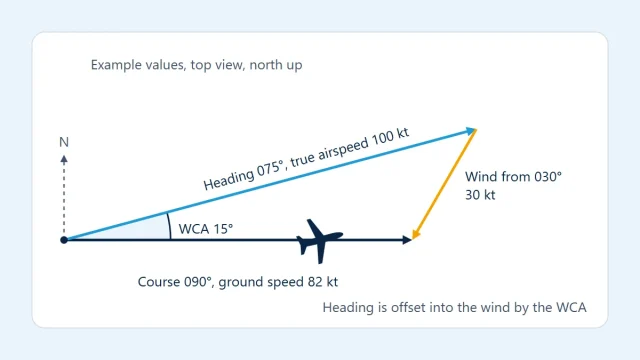
Point an aircraft straight along a line on the chart in a crosswind and it will slide off downwind. To stay on the line the nose has to be turned slightly into the wind, and the size of that turn is the wind correction angle. This calculator finds it from the ratio of the crosswind to the true airspeed, then adds it to the course to give the heading to fly.
The angle depends on airspeed as much as on wind: a slow aircraft needs a large correction for a wind that a fast one barely notices. Seeing the heading and the ground speed come out of the same triangle also makes clear that crabbing into the wind is not free.
How to use this calculator
- Enter the planned cruise True airspeed in kt, km/h, mph or m/s.
- Enter True course, the direction of the line you want to follow, in degrees.
- Enter Wind direction (from) in degrees true.
- Enter Wind speed and the unit the forecast gives it in.
Keep everything in true directions. The course measured from a chart against the meridians is true, and forecast winds aloft are given in degrees true, so the two fit together as they are. The heading that comes out is therefore also true. Variation and compass deviation are applied afterwards, never before; the true heading and magnetic heading calculator handles that step. Airspeed and wind speed may be entered in different units.
Formula
WCA = asin( W × sin(WD − TC) ÷ TAS )
true heading = TC + WCA
GS = TAS × cos(WCA) − W × cos(WD − TC)
What the variables mean
- WCA
- wind correction angle; positive is a correction to the right
- TC
- true course
- WD
- wind direction, the direction the wind blows from
- W
- wind speed
- TAS
- true airspeed
- GS
- ground speed
Worked example
These example values are illustrative round numbers, not data for any particular aircraft. Select "Fill in the example" in the calculator to load them.
Inputs
- True airspeed: 100 kt
- True course: 360°
- Wind direction (from): 270°
- Wind speed: 15 kt
Working
- Wind angle = WD − TC = 270° − 360° = −90°.
- WCA = asin(15.0 × sin(−90°) ÷ 100.0) = −8.6°.
- True heading = 360° + (−8.6°) = 351.4°.
- GS = 100.0 × cos(−8.6°) − 15.0 × cos(−90°) = 98.9 kt.
Result
- Wind correction angle: 8.6° left
- True heading: 351.4°
- Ground speed: 98.9 kt
- Crosswind on the course: 15.0 kt from the left
Reading the result
Wind correction angle is given in degrees with the word left or right, the direction to turn the nose from the course. True heading is the course with that correction applied: a left correction lowers the number and a right correction raises it, wrapping through 360°. Ground speed is the speed made good along the course on that heading. Crosswind on the course shows the sideways part of the wind and the side it comes from, in the unit chosen for true airspeed; the correction is always toward that side. With no crosswind the angle reads 0.0° (no correction).
Assumptions and limitations
- One steady wind applies to the whole leg; in practice the forecast wind is an estimate for a region and a time period.
- True airspeed is constant and the aircraft is in level, coordinated flight.
- The geometry is flat, which is appropriate for a single leg but not for a long great-circle route whose course changes.
- The output is a true heading with no magnetic variation or compass deviation applied.
- A crosswind stronger than the true airspeed, or a wind that leaves no forward progress, has no solution and is reported as an error.
- The pilot is assumed to hold the computed heading exactly; turbulence and heading wander are ignored.
Common mistakes
- Turning away from the wind instead of into it, applying the correction with the wrong sign.
- Applying magnetic variation to the course first and then using a true wind direction.
- Using indicated airspeed where true airspeed is required, which makes the angle too large at altitude.
- Assuming the angle is proportional to wind speed alone and forgetting that a lower airspeed increases it.
- Treating the computed heading as a magnetic or compass heading and flying it unchanged.
- Keeping the planned heading when the track observed over the ground shows the actual wind differs from the forecast.
References
- Federal Aviation Administration, Pilot's Handbook of Aeronautical Knowledge (FAA-H-8083-25).
- Federal Aviation Administration, Aeronautical Information Manual.
These public sources explain the formulas and definitions used here. Citing them does not mean they have reviewed, endorsed or certified AviationCalc.
Related calculators
Ground Speed Calculator
Find ground speed from true airspeed, course and wind using the wind triangle.
Flight Speed and Distance
True Heading and Magnetic Heading Calculator
Convert between true, magnetic and compass headings with variation and deviation.
Aviation Navigation
Crosswind Component Calculator
Split a reported wind into crosswind and headwind components for a runway heading.
Wind Calculations
Headwind and Tailwind Calculator
Find the headwind or tailwind component of any wind along your track.
Wind Calculations
Guides that explain this calculation
Aviation Navigation
Wind Correction Angle Explained
Why an aircraft has to point into a crosswind to hold its course, how the wind triangle gives the angle, and how airspeed changes the answer.

Flight Speed and Distance
Understanding Ground Speed in Aviation
Ground speed is true airspeed and wind added as vectors. See the wind triangle formula, a worked example and why a pure crosswind still slows you down.
Aviation Navigation
True Heading vs Magnetic Heading
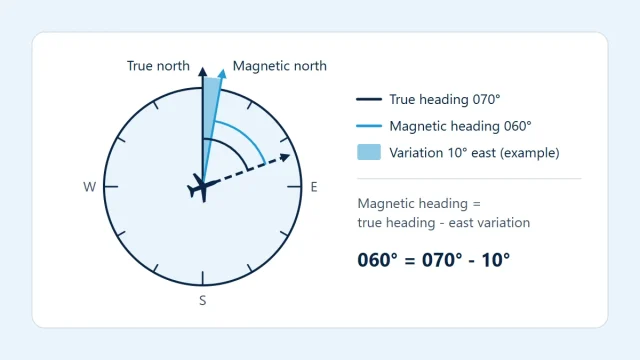
True, magnetic and compass headings differ by variation and deviation. Learn the sign convention and follow a worked conversion with example values.