Aviation uses several length units at once. Horizontal distance is usually in nautical miles, altitude in feet, and visibility or runway length in statute miles, feet or meters depending on the country. Each unit has an exact definition, so converting between them is never a matter of opinion, only of using the right factor in the right direction.
The units and their exact definitions
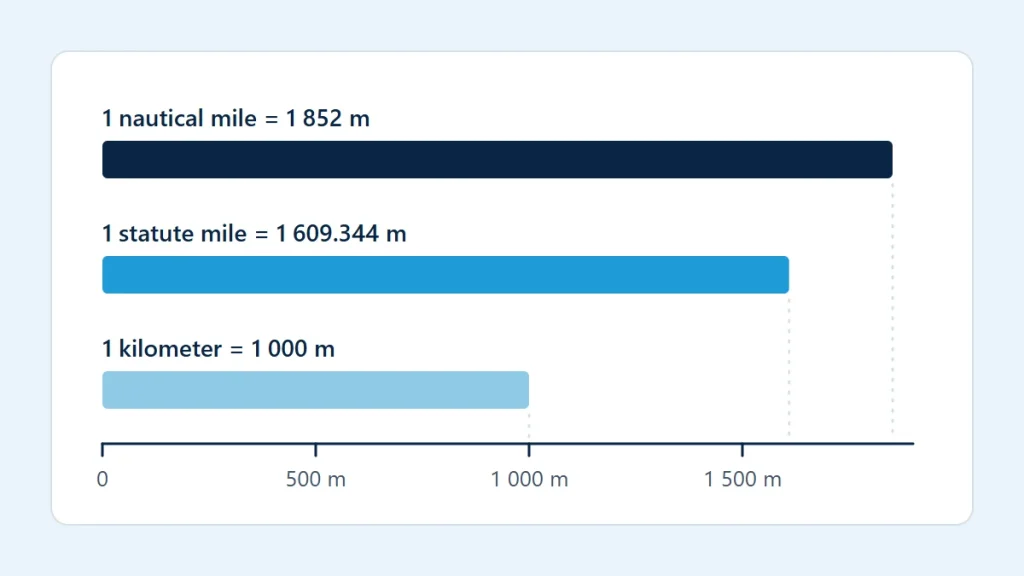
All of the units below are defined in terms of the meter. The diagram at the top of this page draws the three “mile-sized” units to the same scale.
| Unit | Exact definition | Typical use in aviation |
|---|---|---|
| Nautical mile (NM) | 1,852 m | Route distances, navigation, distance to a waypoint |
| Statute mile (mi) | 1,609.344 m (5,280 ft) | Visibility in the United States; road and map distances |
| Kilometer (km) | 1,000 m | Visibility and distances in countries using metric units |
| Foot (ft) | 0.3048 m | Altitude and elevation; runway length in some countries |
| Meter (m) | The SI base unit of length | Runway length and visibility in many countries |
The “typical use” column describes common practice, which differs between countries. The units actually in force for a given flight are the ones on the current official charts and publications for that region.
Why the nautical mile survives
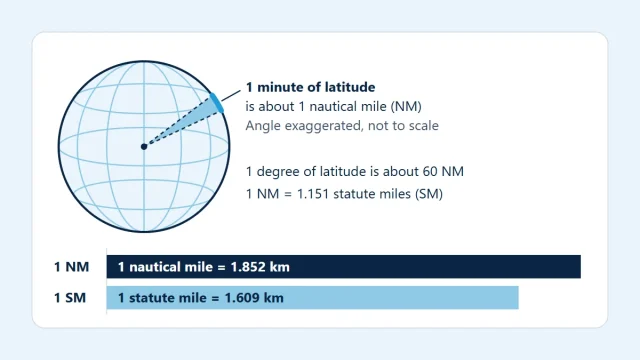
The nautical mile was originally tied to the Earth itself: one minute of arc of latitude, so that one degree of latitude is 60 NM. That link makes distance easy to read from a chart, because the latitude scale on the side of the chart doubles as a distance scale.
The Earth is not a perfect sphere, so a minute of latitude is not exactly the same length everywhere. The modern nautical mile is therefore fixed at exactly 1,852 m, close to the average. The flight distance calculator, which uses a spherical Earth with a mean radius of 6,371.0088 km, gives 60.0 NM (111.2 km) between two points on the same meridian one degree of latitude apart.
The convenience applies only to latitude. Meridians converge toward the poles, so one minute of longitude is shorter than a nautical mile everywhere except on the equator.
Speed units follow the distance units
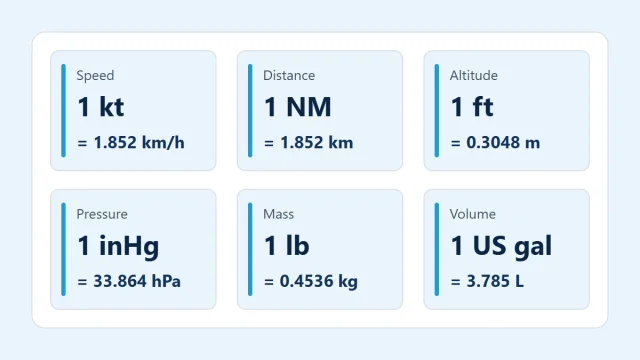
A knot is one nautical mile per hour, which makes it exactly 1.852 km/h. Statute miles pair with miles per hour and kilometers with kilometers per hour. For illustration, 120 kt is 222.24 km/h, or 138.09 mph.
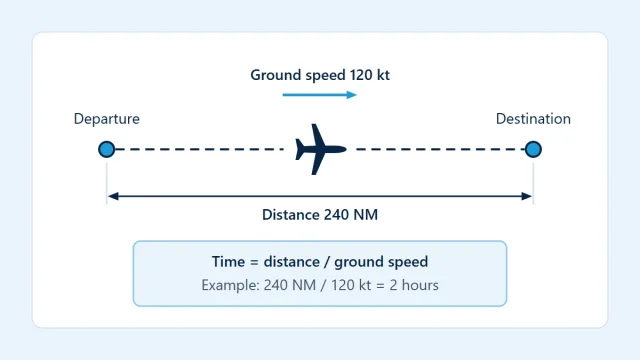
The pairing matters more than any single factor. Time is distance divided by speed, and the division only gives hours when the two units belong together. See How Pilots Calculate Flight Time for the formula.
Conversion factors
| From | To | Multiply by |
|---|---|---|
| Nautical miles | Kilometers | 1.852 (exact) |
| Nautical miles | Statute miles | 1.150779 |
| Nautical miles | Feet | 6,076.115 |
| Statute miles | Nautical miles | 0.8689762 |
| Statute miles | Kilometers | 1.609344 (exact) |
| Kilometers | Nautical miles | 0.5399568 |
| Kilometers | Statute miles | 0.6213712 |
| Meters | Feet | 3.28084 |
Factors marked exact follow directly from the definitions. The others are rounded to seven significant figures, far more than any practical calculation needs.
A conversion worked both ways
Suppose a route is measured as 250 NM. Using the factors above:
- 250 × 1.852 = 463 km
- 250 × 1.150779 = 287.69 statute miles
The number grows in both cases because the nautical mile is the longest of the three units. Going the other way, the number shrinks: 100 km is 53.996 NM, and 100 statute miles is 86.898 NM. That gives a quick test for any conversion. A distance in nautical miles must be a smaller number than the same distance in statute miles or kilometers; if your result went the wrong way, the factor was applied upside down.
The nautical miles to kilometers calculator accepts a distance in any of these units and returns all of the others at once, which avoids choosing a factor at all. For speeds, pressures, masses and volumes as well as lengths, use the aviation unit conversion calculator.
Where mixed units cause errors
Most unit mistakes come from a number that has lost its label. A few patterns account for many of them:
- Statute miles treated as nautical miles. For illustration, 240 statute miles is 208.6 NM. At a ground speed of 120 kt that is 1 h 44 min, not the 2 h 00 min you get by dividing 240 by 120.
- Vertical and horizontal units combined. A climb gradient in feet per nautical mile, or a glide expressed as distance per unit of height, mixes feet with nautical miles. One nautical mile is 6,076.115 ft; rounding it to 6,000 ft is a common shortcut that carries an error of a little over 1 percent.
- Feet and meters confused. A meter is more than three feet, so a height of 1,500 m is 4,921 ft. Reading a metric value as feet, or the reverse, changes the quantity by a factor of more than three.
- Map tools in the wrong unit. Road maps and many general-purpose mapping tools report statute miles or kilometers by default, while aeronautical charts are scaled in nautical miles.
Nautical Miles vs Statute Miles compares the two miles in more depth, and Essential Aviation Unit Conversions extends the same approach to pressure, temperature, fuel and mass.
What conversion does not settle
A conversion changes the unit of a number and nothing else. It cannot tell you whether the number was right to begin with, or what it was measuring. A straight-line distance converted to nautical miles is still a straight-line distance, shorter than the route an aircraft actually flies. A runway length converted from meters to feet is still only a length, and says nothing about whether a particular aircraft can use that runway on a particular day.
Which units apply, and the values themselves, come from current official charts and aeronautical publications. Performance figures come from the aircraft flight manual (POH/AFM) in the units printed there, and flight operations are subject to current weather information and the applicable regulations. The tables on this page are for learning and for checking arithmetic.