Nautical Miles to Kilometers Calculator
A nautical mile is 1,852 meters by definition, which makes it longer than both a kilometer and a statute mile. This calculator takes one distance in nautical miles, kilometers, statute miles, meters or feet and shows it in all of the others at once, so it works in either direction.
Aviation measures route distances in nautical miles because one nautical mile is close to one minute of latitude, and a knot is one nautical mile per hour. Road maps, runway lengths, visibility reports and everyday references often use other units, so moving cleanly between them is a routine part of reading charts and following examples in training material.
How to use this calculator
- Type the distance in Distance.
- In the unit list beside it, pick the unit you are starting from: nautical miles, kilometers, statute miles, meters or feet.
- Read the converted values. Your starting unit is repeated in its own row, which is a quick check that you chose the right one.
Only zero or positive distances are accepted. The word miles on its own is ambiguous: on this page mi always means the statute mile of 5,280 ft, and NM always means the nautical mile. If what you need is the distance between two positions rather than a change of unit, use the flight distance calculator.
Formula
km = NM × 1.852
NM = km ÷ 1.852
statute miles = NM × 1 852 ÷ 1 609.344
What the variables mean
- NM
- international nautical mile, exactly 1 852 m
- km
- kilometer, 1 000 m
- statute mile
- exactly 1 609.344 m
Worked example
These example values are illustrative round numbers, not data for any particular aircraft. Select "Fill in the example" in the calculator to load them.
Inputs
- Distance: 150 NM
Working
- Convert to meters with the exact definition of the starting unit: 277,800 m.
- NM = meters ÷ 1 852 = 150.
- km = meters ÷ 1 000 = 277.8.
- Statute miles = meters ÷ 1 609.344 = 172.6169.
Result
- Nautical miles: 150 NM
- Kilometers: 277.8 km
- Statute miles: 172.6169 mi
- Meters and feet: 277,800 m (911,417.3 ft)
Reading the result
Four rows are returned: Nautical miles, Kilometers, Statute miles, and Meters and feet together on the last row. Values are shown to seven significant figures, so a long distance drops trailing decimals instead of gaining false precision. For illustration, 150 NM appears as 277.8 km and 172.6169 mi. The feet figure is handy for comparing a horizontal distance with an altitude: 1 NM is 6,076.115 ft. Because every definition used is exact, any difference from a hand calculation comes from rounding in the factor you used.
Assumptions and limitations
- The international nautical mile of exactly 1,852 m is used, not older national definitions.
- The statute mile is the international mile of exactly 1,609.344 m, which differs very slightly from the US survey mile.
- The foot is the international foot of exactly 0.3048 m.
- Results are displayed to seven significant figures; the underlying conversion is not rounded before that.
- This is a change of units only. It does not measure a route, follow a great circle or allow for the distance flown in climbs, turns and procedures.
Common mistakes
- Multiplying nautical miles by 1.609, the statute mile factor, instead of 1.852.
- Treating a nautical mile and a statute mile as interchangeable, when the nautical mile is about 15% longer.
- Dividing a distance in kilometers or statute miles by a speed in knots to get a flight time.
- Rounding the factor to 2 km per nautical mile for a long leg, which overstates the distance by about 8%.
- Reading a visibility given in statute miles or meters as if it were in nautical miles.
- Using 5,280 ft for a nautical mile in a descent or glide calculation, when that is the length of a statute mile.
References
- National Institute of Standards and Technology, Guide for the Use of the International System of Units (SI), Special Publication 811.
- Federal Aviation Administration, Pilot's Handbook of Aeronautical Knowledge (FAA-H-8083-25).
These public sources explain the formulas and definitions used here. Citing them does not mean they have reviewed, endorsed or certified AviationCalc.
Related calculators
Aviation Unit Conversion Calculator
Convert the speed, distance, altitude, mass, volume, pressure and temperature units used in aviation.
Aviation Units and Conversions
Flight Distance Calculator
Great-circle distance and initial true course between two latitude and longitude points.
Flight Speed and Distance
Flight Time Calculator
Time en route from distance and ground speed, in hours and minutes.
Flight Speed and Distance
Altimeter Pressure Conversion Calculator
Convert altimeter settings between inHg, hPa (millibars), mmHg, kPa and psi.
Atmosphere and Altitude
Guides that explain this calculation
Aviation Units and Conversions
Nautical Miles vs Statute Miles
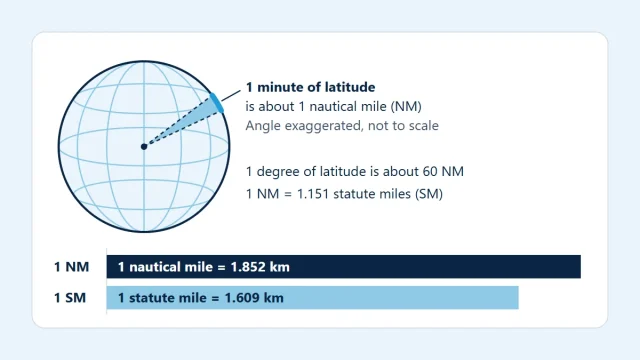
A nautical mile is exactly 1,852 m and about one minute of latitude; a statute mile is 1,609.344 m. See why aviation uses one and how to convert.
Aviation Units and Conversions
Aviation Distance Units Explained
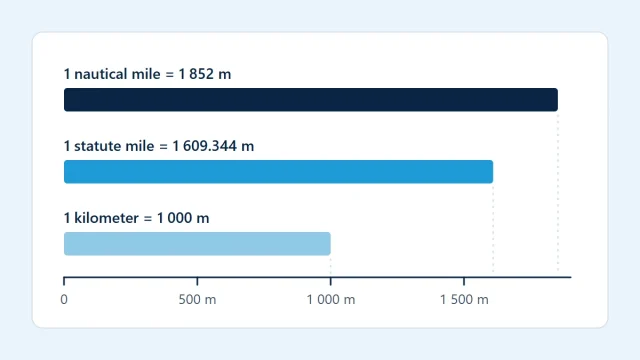
Nautical miles, statute miles, kilometers, feet and meters each have an exact definition. See where each is used and how to convert without errors.
Aviation Units and Conversions
Essential Aviation Unit Conversions
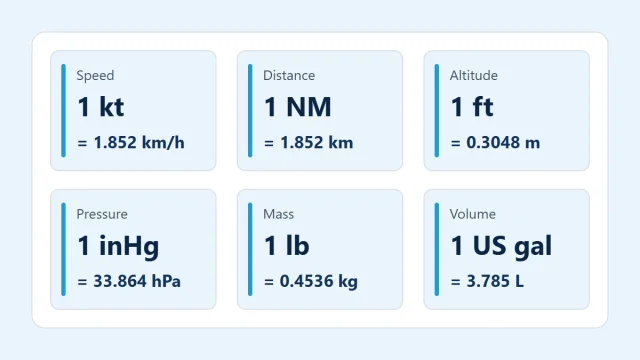
The speed, distance, altitude, pressure, temperature, mass and volume conversions aviation uses most, with exact factors and the shortcuts labelled.