Aviation runs on a mixed set of units. Altitude is usually in feet, distance in nautical miles, speed in knots, pressure in inches of mercury or hectopascals, fuel in gallons, liters, pounds or kilograms, and temperature in degrees Celsius or Fahrenheit. Which combination you meet depends on the country, the aircraft and the age of its documentation.
A number without its unit is the starting point of many calculation errors. This guide collects the conversions that come up most often, states which factors are exact, and points out the one conversion that cannot be done with a fixed factor at all.
Six definitions worth memorizing
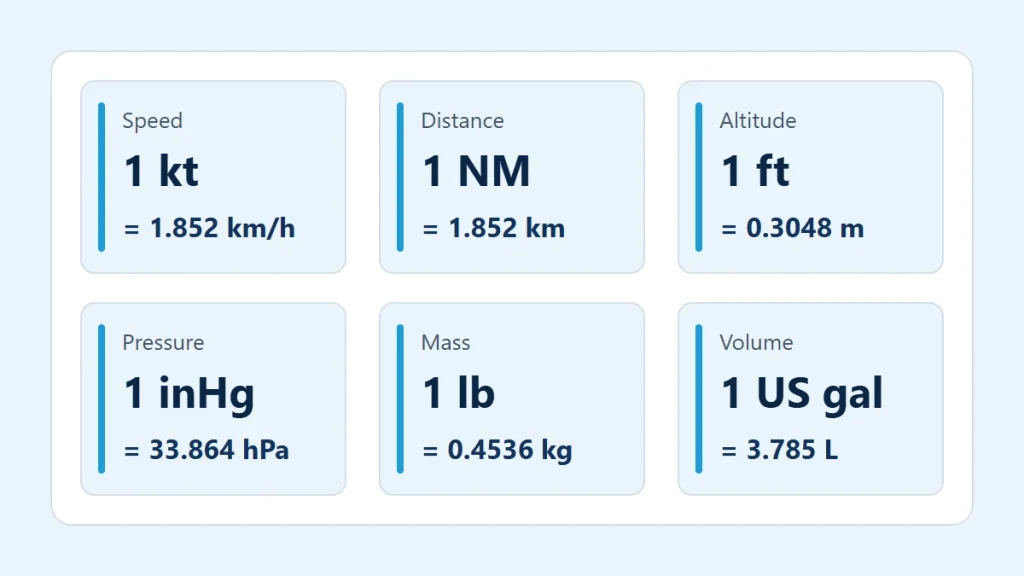
Most aviation conversions rest on a handful of definitions. Five of the six below are exact by international agreement; the inch of mercury uses a conventional value. The diagram at the top of this page shows the same six, rounded.
| Quantity | Unit | Equals | Status |
|---|---|---|---|
| Speed | 1 kt | 1.852 km/h | Exact (1 NM per hour) |
| Distance | 1 NM | 1,852 m | Exact |
| Altitude | 1 ft | 0.3048 m | Exact |
| Pressure | 1 inHg | 33.86389 hPa | Conventional value |
| Mass | 1 lb | 0.45359237 kg | Exact |
| Volume | 1 US gal | 3.785411784 L | Exact |
Every other factor in this article is derived from these and from the statute mile, 1,609.344 m, and the imperial gallon, 4.54609 L. The aviation unit conversion calculator works the same way: it converts the value you enter to an SI base unit and then to every other unit of that quantity.
Speed and distance
Horizontal speed is normally in knots. Some older airspeed indicators read in miles per hour, some countries and many gliders use kilometers per hour, and wind is reported in meters per second in a few regions.
- 1 kt = 1.150779 mph = 1.852 km/h = 0.5144444 m/s
- 1 mph = 0.8689762 kt
- 100 km/h = 53.99568 kt
- 1 m/s = 1.943844 kt
Two rough mental checks follow from these: meters per second times two is slightly more than the figure in knots, and kilometers per hour divided by two is slightly less. Both are approximations for sanity-checking only.
Vertical speed has its own pair of units, feet per minute and meters per second. A climb of 500 ft/min is 2.54 m/s, and 1 m/s is 196.8504 ft/min, so “multiply meters per second by 200” is a close approximation. One knot is 101.2686 ft/min, which is why knots and hundreds of feet per minute are nearly interchangeable when comparing horizontal and vertical speed.
Distance and height
Horizontal distance is in nautical miles and vertical distance in feet across most of the world, with meters used for altitude in some countries and for runway lengths and visibility in many.
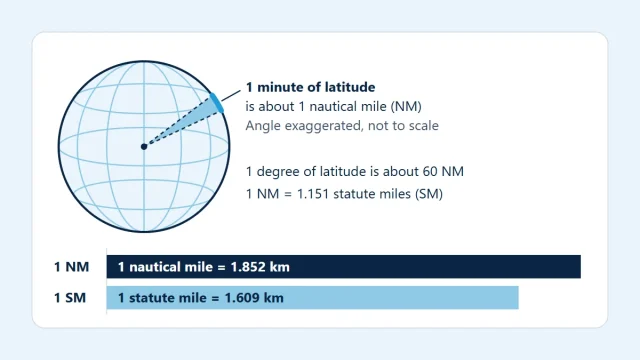
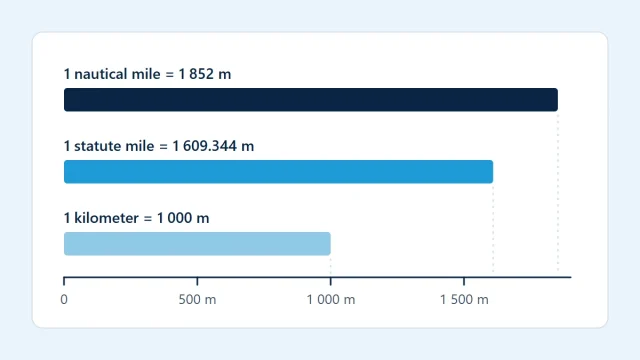
- 1 NM = 1,852 m = 6,076.115 ft = 1.150779 statute miles
- 10,000 ft = 3,048 m
- 1,000 m = 3,280.84 ft
The common shortcut “meters times three, plus ten percent” gives 3,300 ft for 1,000 m against the exact 3,280.84 ft. It is an approximation that reads slightly high. Nautical miles vs statute miles covers the two miles in detail, and aviation distance units explained looks at when each unit is used.
Pressure
Altimeter settings are given in inches of mercury in the United States and a few other countries, and in hectopascals almost everywhere else. A hectopascal and a millibar are the same size, so no conversion is needed between those two.
- 1 inHg = 33.86389 hPa
- 1 hPa = 0.02952998 inHg
- Standard sea-level pressure: 1013.25 hPa = 29.92125 inHg, which is rounded to 29.92 inHg
The rounding is visible if you convert back: 29.92 inHg is 1,013.208 hPa, not 1013.25. The difference is far smaller than an altimeter can show, but it explains why two tools can disagree in the last digit. Settings are passed in hundredths of an inch or whole hectopascals, and the altimeter pressure conversion calculator shows both along with the difference from standard. Aviation altimeter settings explained describes what the setting does.
Temperature
Temperature is the one common conversion with an offset as well as a scale factor, so it cannot be done by multiplying alone.
°F = °C × 9 ÷ 5 + 32
K = °C + 273.15
The standard sea-level temperature of 15 °C is 59 °F and 288.15 K. Freezing is 0 °C or 32 °F, and the two scales meet at −40. Atmosphere and airspeed formulas need absolute temperature in kelvin; putting degrees Celsius straight into them is a frequent source of wrong answers.
Mass and volume, and why they do not convert into each other
Aircraft mass is in pounds or kilograms: 1 kg = 2.204623 lb. Fuel volume is in US gallons, liters or imperial gallons, and the two gallons are not the same size.
- 1 US gal = 3.785412 L = 0.8326742 imperial gal
- 1 imperial gal = 4.54609 L = 1.20095 US gal
As an illustration, suppose a fuel quantity is given as 40 US gal. That is 151.4165 L, about 151 L, and 33.30697 imperial gal, about 33.3. Reading the same “40” as imperial gallons would overstate the quantity in liters by about a fifth, because an imperial gallon is 1.20095 US gal.
What no fixed factor can do is turn a volume of fuel into a mass. That depends on the density of the particular fuel, which differs between fuel types and changes with temperature. AviationCalc’s tools never convert between the two; the fuel consumption calculator keeps the result in whichever kind of unit you entered. The density to use for a real aircraft comes from its own documentation and the fuel supplied.
Habits that prevent unit errors
- Write the unit beside every number, including intermediate results.
- Convert all inputs to one consistent set before starting, not partway through.
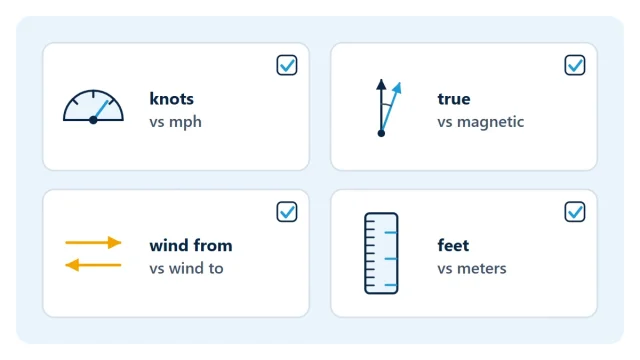
- Say which gallon, which mile and which temperature scale.
- Check the size of the answer with a rough shortcut, then trust the exact factor.
- Keep the rounding for the final answer; rounding each step compounds.
More examples of how these slips happen are in common aviation calculation mistakes.
What conversion factors cannot tell you
A conversion is exact arithmetic applied to whatever number goes in. It does not improve a rough measurement, and extra decimal places in the output are not extra accuracy. It also says nothing about which unit is correct for the task: the aircraft flight manual (POH/AFM) states its speeds, masses and fuel quantities in particular units, charts and weather reports use the units of the issuing authority, and the applicable regulations specify their own.
For real operations, read values in the units of the official source, convert only when you must, and confirm the result against the aircraft’s documentation and current official charts and weather information.