Aviation Unit Conversion Calculator
Aviation mixes unit systems more than most fields: speeds in knots, altitudes in feet, visibility in statute miles or meters, pressure in inches of mercury or hectopascals, fuel in gallons, liters, pounds or kilograms. This converter takes one value in one unit and shows it in every other unit of the same kind.
It covers six groups: speed, distance and altitude, mass, volume, pressure and temperature. That is enough to follow a manual written in one system while reading weather and charts in another, or to check a conversion you did by hand. Each group is converted through an SI unit using exact definitions where they exist.
How to use this calculator
- Enter the number in Value.
- Open Unit and choose the unit that value is in. The list is grouped into Speed, Distance and altitude, Mass, Volume, Pressure and Temperature.
- Read the results: one row for each of the other units in that group.
Unit is the unit you are converting from; there is no target to choose because all the others are shown. Negative numbers are accepted only for distance and altitude, and for temperatures that stay above absolute zero, so a rate of descent has to be entered as a positive number. US gallons and imperial gallons are separate entries in the Volume group: check which one your source means before choosing.
Formula
value in SI = value × factor of the starting unit
result = value in SI ÷ factor of the target unit
temperature: K = °C + 273.15 and °C = (°F − 32) × 5 ÷ 9
What the variables mean
- factor
- the exact or conventional SI value of one unit, for example 1 kt = 1 852 ÷ 3 600 m/s
- SI
- the International System of Units
Worked example
These example values are illustrative round numbers, not data for any particular aircraft. Select "Fill in the example" in the calculator to load them.
Inputs
- Value: 120
- Unit: knots (kt)
Working
- Multiply by the factor of the starting unit (0.5144444444): 61.7333333 in the reference unit for this quantity.
- Divide by the factor of each target unit to get the results shown.
Result
- Kilometers per hour: 222.24 km/h
- Miles per hour: 138.0935 mph
- Meters per second: 61.73333 m/s
- Feet per minute: 12,152.23 ft/min
- Feet per second: 202.5372 ft/s
Reading the result
Each row is labeled with the full name of a unit and gives the value to seven significant figures; the unit you started from is left out. For illustration, 120 kt returns 222.24 km/h, 138.0935 mph, 61.73333 m/s, 12,152.23 ft/min and 202.5372 ft/s. Rows never cross groups, so gallons become liters but never pounds or kilograms. A temperature is converted as a reading on a scale, which is the right treatment for an outside air temperature and the wrong one for a temperature difference.
Assumptions and limitations
- The nautical mile, foot, statute mile, pound, US gallon and imperial gallon use their exact international definitions.
- Inches and millimeters of mercury are converted with fixed conventional factors, not from the density of mercury at a particular temperature.
- Mass and volume are separate groups and no fuel density is assumed, so a volume of fuel cannot be turned into a mass here.
- Temperatures are treated as points on a scale with their offsets, not as intervals.
- Results are rounded for display to seven significant figures, which is far finer than most aviation inputs are known.
Common mistakes
- Converting a temperature difference with the scale formula: a reading of 10 °C is 50 °F, but a 10 °C rise is an 18 °F rise.
- Mixing US and imperial gallons, when the imperial gallon is about 20% larger.
- Reading the mph scale of an airspeed indicator as knots, or the reverse.
- Confusing feet per minute with feet per second for vertical speed, a factor of 60.
- Typing an altimeter setting in inches of mercury while hectopascals is selected, or the other way round.
- Expecting gallons or liters of fuel to convert straight to pounds or kilograms without the density of that fuel at its temperature.
References
- National Institute of Standards and Technology, Guide for the Use of the International System of Units (SI), Special Publication 811.
- Federal Aviation Administration, Pilot's Handbook of Aeronautical Knowledge (FAA-H-8083-25).
These public sources explain the formulas and definitions used here. Citing them does not mean they have reviewed, endorsed or certified AviationCalc.
Related calculators
Nautical Miles to Kilometers Calculator
Convert nautical miles to kilometers, statute miles, meters and feet, in either direction.
Aviation Units and Conversions
Altimeter Pressure Conversion Calculator
Convert altimeter settings between inHg, hPa (millibars), mmHg, kPa and psi.
Atmosphere and Altitude
Speed of Sound Calculator
Speed of sound in air from temperature, in knots, m/s, km/h, mph and ft/s.
Atmosphere and Altitude
Fuel Consumption Calculator
Average fuel flow per hour and fuel per distance from fuel used and time flown.
Aviation Fuel Mathematics
Guides that explain this calculation
Aviation Units and Conversions
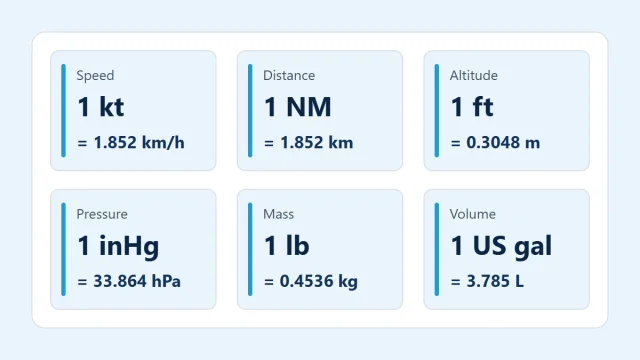
Essential Aviation Unit Conversions
The speed, distance, altitude, pressure, temperature, mass and volume conversions aviation uses most, with exact factors and the shortcuts labelled.
Aviation Units and Conversions
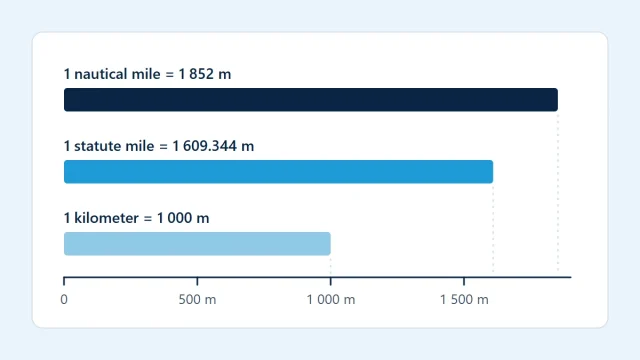
Aviation Distance Units Explained
Nautical miles, statute miles, kilometers, feet and meters each have an exact definition. See where each is used and how to convert without errors.
Aviation Navigation
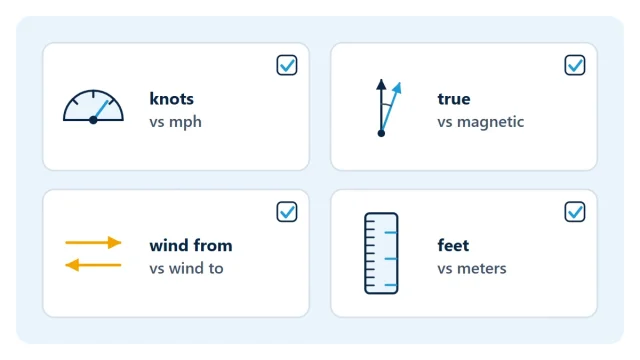
Common Aviation Calculation Mistakes
Unit mix-ups, true versus magnetic, wind from versus to, and airspeed used as ground speed: the common errors, with the size of each shown.