Flight time comes from one division: distance over ground speed. The arithmetic is easy. The skill is in feeding it the right two numbers, keeping their units consistent, and knowing how far to trust the answer.
The time, speed and distance relationship
Time = distance ÷ ground speed
With distance in nautical miles and ground speed in knots, the result is in hours, because a knot is one nautical mile per hour. Rearranged, the same relationship gives the other two quantities:
- Distance = ground speed × time
- Ground speed = distance ÷ time
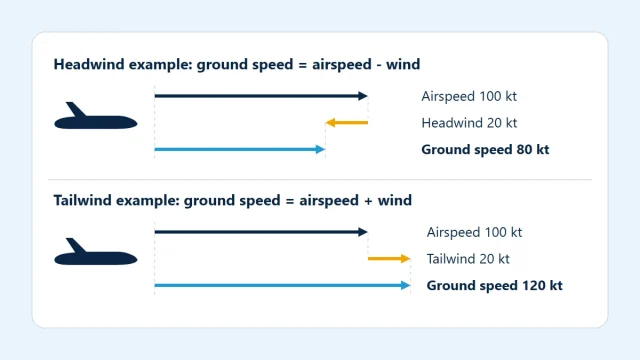
The speed in this formula is always ground speed. Airspeed tells you how fast the aircraft moves through the air; only ground speed tells you how fast the destination is getting closer. The difference between the two is the wind, as described in Understanding Ground Speed in Aviation.
Turning decimal hours into hours and minutes
The division gives decimal hours, and decimal hours are easy to misread. A result of 1.5 hours is 1 hour 30 minutes, not 1 hour 50 minutes. To convert, keep the whole hours and multiply the decimal part by 60.
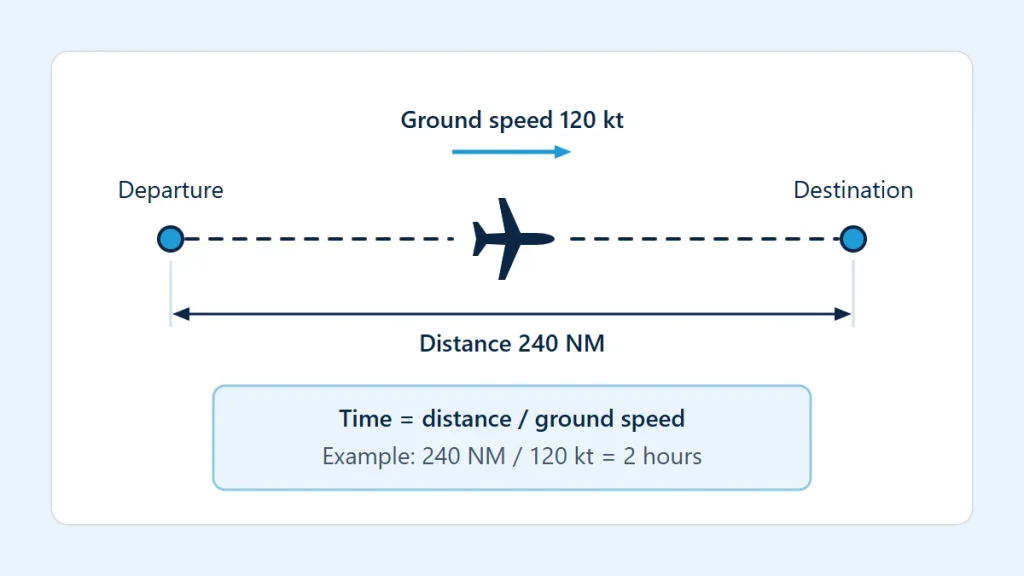
The diagram at the top of this page uses round illustrative values: 240 NM at a ground speed of 120 kt.
240 NM ÷ 120 kt = 2.00 h = 2 h 00 min
Change the ground speed to 100 kt and the division gives 2.40 hours. The decimal part, 0.40, times 60 is 24, so the time is 2 h 24 min. The flight time calculator performs both steps and shows the result as hours and minutes, as decimal hours and as total minutes.
For short legs it is often handier to work in minutes directly: minutes = distance ÷ ground speed × 60. At 120 kt the aircraft covers 2 NM per minute, a figure that is easy to carry in your head.
How much the wind moves the answer
The table below keeps the 240 NM distance and changes only the ground speed. If the true airspeed were 120 kt, the rows would correspond to headwind or tailwind components of 20 and 40 kt. All values are examples.
| Ground speed | Time for 240 NM | Total minutes |
|---|---|---|
| 80 kt | 3 h 00 min | 180 |
| 100 kt | 2 h 24 min | 144 |
| 120 kt | 2 h 00 min | 120 |
| 140 kt | 1 h 43 min | 103 |
| 160 kt | 1 h 30 min | 90 |
The effect is not symmetrical. A 40 kt headwind component adds 60 minutes to the still-air time, while a 40 kt tailwind component removes only 30. Time depends on the reciprocal of ground speed, so each knot lost costs more than each knot gained gives back. This is also why a round trip in a steady wind always takes longer than the same round trip in calm air: the aircraft spends more time on the slow leg than on the fast one.
Understanding Headwinds and Tailwinds shows how to find the along-track component of a wind, and the ground speed calculator gives the ground speed for any course and wind, including the loss caused by a crosswind.
Working leg by leg
A route is rarely flown at one ground speed. The course changes at each turning point, so the same wind produces a different ground speed on each leg. The usual method is to treat every leg separately and add the times:
- Measure the distance of the leg.
- Find the true airspeed planned for that part of the flight.
- Apply the forecast wind to get the ground speed on that leg’s course.
- Divide distance by ground speed to get the leg time.
- Add the leg times to get the total, and keep a running total at each point.
Suppose the 240 NM route is split into a 95 NM leg flown at a ground speed of 105 kt and a 145 NM leg at 130 kt. The first leg takes 54 minutes and the second 1 h 07 min, a total of about 2 h 01 min. The numbers are invented for the example; the point is that the total comes from the legs, not from an average speed guessed for the whole route.
The running totals have a second use in flight. Comparing the actual time at each point with the planned time shows whether the real ground speed matches the plan, and the formula rearranged as ground speed = distance ÷ time turns two timed positions into a measured ground speed.
Unit traps
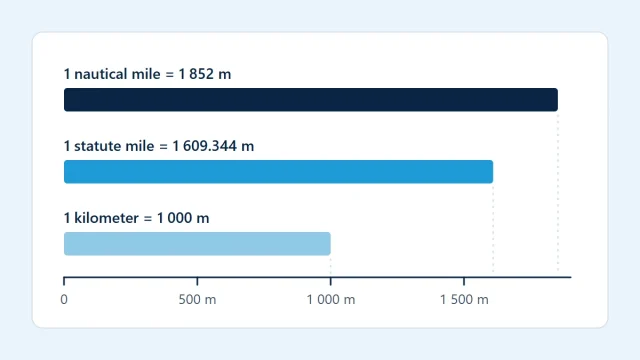
The formula only works when the distance unit matches the speed unit: nautical miles with knots, statute miles with miles per hour, kilometers with kilometers per hour. Mixing them produces an answer that looks plausible and is wrong.
For illustration, 240 statute miles at 120 kt is not two hours. Converted properly it is 208.6 NM, and the time is 1 h 44 min. The flight time calculator converts the units you select before it divides; on paper the conversion is a separate step. Aviation Distance Units Explained lists the exact factors.
What a single division cannot tell you
Distance over ground speed assumes one constant ground speed from the first mile to the last. A real flight does not behave that way:
- The climb is flown at a lower airspeed than cruise and the descent at a different one again, and true airspeed changes with altitude throughout both.
- Wind differs between altitudes and along the route, and the forecast is not the wind you will find.
- The distance flown is longer than the straight line between two airports once departure and arrival routing, traffic patterns and any diversions around weather or airspace are included.
- Time on the ground with the engine running, before takeoff and after landing, is not part of the airborne time but still uses fuel.
Flight time is also the input to fuel planning, since trip fuel is fuel flow multiplied by time. The fuel required calculator shows that arithmetic, but how much fuel must be carried beyond the trip itself is set by the applicable regulations, the operator and the aircraft flight manual, not by a formula on a web page.
Treat the result as an educational estimate. Actual flight planning requires current official charts and weather information, the performance data in the aircraft flight manual (POH/AFM) and the applicable regulations.