Flight Time Calculator
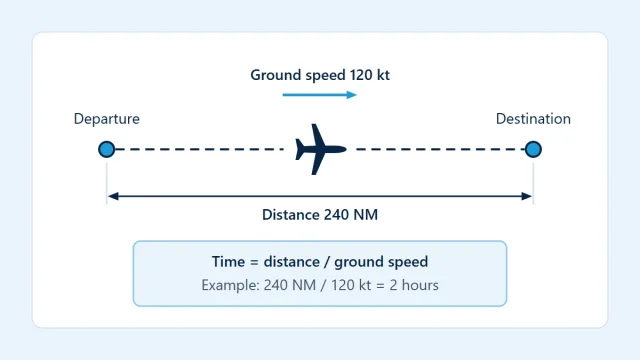
Time en route is distance divided by speed over the ground. The division is simple, but its answer comes out in decimal hours, and the step that trips people up is turning 2.33 hours into hours and minutes. This calculator does the division, converts mixed units to nautical miles and knots first, and presents the answer in the form used on a navigation log.
The result is the foundation for almost everything that follows in a flight plan: estimated arrival times at checkpoints, fuel burned on a leg, and how much a change in wind will stretch or shorten a trip. Understanding how sensitive time is to ground speed is as useful as the number itself.
How to use this calculator
- Enter Distance and choose nautical miles, kilometers or statute miles.
- Enter Ground speed and choose kt, km/h or mph.
- Read the time en route in hours and minutes, with decimal hours and total minutes alongside.
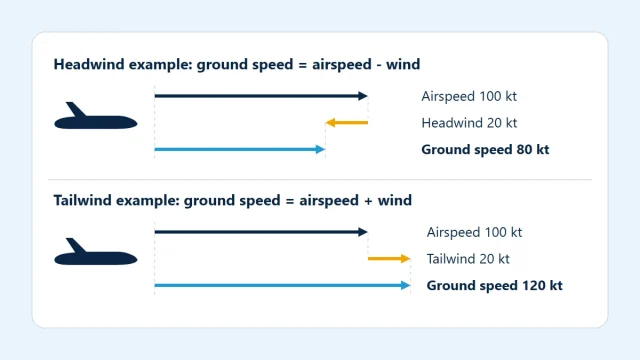
The speed must be ground speed, the speed along the track after wind, not the airspeed shown in the cockpit or true airspeed. If you have true airspeed and a wind, work out the ground speed first with the ground speed calculator. The two units do not need to match, since each is converted before dividing, but check that the selector beside each number shows the unit your figure is actually in. Both values must be greater than zero.
Formula
time = distance ÷ ground speed
What the variables mean
- time
- time en route in hours; multiply the decimal part by 60 for minutes
- distance
- distance over the ground
- ground speed
- speed over the ground, in the matching unit per hour
Worked example
These example values are illustrative round numbers, not data for any particular aircraft. Select "Fill in the example" in the calculator to load them.
Inputs
- Distance: 245 NM
- Ground speed: 105 kt
Working
- Distance = 245.0 NM and ground speed = 105.0 kt (after unit conversion).
- Time = 245.0 ÷ 105.0 = 2.333 h.
- Decimal part × 60 gives minutes: 2 h 20 min.
Result
- Time en route: 2 h 20 min (2.33 hours)
- Total minutes: 140 min
Reading the result
Time en route is written as hours and minutes, rounded to the nearest whole minute, with the same time in decimal hours beside it. The decimal form is the one to multiply by an hourly fuel flow; the hours-and-minutes form is the one to add to a departure time. Total minutes gives the whole duration in minutes, which is convenient for short legs. Because of the rounding, a very short leg can show as 0 h 01 min while its decimal value reads 0.01 hours. Treat the result as cruise time at one steady speed, not a gate-to-gate duration.
Assumptions and limitations
- Ground speed is constant for the entire distance, as if the aircraft were already at cruise speed at the first mile.
- The slower climb and the descent, and the extra distance they may involve, are not modelled.
- Wind is assumed not to change along the route, since any change would alter the ground speed.
- The distance is taken as flown exactly, with no vectors, holding, circling or deviations around weather.
- Taxi, run-up and time spent in the traffic pattern are excluded.
- Minutes are rounded to the nearest whole minute, so legs added together from rounded values can differ slightly from one calculation of the total.
Common mistakes
- Dividing by true airspeed or indicated airspeed when the wind makes ground speed noticeably different.
- Reading 2.33 hours as 2 hours 33 minutes instead of 2 hours 20 minutes.
- Combining a distance in statute miles or kilometers with a speed in knots without converting one of them.
- Using a straight-line distance when the planned route has several legs that add up to more.
- Assuming that a headwind outbound and an equal tailwind on the return cancel out, when the round trip always takes longer than in still air.
- Treating the computed time as an arrival time without adding the time for departure and approach.
References
- Federal Aviation Administration, Pilot's Handbook of Aeronautical Knowledge (FAA-H-8083-25).
These public sources explain the formulas and definitions used here. Citing them does not mean they have reviewed, endorsed or certified AviationCalc.
Related calculators
Ground Speed Calculator
Find ground speed from true airspeed, course and wind using the wind triangle.
Flight Speed and Distance
Flight Distance Calculator
Great-circle distance and initial true course between two latitude and longitude points.
Flight Speed and Distance
Fuel Required Calculator
Trip fuel from distance, ground speed and fuel flow, plus any extra fuel you enter.
Aviation Fuel Mathematics
Fuel Endurance Calculator
How long a quantity of usable fuel lasts at a constant fuel flow.
Aviation Fuel Mathematics
Guides that explain this calculation
Flight Speed and Distance
How Pilots Calculate Flight Time
Flight time is distance divided by ground speed. See how to convert decimal hours, why headwinds cost more than tailwinds return, and how to work leg by leg.

Flight Speed and Distance
Understanding Ground Speed in Aviation
Ground speed is true airspeed and wind added as vectors. See the wind triangle formula, a worked example and why a pure crosswind still slows you down.
Wind Calculations
Understanding Headwinds and Tailwinds
How wind along the track changes ground speed and flight time, how to find the component with a cosine, and why wind never cancels on a round trip.