Fuel Required Calculator
Trip fuel in its simplest form is time multiplied by burn rate. This calculator divides the distance by the ground speed to get the time en route, multiplies that by the hourly fuel flow, and then adds any additional fuel you choose to enter, showing the trip figure and the total separately.
It is a teaching tool for the cruise arithmetic inside a fuel plan, and it shows clearly how sensitive the answer is to ground speed: the same distance into a headwind takes longer and burns more. It does not build a complete fuel plan, and beyond the arithmetic it does not say how much fuel a flight needs.
How to use this calculator
- Enter Distance in nautical miles, kilometers or statute miles.
- Enter Ground speed in knots, km/h or mph.
- Enter Fuel flow per hour and choose its unit.
- Optionally enter Additional fuel, in the same unit as the fuel flow.
The speed must be ground speed, not airspeed; the ground speed calculator works it out from true airspeed and wind. The fuel flow has to be the figure for your aircraft at the planned power setting and altitude, taken from its flight manual. Additional fuel is a single number of your own that can stand for anything outside the cruise sum. The page neither proposes an amount nor checks the one you type.
Formula
time = distance ÷ ground speed
trip fuel = fuel flow × time
total = trip fuel + additional fuel you enter
What the variables mean
- distance
- distance over the ground
- ground speed
- expected speed over the ground
- fuel flow
- fuel burned per hour
- additional fuel
- any taxi, contingency or reserve fuel you decide to add from your own requirements; nothing is added automatically
Worked example
These example values are illustrative round numbers, not data for any particular aircraft. Select "Fill in the example" in the calculator to load them.
Inputs
- Distance: 320 NM
- Ground speed: 128 kt
- Fuel flow per hour: 10.2 US gal/h
- Additional fuel: 9 US gal
Working
- Time = 320.0 NM ÷ 128.0 kt = 2.500 h.
- Trip fuel = 10.20 × 2.500 = 25.5 US gal.
- Total = 25.5 + 9.0 = 34.5 US gal.
Result
- Trip fuel: 25.5 US gal (96.5 L · 21.2 imp gal)
- Time en route: 2 h 30 min (2.50 hours)
- Total with your additional fuel: 34.5 US gal (Includes 9.0 US gal that you entered)
Reading the result
Trip fuel is the fuel flow multiplied by the time, with the other units of the same kind beside it. Time en route is given in hours and minutes and as decimal hours. Total with your additional fuel is the trip fuel plus what you entered, and the note beside it states that amount or says that none was entered, in which case the two fuel rows match. For illustration, 320 NM at 128 kt and 10.2 US gal/h gives 2 h 30 min and 25.5 US gal of trip fuel. Neither row is a statement of the fuel a flight must carry.
Assumptions and limitations
- One ground speed and one fuel flow apply to the entire distance.
- Start, taxi, takeoff, climb, descent and approach are not modeled; the whole distance is treated as cruise.
- The distance is exactly the number entered, with no allowance for routing, vectors or holding.
- Alternate, contingency and reserve fuel are not calculated and appear only if you include them in the additional fuel.
- Wind enters only through the ground speed, so a change in wind along the route is not captured.
- The fuel unit is kept as chosen; volume and mass are not converted into each other.
Common mistakes
- Entering true airspeed in the ground speed box, which hides the whole effect of the wind.
- Reading the total as a finished fuel plan when it holds only the cruise sum and one number you added.
- Taking a fuel flow for a lower power setting than the one that gives the speed entered.
- Typing the additional fuel in gallons while the fuel flow unit is liters.
- Using the straight-line distance between two airports when the route to be flown is longer.
- Reading 2.50 hours as 2 hours 50 minutes.
References
- Federal Aviation Administration, Pilot's Handbook of Aeronautical Knowledge (FAA-H-8083-25).
These public sources explain the formulas and definitions used here. Citing them does not mean they have reviewed, endorsed or certified AviationCalc.
Related calculators
Fuel Endurance Calculator
How long a quantity of usable fuel lasts at a constant fuel flow.
Aviation Fuel Mathematics
Fuel Consumption Calculator
Average fuel flow per hour and fuel per distance from fuel used and time flown.
Aviation Fuel Mathematics
Flight Time Calculator
Time en route from distance and ground speed, in hours and minutes.
Flight Speed and Distance
Aircraft Range Estimator
A simple constant-speed, constant-fuel-flow range estimate with a wind component you enter.
Aircraft Performance Concepts
Guides that explain this calculation

Aviation Fuel Mathematics
Understanding Aircraft Fuel Consumption
How fuel flow is worked out from fuel used and time, why fuel per mile depends on wind, and why volume and mass of fuel are not interchangeable.
Aviation Fuel Mathematics
Fuel Endurance Mathematics Explained
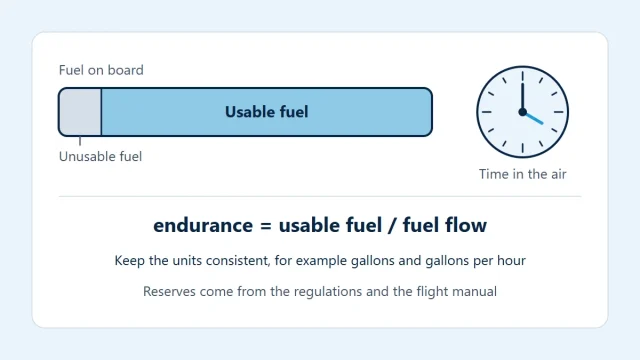
Endurance is usable fuel divided by fuel flow. See the steps, how sensitive the answer is to fuel flow, and why wind changes range but not endurance.
Flight Speed and Distance
How Pilots Calculate Flight Time
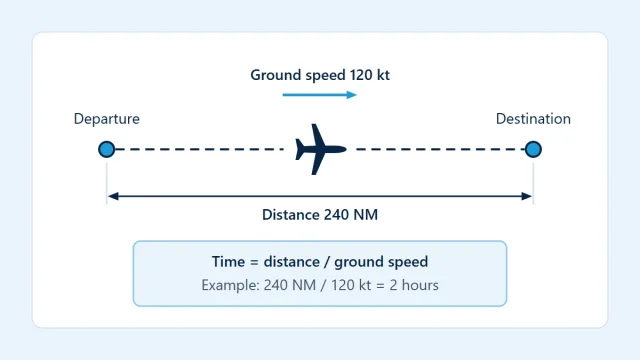
Flight time is distance divided by ground speed. See how to convert decimal hours, why headwinds cost more than tailwinds return, and how to work leg by leg.