An aircraft flies through a body of air, and that air is usually moving over the ground. A headwind is air moving against the direction of travel; a tailwind is air moving with it. Neither changes how the aircraft flies through the air, but both change how fast it crosses the ground, and that affects flight time, fuel used and the length of runway covered during takeoff and landing.
Airspeed stays, ground speed changes
The wing and the airspeed indicator respond only to the air flowing past the aircraft. In steady wind the aircraft is carried along with the air mass in the same way a swimmer is carried by a river: the swimmer’s speed through the water is unchanged, but the speed past the bank is not.
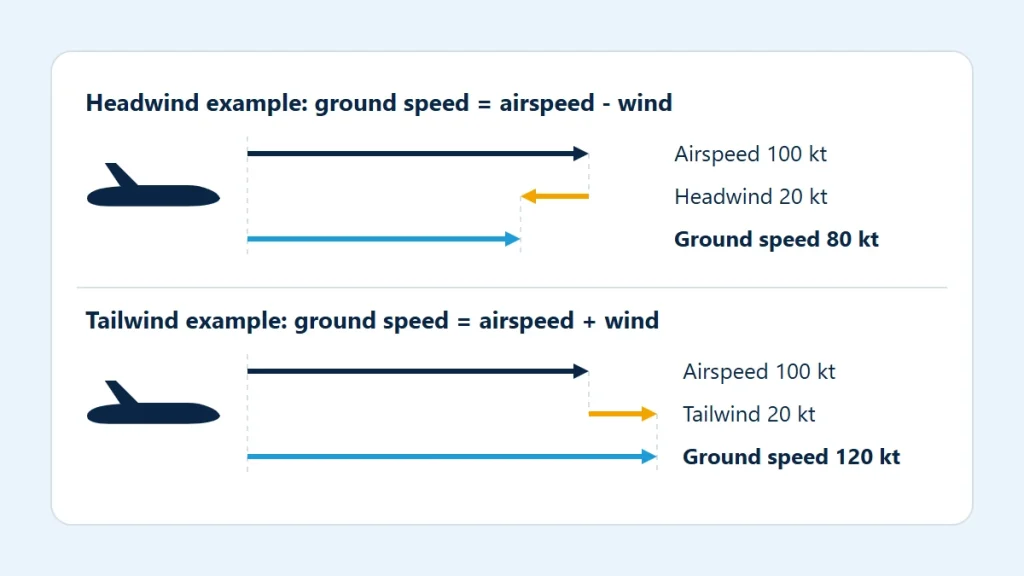
When the wind lies exactly along the track, the arithmetic is simple, as the diagram at the top of this page shows. With a true airspeed of 100 kt, a 20 kt headwind gives a ground speed of 80 kt and a 20 kt tailwind gives 120 kt.
Ground speed = true airspeed − headwind component
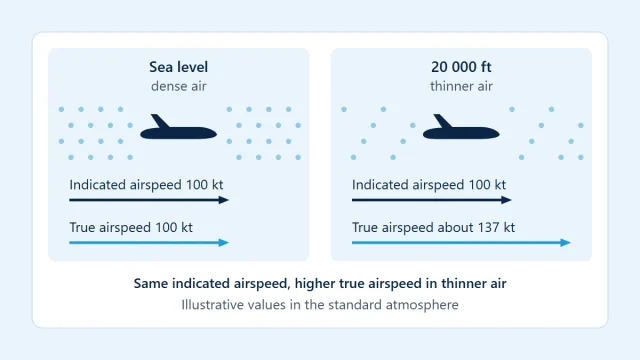
A tailwind is a negative headwind, so subtracting it adds to the ground speed. The speed in this sum is true airspeed, not the indicated value on the dial; true airspeed vs indicated airspeed explains the gap between them.
When the wind is at an angle
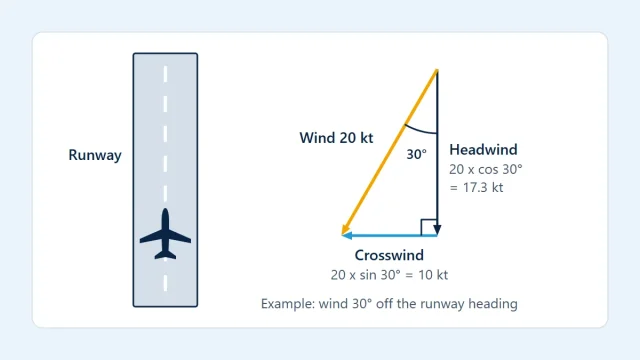
Wind seldom lines up with the track. The part of it that acts along the track is found with the cosine of the angle between the wind direction and the track, where wind direction is the direction the wind blows from:
Headwind component = W × cos(wind direction − track)
A positive result is a headwind and a negative result is a tailwind. The remaining part of the wind, W × sin(angle), is the crosswind component covered in how to calculate crosswind components. The table shows how much of the wind speed acts along the track at different angles.
| Angle between wind and track | Along-track share of wind speed | Type |
|---|---|---|
| 0° | 100% | Headwind |
| 30° | 86.6% | Headwind |
| 45° | 70.7% | Headwind |
| 60° | 50.0% | Headwind |
| 90° | 0% | Neither: all crosswind |
| 120° | 50.0% | Tailwind |
| 180° | 100% | Tailwind |
Cosine falls slowly at first. A wind 30° off the nose still delivers 86.6% of its speed as headwind, so a wind does not have to be nearly aligned with the track to have almost its full effect on ground speed.
An out-and-back illustration
Suppose an aircraft cruises at a true airspeed of 110 kt on a track of 360°, then returns on a track of 180°. The wind is from 040° at 25 kt for both legs. These are round example values. The headwind and tailwind calculator gives:
- Outbound, track 360°: the angle is 40°, so the headwind component is 25 × cos(40°) = 19.2 kt, with a crosswind of 16.1 kt from the right.
- Return, track 180°: the angle is −140°, so the component is −19.2 kt, a tailwind of 19.2 kt, with 16.1 kt of crosswind from the left.
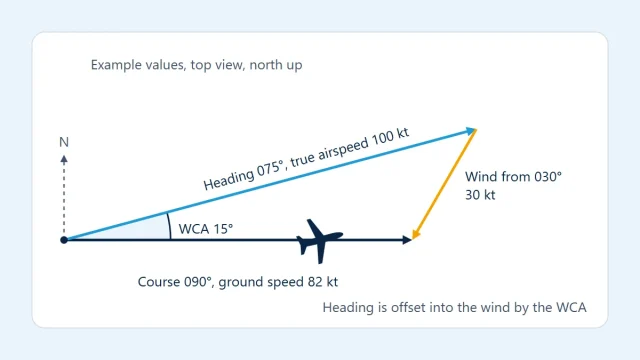
Subtracting 19.2 from 110 suggests an outbound ground speed of 90.8 kt. The full wind triangle in the ground speed calculator gives 89.7 kt outbound and 128.0 kt on the return. The difference comes from the crosswind. To stay on the track the aircraft has to point 8.4° into the wind, and with the nose turned away from the track only part of the airspeed, TAS × cos(8.4°), acts along it. The simple subtraction is therefore an approximation that works well when the crosswind is small compared with the airspeed and drifts further from the exact figure as the correction angle grows. Wind correction angle explained covers that angle in detail.
Why wind never cancels out on a round trip
It is tempting to assume that a headwind one way and an equal tailwind back leave the total time unchanged. They do not. Take 200 NM each way at a true airspeed of 100 kt with a 20 kt wind directly along the route, again as an illustration:
- Into the wind at 80 kt, the leg takes 2 h 30 min.
- With the wind at 120 kt, the leg takes 1 h 40 min.
- The round trip takes 4 h 10 min, against 4 h 00 min in still air.
The aircraft spends more time on the slow leg than on the fast one, so the headwind acts for longer than the tailwind does. The loss grows as the wind becomes a larger fraction of the airspeed. Any steady wind lengthens an out-and-back flight, and the flight time calculator lets you check each leg separately.
Headwind and tailwind near the runway
An aircraft lifts off and touches down at a particular airspeed. With a headwind, part of that airspeed is supplied by the moving air, so the ground speed at liftoff and touchdown is lower and less runway is covered while accelerating or stopping. A tailwind does the opposite: the ground speed is higher at the same airspeed, and the distances grow. The angle of climb or descent over the ground changes in the same sense, steeper into wind and shallower with a tailwind, because the same vertical speed is spread over less or more ground.
How much the distances change is specific to each aircraft and is set out in its performance data. AviationCalc does not state those figures or any tailwind limit: they come from the aircraft flight manual (POH/AFM) and the operator.
Limits of the simple picture
Everything above assumes one steady wind. Along a real route the wind changes with altitude, position and time, and a forecast wind aloft is an estimate for a broad area rather than a measurement at the aircraft. Climb and descent pass through several wind layers at changing airspeeds. Near the ground, gusts and wind shear change the headwind component from second to second, which the component formula cannot represent.
Use these calculations to understand the relationship between wind, ground speed and time. Planning a real flight needs current official weather information and charts, the aircraft’s own performance data, and the fuel and operating requirements of the applicable regulations and the operator.