An aircraft moves through the air, and the air moves over the ground. Ground speed is what you get when you add those two motions together: the speed of the aircraft measured against the surface of the Earth. It is the speed that decides how long a leg takes and how far a given amount of fuel will carry you.
Airspeed alone cannot answer those questions. Two aircraft flying at the same true airspeed on opposite courses in the same wind will cover very different distances in an hour.
Airspeed, wind and ground speed
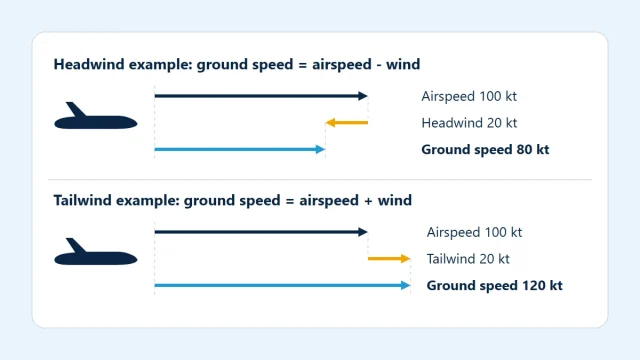
True airspeed (TAS) is the speed of the aircraft relative to the air mass it is flying in. Wind is the motion of that air mass relative to the ground. Ground speed (GS) is the vector sum of the two.
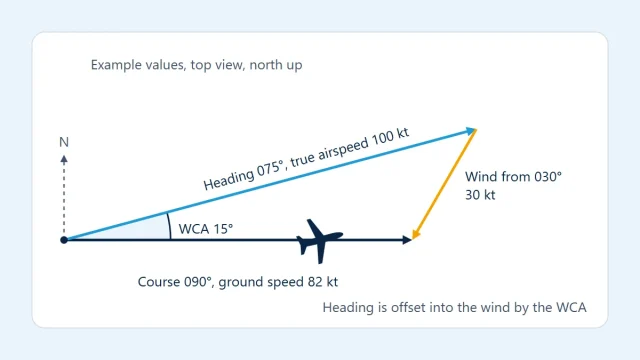
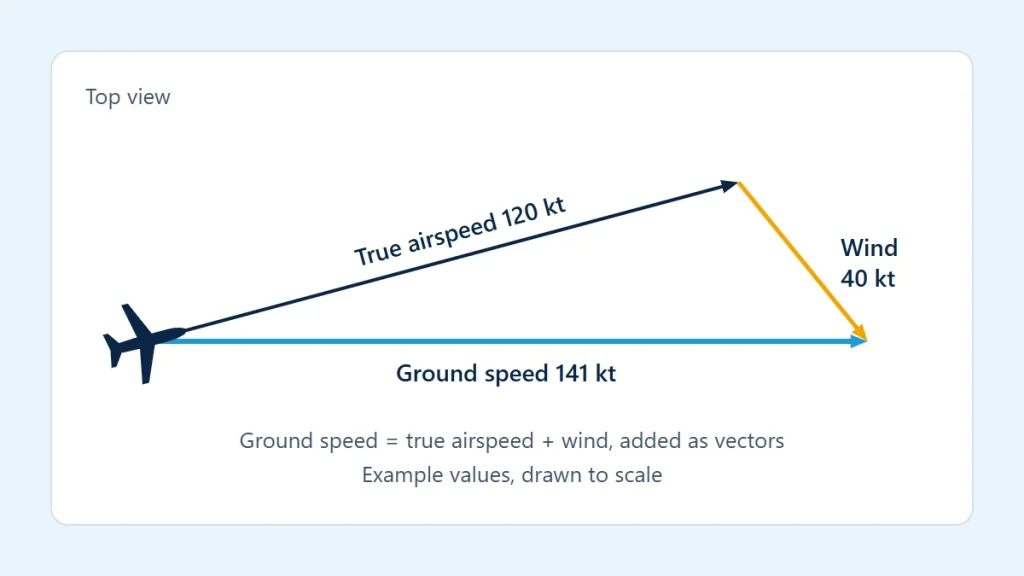
The word “vector” matters. Speeds along the same line simply add or subtract, but a wind that blows across the course has to be handled with its direction as well as its strength. The diagram at the top of this page shows the three vectors drawn to scale: the true airspeed along the aircraft’s heading, the wind, and the ground speed along the course that results.
Two conventions keep the arithmetic consistent:
- Wind direction is the direction the wind blows from. A wind of 270° at 20 kt is moving toward the east.
- The course and the wind direction must share the same north reference. Winds aloft are normally given relative to true north, so they pair with a true course.
The wind triangle formula
To stay on a chosen course in a crosswind, the aircraft is pointed slightly into the wind. That offset is the wind correction angle (WCA). Once it is known, the ground speed follows.
WCA = asin( W × sin(WD − TC) ÷ TAS )
GS = TAS × cos(WCA) − W × cos(WD − TC)
Here W is the wind speed, WD the wind direction (from), TC the true course and TAS the true airspeed. The first term of the ground speed formula is the part of the airspeed that still points along the course after the aircraft has been turned into the wind. The second term is the headwind component: positive when the wind comes from ahead, negative when it comes from behind, which then adds to the ground speed.
The true heading to fly is the course plus the wind correction angle. The ground speed calculator works through these exact steps, and Wind Correction Angle Explained covers the angle itself in more detail.
A worked example
For illustration, suppose a true airspeed of 120 kt on a true course of 090°, with the wind from 321° at 40 kt. These are the values in the diagram.
- Wind angle = 321° − 90° = 231°, which is the same as −129° when taken between −180° and 180°. The wind is coming from behind and to the left.
- WCA = asin(40 × sin(−129°) ÷ 120) = −15.0°, a correction of 15.0° to the left.
- True heading = 090° − 15° = 075°.
- GS = 120 × cos(−15.0°) − 40 × cos(−129°) = 141.1 kt.
The component of this wind along the course is a 25.2 kt tailwind. Adding that directly to the airspeed would give 145.2 kt, which is too high. The real answer is 141.1 kt because part of the airspeed is spent holding the nose 15° into the wind. The gap is small at shallow angles and grows quickly as the correction angle gets larger.
How the same wind changes the result
Keeping the illustrative 120 kt true airspeed, the 090° course and the 40 kt wind, only the wind direction changes in the table below. Each row was computed with the wind triangle formulas above.
| Wind from | Situation | Wind correction | Ground speed |
|---|---|---|---|
| 090° | Direct headwind | None | 80.0 kt |
| 180° | Direct crosswind from the right | 19.5° right | 113.1 kt |
| 321° | Quartering tailwind from the left | 15.0° left | 141.1 kt |
| 270° | Direct tailwind | None | 160.0 kt |
The second row is worth a close look. A wind exactly across the course has no headwind or tailwind component, yet the ground speed is 113.1 kt, almost 7 kt below the true airspeed. A pure crosswind always costs some ground speed, because the aircraft has to be angled into it to hold the course.
Understanding Headwinds and Tailwinds explains how a wind is split into its along-track and across-track parts, and the headwind and tailwind calculator does that split for any track and wind.
Why ground speed matters
Every time and distance question in navigation uses ground speed, not airspeed:
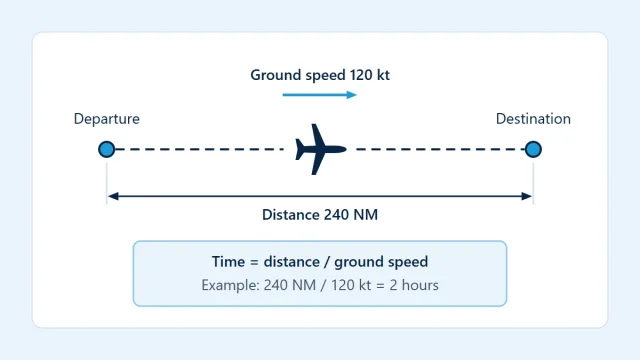
- Time en route. Time is distance divided by ground speed. In the table above, the direct headwind case covers the ground at half the speed of the direct tailwind case, so the same leg takes twice as long. See How Pilots Calculate Flight Time.
- Fuel for the trip. An engine burns fuel per hour, not per mile, so a lower ground speed means more fuel for the same distance.
- Climb and descent gradients. The height gained per nautical mile depends on ground speed. A tailwind flattens a climb measured over the ground even though the rate of climb is unchanged.
Ground speed does not affect how the aircraft flies. Lift, drag and the stall depend on the air flowing over the wing, which is an airspeed matter. An aircraft with a strong tailwind is not “flying faster” in any aerodynamic sense.
What the calculation leaves out
The wind triangle assumes one steady wind and one steady true airspeed for the whole leg. Real wind changes with altitude, with position along the route and with time, and a forecast wind is an estimate of what will be found. True airspeed also changes during climb and descent and with air temperature, so the “TAS” in the formula is itself a planning figure. See True Airspeed vs Indicated Airspeed for how it is derived.
In flight, ground speed is measured directly, by a satellite navigation receiver or by timing the passage between two known points, and that measured value replaces the planned one. The figures on this page are educational examples. Planning an actual flight requires current official weather information and charts, the aircraft flight manual (POH/AFM) and the applicable regulations.