Ground Speed Calculator
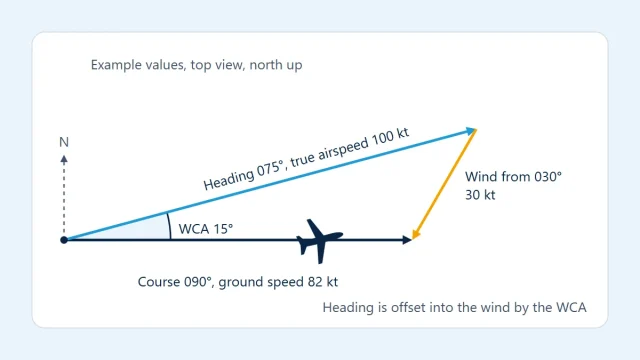
An aircraft moves through a mass of air that is itself moving. Ground speed is what remains once that motion is accounted for: the rate at which the aircraft actually covers distance along its intended track. This calculator solves the wind triangle for you, taking true airspeed, the course you want to follow and the wind, and returning the speed made good along that course.
The figure matters because every time and fuel estimate depends on it. Two flights at the same true airspeed can differ by tens of knots over the ground, and the difference is not simply the wind speed added or subtracted, because part of the airspeed is spent holding the course against the crosswind.
How to use this calculator
- Enter True airspeed and pick its unit (kt, km/h, mph or m/s).
- Enter True course, the direction of the track you want over the ground, from 0° to 360°.
- Enter Wind direction (from) in degrees, using the same north reference as the course.
- Enter Wind speed with its own unit. It does not have to match the airspeed unit.
The input that needs most care is the wind direction. It is the direction the wind blows from, as winds are reported, and it must share a reference with the course. Winds aloft forecasts are normally given relative to true north, so pair them with a true course. If you only have indicated or calibrated airspeed, convert it first with the true airspeed calculator.
Formula
WCA = asin( W × sin(WD − TC) ÷ TAS )
GS = TAS × cos(WCA) − W × cos(WD − TC)
What the variables mean
- GS
- ground speed, the speed over the ground along the course
- TAS
- true airspeed
- TC
- true course, the intended track over the ground
- W
- wind speed
- WD
- wind direction, the direction the wind blows from
- WCA
- wind correction angle, positive to the right
Worked example
These example values are illustrative round numbers, not data for any particular aircraft. Select "Fill in the example" in the calculator to load them.
Inputs
- True airspeed: 120 kt
- True course: 90°
- Wind direction (from): 45°
- Wind speed: 20 kt
Working
- Wind angle = WD − TC = 45° − 90° = −45°.
- WCA = asin(20.0 × sin(−45°) ÷ 120.0) = −6.8°.
- GS = 120.0 × cos(−6.8°) − 20.0 × cos(−45°) = 105.0 kt.
Result
- Ground speed: 105.0 kt (194.5 km/h)
- Wind correction angle: 6.8° left
- True heading to hold the course: 083.2°
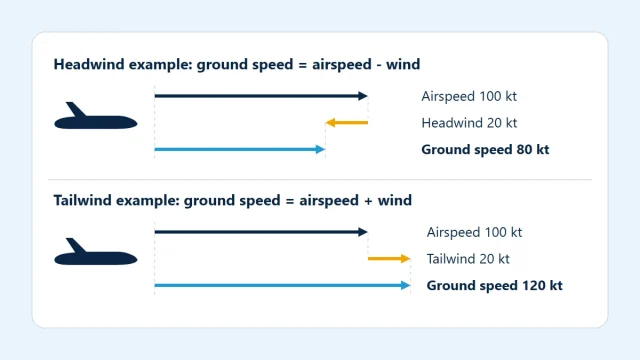
- Wind along the course: 14.1 kt headwind
Reading the result
Ground speed is shown in the unit you chose for true airspeed, with knots or km/h beside it. Wind correction angle says how far, and to which side, the nose must point away from the course. True heading to hold the course is the course with that angle applied, written as three digits with north as 360°. Wind along the course is the headwind or tailwind part of the wind, also in the airspeed unit. Ground speed is usually a little lower than airspeed minus that headwind, because the crab angle costs some forward speed.
Assumptions and limitations
- The wind is treated as steady and uniform, with one direction and one speed for the whole leg.
- True airspeed is assumed constant, so climb and descent segments with changing speed are not represented.
- The triangle is solved on a flat plane in level flight; vertical air motion and the curvature of a long great-circle track are ignored.
- The aircraft is assumed to hold exactly the heading that keeps it on the course, with no drift or wandering.
- If the crosswind part of the wind exceeds the true airspeed, or the wind leaves no forward progress along the course, there is no solution and the calculator reports that instead of a number.
Common mistakes
- Entering the direction the wind is blowing toward instead of the direction it comes from, which turns a headwind into a tailwind.
- Mixing a magnetic course with a wind direction given relative to true north.
- Typing indicated airspeed into the True airspeed field, which understates airspeed more and more as altitude increases.
- Subtracting the full wind speed from airspeed when the wind is at an angle to the course.
- Using a surface wind report for a cruise leg flown thousands of feet higher, where the wind is usually different in both direction and speed.
References
- Federal Aviation Administration, Pilot's Handbook of Aeronautical Knowledge (FAA-H-8083-25).
- Federal Aviation Administration, Aeronautical Information Manual.
These public sources explain the formulas and definitions used here. Citing them does not mean they have reviewed, endorsed or certified AviationCalc.
Related calculators
Wind Correction Angle Calculator
Wind correction angle, true heading and ground speed for a course and wind.
Aviation Navigation
Headwind and Tailwind Calculator
Find the headwind or tailwind component of any wind along your track.
Wind Calculations
Flight Time Calculator
Time en route from distance and ground speed, in hours and minutes.
Flight Speed and Distance
True Airspeed Calculator
Convert calibrated airspeed to true airspeed from pressure altitude and outside air temperature.
Flight Speed and Distance
Guides that explain this calculation

Flight Speed and Distance
Understanding Ground Speed in Aviation
Ground speed is true airspeed and wind added as vectors. See the wind triangle formula, a worked example and why a pure crosswind still slows you down.
Aviation Navigation
Wind Correction Angle Explained
Why an aircraft has to point into a crosswind to hold its course, how the wind triangle gives the angle, and how airspeed changes the answer.
Wind Calculations
Understanding Headwinds and Tailwinds
How wind along the track changes ground speed and flight time, how to find the component with a cosine, and why wind never cancels on a round trip.