Endurance is the length of time an aircraft can stay airborne on the fuel it carries. It is a time, measured in hours and minutes, and it is found with one division. The care lies in choosing the two numbers that go into that division and in remembering what the answer does not include.
The endurance formula
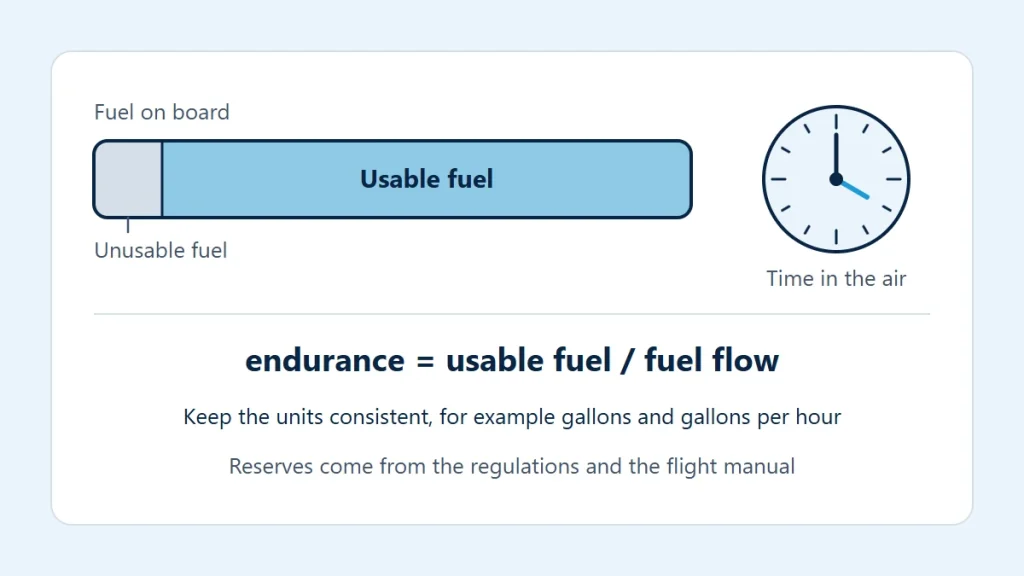
endurance = usable fuel ÷ fuel flow
Usable fuel is the quantity that can actually be delivered to the engine, in gallons, liters, pounds or kilograms. Fuel flow is the rate at which the engine uses it, in the same unit per hour. Dividing a quantity by a quantity per hour leaves hours.
Two conditions are built into the formula. The units must match: gallons with gallons per hour, kilograms with kilograms per hour. And the fuel flow is treated as constant for the whole period, which is an idealization discussed further down.
Usable fuel is not the same as tank capacity
Every fuel system holds a small quantity that cannot be relied on to reach the engine in all flight attitudes. This is unusable fuel, and it is shown at the bottom of the tank in the diagram at the top of this page. It is part of the aircraft, not part of the fuel supply, and it never enters an endurance calculation.
The usable quantity for a given aircraft is stated in its flight manual. The amount actually on board for a flight is whatever was confirmed before departure, which may be less than full tanks. Starting the division from total capacity instead of confirmed usable fuel overstates endurance from the first step.
Working through an example
The numbers below are round values chosen for illustration. They do not describe any real aircraft.
- Suppose there are 40 US gal of usable fuel on board and the fuel flow is 8 US gal/h.
- Check the units: gallons and gallons per hour, so they can be divided directly.
- Divide: 40 ÷ 8 = 5.00 hours.
- Convert the decimal to minutes if needed. Here there is no fraction, so the endurance is 5 h 00 min.
The fuel endurance calculator performs the same steps and labels this figure as the time to empty tanks, which is exactly what it is: the moment the last usable fuel is burned.
That calculator also has an optional field for fuel to keep unused. It subtracts whatever quantity you enter before dividing. If, only to show the arithmetic, 6 US gal are entered there, the fuel counted becomes 34 US gal and the endurance on that fuel is 34 ÷ 8 = 4.25 hours, or 4 h 15 min. The calculator does not suggest a value for this field and neither does this article. How much fuel must remain in the tanks is determined by the applicable regulations, the operator and the aircraft flight manual.
How sensitive endurance is to fuel flow
Because fuel flow is the divisor, endurance is inversely proportional to it. The same 40 US gal gives very different times at different flows:
| Fuel flow (illustrative) | Calculation | Time to empty tanks |
|---|---|---|
| 6 US gal/h | 40 ÷ 6 | 6 h 40 min |
| 8 US gal/h | 40 ÷ 8 | 5 h 00 min |
| 10 US gal/h | 40 ÷ 10 | 4 h 00 min |
Going from 8 to 10 US gal/h is a 25 percent increase in flow and removes a full hour, one fifth of the endurance. An error of that size is easy to make by using a cruise figure for a flight that includes a long climb, or by assuming a leaner mixture than was actually set. The article on aircraft fuel consumption explains what moves the flow figure up and down.
What wind does and does not change
Endurance contains no speed and no distance. An aircraft with five hours of fuel has five hours of fuel in a headwind, a tailwind or calm air, because a steady wind does not change how hard the engine is working.
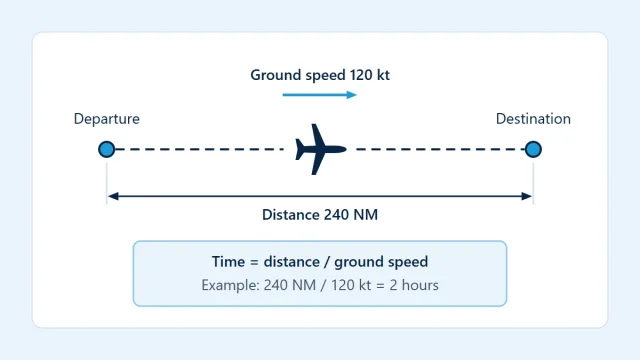
What wind changes is how far the aircraft travels over the ground during those hours. That is range, and it is found by multiplying endurance by ground speed, as described in how aircraft range is estimated. Keeping the two ideas separate avoids a common mistake: assuming that a tailwind buys extra time in the air. It buys distance, not time.
The reverse question, how much fuel a given distance needs, does involve wind, because time en route is distance divided by ground speed. The fuel required calculator handles that version, and how pilots calculate flight time covers the time step.
Flying for time instead of distance
If the goal is to stay airborne as long as possible, as in holding or loitering, the aim is the lowest fuel flow that still sustains level flight. For a propeller aircraft that is close to the speed at which the least power is required, which is slower than a normal cruise and slower than the speed that gives the most distance per unit of fuel. Maximum endurance and maximum range are therefore different operating points. The speeds and power settings for each belong to the individual aircraft and are found in its flight manual.
Where the simple division falls short
The formula assumes one fuel flow from start to finish. A real flight has a start, taxi and takeoff at high flow, a climb at high power, a cruise that may be flown at more than one setting, and a descent. An endurance worked out from a cruise flow alone is longer than the aircraft will actually achieve.
It also assumes the fuel quantity is known exactly. Gauges have tolerances, tanks may not have been filled to the level assumed, and fuel can be lost through a leak or an unsecured cap. None of that appears in the division.
- The flow used should come from the flight manual tables for the planned power setting, altitude and temperature, not from a single remembered figure.
- The fuel used should be the usable quantity confirmed on board, in the same unit as the flow. Volume and mass cannot be mixed, and converting between them needs the density of the actual fuel at its actual temperature.
- The result is a time to empty tanks. It is not a planned flight time, and it says nothing about reserves, alternates or delays.
Real fuel planning combines the aircraft flight manual (POH/AFM), current weather information, official charts and the applicable regulations and operator requirements. The division shown here is the piece of mathematics inside that process.