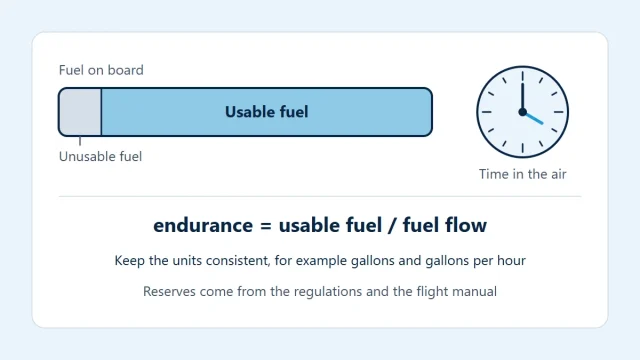
Fuel consumption is the rate at which an aircraft uses fuel, and almost every other fuel calculation is built on it. Endurance, trip fuel and range all start from one number: how much fuel leaves the tanks per hour. That number is easy to compute after a flight and harder to predict before one, because it changes with what the engine is being asked to do.
This guide covers the arithmetic of fuel flow, the two ways of expressing it (per hour and per distance), the difference between measuring fuel by volume and by mass, and the reasons a single average figure has to be handled with care.
Fuel flow is fuel divided by time
The basic relationship is a simple rate:
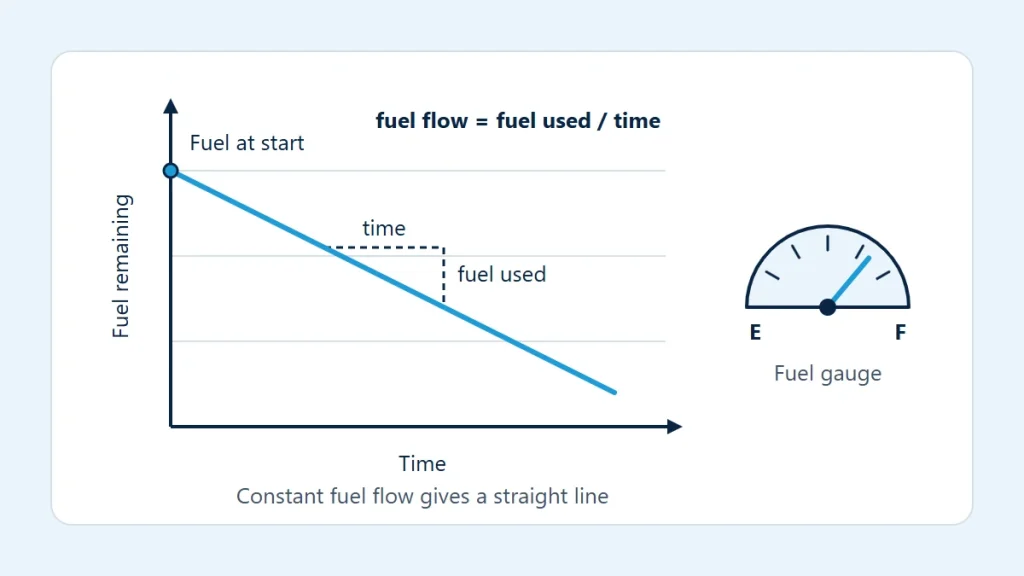
fuel flow = fuel used ÷ time
Fuel used is the quantity burned over a period, in US gallons, liters, imperial gallons, pounds or kilograms. Time is the length of that period in hours. The result is a quantity per hour, such as US gal/h or kg/h.
The diagram at the top of this page plots fuel remaining against time. When fuel flow is constant the plot is a straight line, and the steepness of the line is the fuel flow. A higher flow gives a steeper line that reaches empty sooner. Real flights do not trace a perfectly straight line, since the slope changes whenever the power setting changes, but the average slope between two points is always fuel used divided by time.
Per hour and per mile
Fuel per hour tells you how long the fuel will last. Fuel per distance tells you how far it will take you. The two are connected by ground speed:
fuel per NM = fuel used ÷ distance = fuel flow ÷ ground speed
The inverse, distance per unit of fuel, is called specific range:
specific range = distance ÷ fuel used = ground speed ÷ fuel flow
The distinction matters because wind changes one and not the other. A steady headwind does not make the engine burn fuel any faster, so fuel per hour is unchanged. It does lower ground speed, so each nautical mile takes longer and costs more fuel. The article on ground speed in aviation explains where that speed comes from.
A worked illustration
Suppose, purely for illustration, that 24 US gal were used over 3 hours of flight and 330 NM were covered in that time. Entering those values in the fuel consumption calculator gives:
| Result | Value | How it is found |
|---|---|---|
| Average fuel flow | 8.00 US gal/h | 24 ÷ 3 |
| Fuel per minute | 0.133 US gal/min | 8.00 ÷ 60 |
| Fuel per nautical mile | 0.073 US gal/NM | 24 ÷ 330 |
| Specific range | 13.75 NM per US gal | 330 ÷ 24 |
| Average ground speed | 110.0 kt | 330 ÷ 3 |
Now keep the fuel and the time the same and suppose a stronger headwind had cut the distance covered to 270 NM. The fuel flow is still 8.00 US gal/h, because the engine did the same work for the same time. The average ground speed falls to 90.0 kt, fuel per nautical mile rises to 0.089 US gal/NM and specific range drops to 11.25 NM per US gal. The hourly figure describes the engine; the per-mile figure describes the engine and the wind together.
These numbers are round values chosen to make the arithmetic visible. They are not the consumption of any particular aircraft.
Volume and mass are different measurements
Fuel can be measured by the space it occupies (gallons, liters) or by how much of it there is (pounds, kilograms). Light piston aircraft usually work in volume because tanks and fuel pumps are marked that way. Larger and turbine aircraft usually work in mass, because the energy released by burning fuel depends on its mass and because mass is what counts toward aircraft weight.
Converting between the two needs the density of the fuel, and density is not a fixed number. It differs between fuel types, and for any one fuel it changes with temperature: fuel expands as it warms, so the same mass takes up more volume on a hot day than on a cold one. A conversion done with a single remembered factor can therefore be wrong for the fuel actually in the tanks.
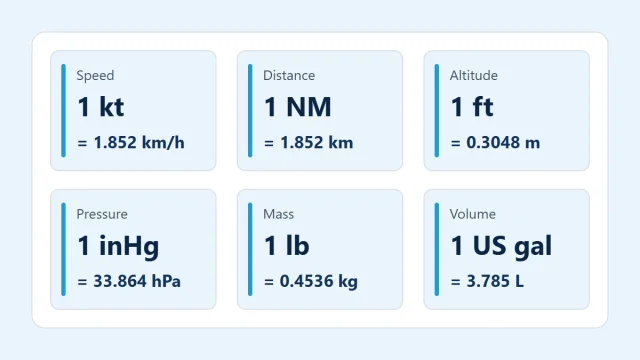
For this reason the calculators on this site never convert volume to mass or mass to volume. Enter fuel in pounds and the result is in pounds per hour; enter liters and the result is in liters per hour, with other volume units shown alongside. The density to use for a real aircraft comes from its flight manual and the fuel supplier’s data for the conditions. Conversions between units of the same kind, such as US gallons to liters, are exact and are covered in essential aviation unit conversions.
Why fuel flow is not one number
An average hides a lot of variation. The main influences are:
- Power setting. Fuel flow rises and falls with the power the engine is producing. Takeoff and climb use far more fuel per hour than a reduced cruise setting.
- Mixture. In piston engines with a manual mixture control, the fuel-to-air ratio is set by the pilot, and a richer mixture burns more fuel for the same power.
- Altitude and temperature. Air density affects how much power an engine can produce and how much thrust or power is needed to hold a given speed.
- Weight and drag. A heavier aircraft, or one in a higher-drag configuration, needs more power to fly at the same speed.
- Phase of flight. Taxi, climb, cruise, descent and holding each have their own flow.
A whole-flight average blends all of these. It will overstate the flow in cruise and understate it in the climb, which is why it should not be applied to a flight with a different profile.
What an average can and cannot tell you
A measured average is useful for understanding the relationships and for comparing a flight with what was expected. Once you have a flow figure, the fuel required calculator multiplies it by time en route, and the fuel endurance calculator divides usable fuel by it; fuel endurance mathematics explained walks through that second step.
What the arithmetic cannot do is decide how much fuel a flight needs. It does not know the fuel burned in taxi and climb, the accuracy of the gauges, how much of the fuel on board is unusable, or the weather ahead. Fuel planning for real flights uses the consumption tables in the aircraft flight manual (POH/AFM) for the planned power setting, altitude and temperature, together with current weather information and official charts. The fuel that must be carried, including reserves, is set by the applicable regulations, the operator and the flight manual, not by a calculator on a website.