Fuel Consumption Calculator
Fuel flow figures in a flight manual are predictions; this calculator works backwards from what actually happened. Enter the fuel a flight used and the time it took, and it returns the average burn per hour and per minute. Add the distance covered and it also gives fuel per nautical mile, specific range and the average ground speed.
Comparing an observed average with the figure that was planned is one of the plainest ways to see how power setting, altitude, leaning and wind show up in a fuel log. The result describes one flight under one set of conditions. It is a record to learn from, not a planning value for the next flight.
How to use this calculator
- Enter Fuel used and choose US gallons, liters, imperial gallons, pounds or kilograms.
- Enter Time flown in hours and minutes.
- Optionally enter Distance flown in nautical miles, kilometers or statute miles to add the per-distance rows.
Fuel used should be a measured quantity from your own records, such as the amount added to bring the tanks back to the level they started at, not a figure from a handbook. The time has to cover the same period as the fuel: if the fuel includes start, taxi and climb, so must the time, or the hourly figure will be overstated. The minutes box takes 0 to 59, so two and a half hours is 2 hours 30 minutes.
Formula
fuel flow = fuel used ÷ time
fuel per distance = fuel used ÷ distance
specific range = distance ÷ fuel used
What the variables mean
- fuel used
- fuel actually burned, by volume or by mass
- time
- elapsed time in hours
- distance
- distance flown, if you want fuel per nautical mile
Worked example
These example values are illustrative round numbers, not data for any particular aircraft. Select "Fill in the example" in the calculator to load them.
Inputs
- Fuel used: 21.5 US gal
- Time flown: 2 h 30 min
- Distance flown: 290 NM
Working
- Time = 2.500 h.
- Fuel flow = 21.50 ÷ 2.500 = 8.60 US gal/h.
- Fuel per NM = 21.50 ÷ 290.0 = 0.074 US gal/NM.
Result
- Average fuel flow: 8.60 US gal/h (32.55 L/h · 7.16 imp gal/h)
- Fuel per minute: 0.143 US gal/min
- Fuel per nautical mile: 0.074 US gal/NM
- Specific range: 13.49 NM per US gal
- Average ground speed: 116.0 kt
Reading the result
Average fuel flow is in the unit you chose per hour, with the other units of the same kind beside it: volume stays volume and mass stays mass. Fuel per minute is the same rate divided by 60. With a distance entered, Fuel per nautical mile and Specific range are two views of one ratio, and Average ground speed is simply distance divided by time, which makes it a useful sanity check on your inputs. For illustration, 21.5 US gal over 2 h 30 min and 290 NM gives 8.60 US gal/h and 13.49 NM per US gal.
Assumptions and limitations
- The result is one average over the whole period, so taxi, climb, cruise and descent are blended together.
- Volume is never converted to mass or mass to volume, because that needs the density of the actual fuel at its actual temperature.
- Distance is treated as distance over the ground, so the per-mile figures carry the effect of whatever wind was present.
- The average ground speed row includes any time on the ground that is part of the time you entered.
- The answer is only as accurate as the fuel measurement behind it; dipsticks, gauges and pump meters all have tolerances.
- Nothing here predicts fuel flow at another weight, altitude, temperature or power setting; planning figures come from the aircraft flight manual.
Common mistakes
- Dividing fuel for the whole flight by airborne time only, or cruise fuel by block time.
- Treating the average as the cruise fuel flow when it also contains the climb and ground running.
- Carrying an average from one flight into the planning of another flown at a different altitude, power setting or weight.
- Noting the refuel in liters and entering the number with US gallons selected.
- Comparing fuel per nautical mile between two flights without allowing for the different winds.
- Entering 2.5 hours as 2 hours 50 minutes instead of 2 hours 30 minutes.
References
- Federal Aviation Administration, Pilot's Handbook of Aeronautical Knowledge (FAA-H-8083-25).
These public sources explain the formulas and definitions used here. Citing them does not mean they have reviewed, endorsed or certified AviationCalc.
Related calculators
Fuel Endurance Calculator
How long a quantity of usable fuel lasts at a constant fuel flow.
Aviation Fuel Mathematics
Fuel Required Calculator
Trip fuel from distance, ground speed and fuel flow, plus any extra fuel you enter.
Aviation Fuel Mathematics
Aircraft Range Estimator
A simple constant-speed, constant-fuel-flow range estimate with a wind component you enter.
Aircraft Performance Concepts
Flight Time Calculator
Time en route from distance and ground speed, in hours and minutes.
Flight Speed and Distance
Guides that explain this calculation

Aviation Fuel Mathematics
Understanding Aircraft Fuel Consumption
How fuel flow is worked out from fuel used and time, why fuel per mile depends on wind, and why volume and mass of fuel are not interchangeable.
Aviation Fuel Mathematics
Fuel Endurance Mathematics Explained
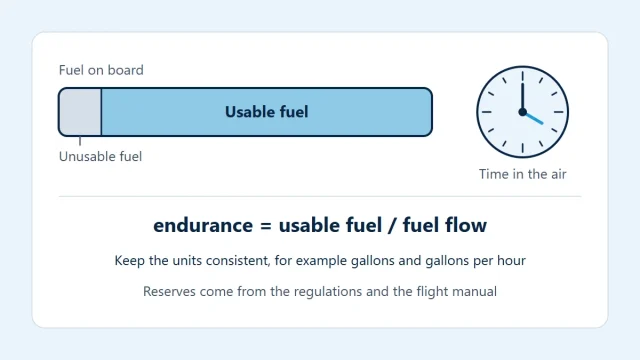
Endurance is usable fuel divided by fuel flow. See the steps, how sensitive the answer is to fuel flow, and why wind changes range but not endurance.

Aircraft Performance Concepts
How Aircraft Range Is Estimated
Range is ground speed multiplied by endurance. See how wind changes the distance but not the time, and what a simple range estimate leaves out.