Crosswind Component Calculator
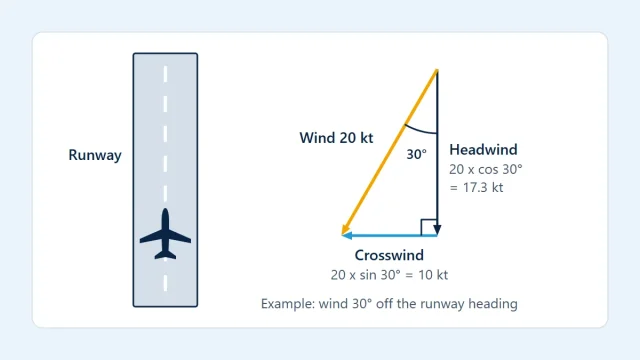
A wind that does not blow straight down the runway can be thought of as two winds at once: one along the runway and one across it. The crosswind component is the across part, the one that pushes an aircraft sideways during takeoff and landing. This calculator resolves a reported wind into those two parts for the runway heading you enter, using the sine and cosine of the angle between them.
Working the split shows something that surprises many students: the crosswind grows quickly at small angles. A wind only 30° off the runway already has half its speed acting across it, and by 60° nearly nine tenths.
How to use this calculator
- Enter Runway heading in degrees, for example about 270 for runway 27.
- Enter Wind direction (from) in degrees.
- Enter Wind speed and choose kt, km/h, mph or m/s.
- Optionally enter Gust speed, in the same unit as the wind speed.
Both directions must use the same north reference. Runway numbers are magnetic, rounded to the nearest 10°; wind in written weather reports is normally given relative to true north, while wind read out by a control tower is normally magnetic. Where variation is large, convert one of them before comparing. A runway number is also only approximate, so use the published runway heading from the airport chart when you have it. The gust speed cannot be lower than the steady wind speed.
Formula
angle = wind direction − runway heading
crosswind = W × sin(angle)
headwind = W × cos(angle)
What the variables mean
- W
- wind speed
- angle
- angle between the wind direction and the runway heading
- crosswind
- component across the runway; positive means from the right
- headwind
- component along the runway; a negative value is a tailwind
Worked example
These example values are illustrative round numbers, not data for any particular aircraft. Select "Fill in the example" in the calculator to load them.
Inputs
- Runway heading: 270°
- Wind direction (from): 300°
- Wind speed: 18 kt
Working
- Angle = wind direction − runway heading = 300° − 270° = 30°.
- Crosswind = 18.0 × sin(30°) = 9.0 kt (positive is from the right).
- Headwind = 18.0 × cos(30°) = 15.6 kt (negative is a tailwind).
Result
- Crosswind component: 9.0 kt from the right
- Headwind component: 15.6 kt
- Angle between wind and runway: 30° (Wind from the right)
Reading the result
Crosswind component gives the speed across the runway and the side it comes from, as seen facing along the runway heading. The second row is labelled Headwind component or Tailwind component according to which way the along-runway part acts. Angle between wind and runway shows the angle used. If a gust speed was entered, Crosswind in gusts and Headwind in gusts (or Tailwind in gusts) repeat the split at the gust speed. The page reports components only. It does not compare them with any limit; crosswind and tailwind limits come from the aircraft flight manual and the operator.
Assumptions and limitations
- The wind is treated as one steady vector, and gusts as the same direction at a higher speed, although real gusts also shift in direction.
- The wind measured at the reporting point is assumed to be the wind over the runway, which trees, buildings and terrain can change.
- Runway heading and wind direction are assumed to be given against the same north reference; no variation is applied.
- The components describe the air's movement only and take no account of the aircraft, its speed or its handling.
- The reported wind is an average over a short period before the observation and may have changed since.
- A wind exactly aligned with the runway returns no crosswind, and a wind of zero returns no components at all.
Common mistakes
- Entering the runway number, such as 27, instead of its heading in degrees.
- Using the heading of the opposite runway end, which swaps headwind for tailwind and left for right.
- Comparing a true wind direction from a written report with a magnetic runway heading where variation is large.
- Estimating the crosswind as proportional to the angle, which badly underestimates it between 30° and 60°.
- Working out the components for the steady wind only and ignoring the reported gust.
- Entering the gust in knots after selecting a different unit for the wind speed.
References
- Federal Aviation Administration, Pilot's Handbook of Aeronautical Knowledge (FAA-H-8083-25).
- Federal Aviation Administration, Airplane Flying Handbook (FAA-H-8083-3).
- Federal Aviation Administration, Aeronautical Information Manual.
These public sources explain the formulas and definitions used here. Citing them does not mean they have reviewed, endorsed or certified AviationCalc.
Related calculators
Headwind and Tailwind Calculator
Find the headwind or tailwind component of any wind along your track.
Wind Calculations
Wind Correction Angle Calculator
Wind correction angle, true heading and ground speed for a course and wind.
Aviation Navigation
Ground Speed Calculator
Find ground speed from true airspeed, course and wind using the wind triangle.
Flight Speed and Distance
True Heading and Magnetic Heading Calculator
Convert between true, magnetic and compass headings with variation and deviation.
Aviation Navigation
Guides that explain this calculation
Wind Calculations
How to Calculate Crosswind Components
Split any wind into crosswind and headwind parts with sine and cosine, then see how the clock method and sixths rule compare with the exact values.
Wind Calculations
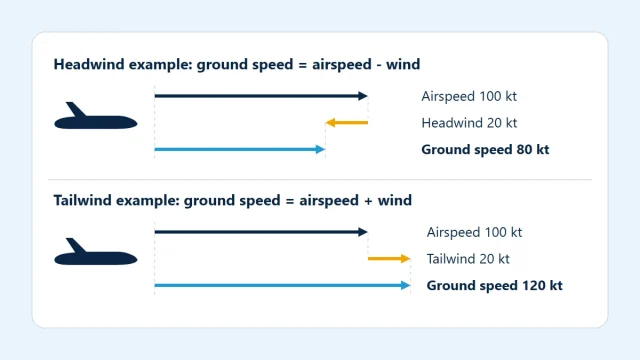
Understanding Headwinds and Tailwinds
How wind along the track changes ground speed and flight time, how to find the component with a cosine, and why wind never cancels on a round trip.
Aviation Navigation
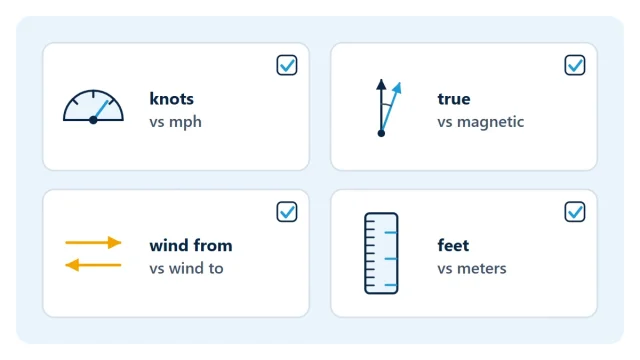
Common Aviation Calculation Mistakes
Unit mix-ups, true versus magnetic, wind from versus to, and airspeed used as ground speed: the common errors, with the size of each shown.