Headwind and Tailwind Calculator
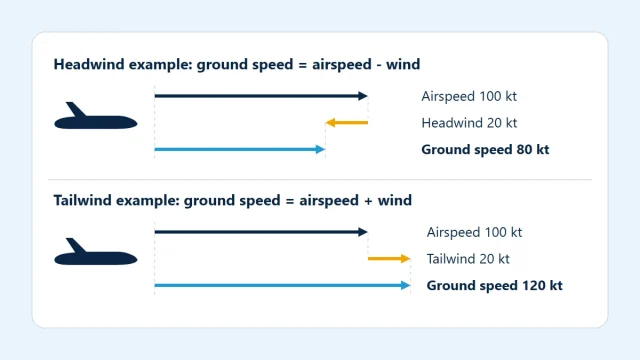
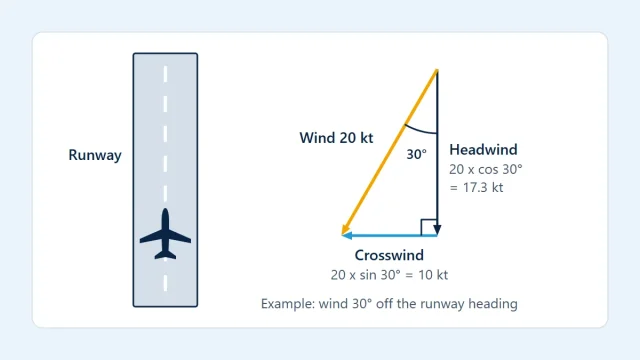
Only part of a wind helps or hinders progress along a route. The headwind or tailwind component is that part: the wind speed multiplied by the cosine of the angle between the wind and the direction of travel. A wind from ahead slows the aircraft over the ground, a wind from behind speeds it up, and a wind from the side does neither directly. This calculator finds the along-track part for any track and any wind.
The component is the quickest way to compare routes, altitudes or directions of flight. It shows at a glance whether a forecast wind is working for or against a leg, and by roughly how much, before a full wind-triangle solution is needed.
How to use this calculator
- Enter Track or course in degrees, the direction of travel over the ground.
- Enter Wind direction (from), the bearing the wind is arriving from.
- Enter Wind speed in whichever of kt, km/h, mph or m/s your wind information uses.
- Read whether the result is a headwind or a tailwind, and its size.
The first field wants the direction the aircraft is moving across the ground, not the direction its nose is pointing, which differs whenever there is a crosswind. Track and wind direction must be measured from the same north, both true or both magnetic. The wind direction is where the wind comes from, so a wind entered as 360° on a track of 360° is a pure headwind. North may be typed as either 0 or 360.
Formula
angle = wind direction − track
headwind = W × cos(angle)
a negative headwind is a tailwind
What the variables mean
- W
- wind speed
- track
- direction of travel over the ground, in degrees
- angle
- angle between the wind direction (from) and the track
- headwind
- component of the wind opposing the direction of travel
Worked example
These example values are illustrative round numbers, not data for any particular aircraft. Select "Fill in the example" in the calculator to load them.
Inputs
- Track or course: 360°
- Wind direction (from): 140°
- Wind speed: 25 kt
Working
- Angle = wind direction − track = 140° − 360° = −220°, which is the same direction as 140° (kept between −180° and 180°).
- Headwind = 25.0 × cos(140°) = −19.2 kt.
- The value is negative, so it is a tailwind of 19.2 kt.
Result
- Tailwind component: 19.2 kt
- Crosswind component: 16.1 kt from the right
- Share of the wind along the track: 77% (Angle between wind and track: 140°)
Reading the result
The first row is titled Headwind component or Tailwind component, so the label itself tells you the direction and the number is always positive. Crosswind component gives the remaining part of the wind and the side it comes from. Share of the wind along the track states what percentage of the full wind speed acts along the track, with the angle between wind and track beside it. Ground speed is not simply airspeed minus the headwind when a crosswind is also present, because some airspeed goes into holding the track; the ground speed calculator solves that case.
Assumptions and limitations
- The wind has one direction and one speed along the whole track, with no change with distance, time or altitude.
- The track is a straight line in a single direction; a route with turns needs one calculation per leg.
- Only horizontal wind is considered, so rising and sinking air are excluded.
- The component is a property of the wind and the track alone and does not depend on airspeed.
- The effect of the crosswind on ground speed through the wind correction angle is not included in this result.
- Track and wind direction are taken as given against the same north reference.
Common mistakes
- Subtracting the whole wind speed from airspeed when the wind is well off the nose.
- Entering the heading being flown instead of the track over the ground.
- Reversing the wind direction, entering where it is going instead of where it comes from.
- Assuming a wind at 90° to the track has no effect on ground speed, when the crab needed to hold the track costs a little.
- Applying one component to a whole trip that includes legs in different directions.
- Using this page for a runway and reading the wrong end, when the runway heading in use determines head or tail.
References
- Federal Aviation Administration, Pilot's Handbook of Aeronautical Knowledge (FAA-H-8083-25).
- Federal Aviation Administration, Aeronautical Information Manual.
These public sources explain the formulas and definitions used here. Citing them does not mean they have reviewed, endorsed or certified AviationCalc.
Related calculators
Crosswind Component Calculator
Split a reported wind into crosswind and headwind components for a runway heading.
Wind Calculations
Ground Speed Calculator
Find ground speed from true airspeed, course and wind using the wind triangle.
Flight Speed and Distance
Wind Correction Angle Calculator
Wind correction angle, true heading and ground speed for a course and wind.
Aviation Navigation
Aircraft Range Estimator
A simple constant-speed, constant-fuel-flow range estimate with a wind component you enter.
Aircraft Performance Concepts
Guides that explain this calculation
Wind Calculations
Understanding Headwinds and Tailwinds
How wind along the track changes ground speed and flight time, how to find the component with a cosine, and why wind never cancels on a round trip.
Wind Calculations
How to Calculate Crosswind Components
Split any wind into crosswind and headwind parts with sine and cosine, then see how the clock method and sixths rule compare with the exact values.

Flight Speed and Distance
Understanding Ground Speed in Aviation
Ground speed is true airspeed and wind added as vectors. See the wind triangle formula, a worked example and why a pure crosswind still slows you down.