Aircraft Range Estimator
Range in its most basic form is endurance multiplied by speed over the ground. This estimator divides the cruise fuel you enter by the hourly fuel flow to get endurance, multiplies by true airspeed for a still-air range, then repeats the sum with a headwind or tailwind component to show how far the same fuel goes with wind.
Its value is in the comparison. Putting the still-air and with-wind figures side by side makes it plain that wind changes range without changing endurance. The estimate burns every unit of fuel entered at one speed and one fuel flow, which makes it a simplification for learning and not a replacement for flight-manual range data.
How to use this calculator
- Enter Fuel available for cruise and choose its unit.
- Enter Fuel flow per hour in that same unit.
- Enter True airspeed in knots, km/h or mph.
- Optionally enter Wind component along route, in the airspeed unit, and set Wind component type to Headwind or Tailwind.
Fuel available for cruise is your own figure and the estimator consumes all of it, so it should be only the fuel meant to be burned in cruise, after whatever the applicable regulations, the operator and the flight manual require has been set aside. Fuel flow and true airspeed are a matched pair from your aircraft's cruise data. The wind entry is the along-track part only, not the full wind speed; the headwind and tailwind calculator resolves it. A headwind equal to or greater than the true airspeed is rejected.
Formula
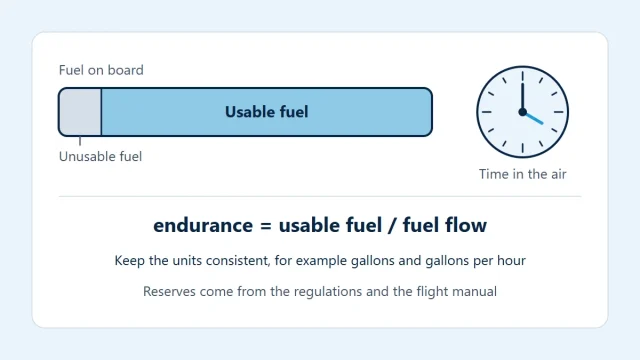
endurance = usable fuel ÷ fuel flow
still-air range = TAS × endurance
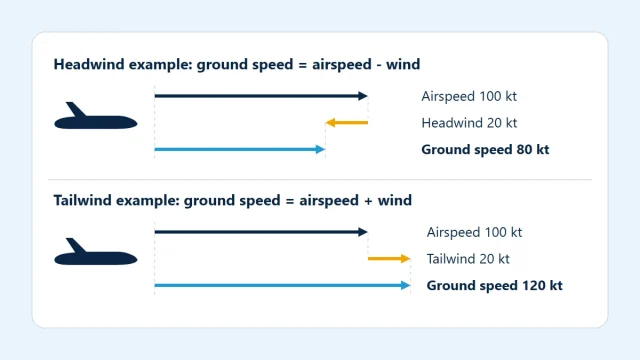
range with wind = (TAS − headwind) × endurance
What the variables mean
- usable fuel
- the fuel you want to count as burned in cruise
- fuel flow
- fuel burned per hour in the same unit
- TAS
- true airspeed in cruise
- headwind
- wind component along the route; a tailwind is a negative headwind
Worked example
These example values are illustrative round numbers, not data for any particular aircraft. Select "Fill in the example" in the calculator to load them.
Inputs
- Fuel available for cruise: 40 US gal
- Fuel flow per hour: 8.5 US gal/h
- True airspeed: 115 kt
- Wind component along route: 15 kt
- Wind component type: Headwind
Working
- Endurance = 40.0 ÷ 8.50 = 4.706 h.
- Still-air range = 115.0 kt × 4.706 h = 541 NM.
- Ground speed = 115.0 − (15.0) = 100.0 kt.
- Range with wind = 100.0 × 4.706 = 471 NM.
Result
- Estimated range with wind: 471 NM (872 km · 542 mi)
- Still-air range: 541 NM (1,002 km)
- Endurance: 4 h 42 min (4.71 hours)
- Ground speed used: 100.0 kt
Reading the result
Estimated range with wind is in nautical miles, with kilometers and statute miles beside it. Still-air range is the same sum with no wind, and the two match when the wind box is empty. Endurance is the time the entered fuel lasts, and Ground speed used shows the true airspeed after the wind component is applied. For illustration, 40 US gal at 8.5 US gal/h and 115 kt gives 4 h 42 min and 541 NM in still air, or 471 NM into a 15 kt headwind. Each range ends where the entered fuel is gone.
Assumptions and limitations
- True airspeed and fuel flow stay constant, although a real aircraft gets lighter as it burns fuel and its best cruise conditions shift.
- The wind is one constant component for the whole route, with no change of wind with position, altitude or time.
- Only the along-route part of the wind is used; the small loss of ground speed from holding a crab angle in a crosswind is ignored.
- Climb and descent are not modeled, so the whole distance is flown at the cruise figures.
- All the fuel entered is burned. Nothing is held back unless you leave it out of the number you type.
- The speed is whatever you enter; the estimator does not look for a best-range speed.
Common mistakes
- Entering the full reported wind speed when only part of it lies along the route.
- Typing all the fuel on board, which produces a range that ends with empty tanks.
- Leaving the wind type on Headwind, its default, when the component is a tailwind.
- Using indicated airspeed at altitude in the true airspeed box.
- Combining a fuel flow from one power setting with a true airspeed from another.
- Setting this estimate against a flight-manual range figure that already includes climb and other allowances, and expecting the two to agree.
References
- Federal Aviation Administration, Pilot's Handbook of Aeronautical Knowledge (FAA-H-8083-25).
These public sources explain the formulas and definitions used here. Citing them does not mean they have reviewed, endorsed or certified AviationCalc.
Related calculators
Fuel Endurance Calculator
How long a quantity of usable fuel lasts at a constant fuel flow.
Aviation Fuel Mathematics
Fuel Required Calculator
Trip fuel from distance, ground speed and fuel flow, plus any extra fuel you enter.
Aviation Fuel Mathematics
Headwind and Tailwind Calculator
Find the headwind or tailwind component of any wind along your track.
Wind Calculations
Ground Speed Calculator
Find ground speed from true airspeed, course and wind using the wind triangle.
Flight Speed and Distance
Guides that explain this calculation

Aircraft Performance Concepts
How Aircraft Range Is Estimated
Range is ground speed multiplied by endurance. See how wind changes the distance but not the time, and what a simple range estimate leaves out.
Aviation Fuel Mathematics
Fuel Endurance Mathematics Explained
Endurance is usable fuel divided by fuel flow. See the steps, how sensitive the answer is to fuel flow, and why wind changes range but not endurance.
Wind Calculations
Understanding Headwinds and Tailwinds
How wind along the track changes ground speed and flight time, how to find the component with a cosine, and why wind never cancels on a round trip.