Speed of Sound Calculator
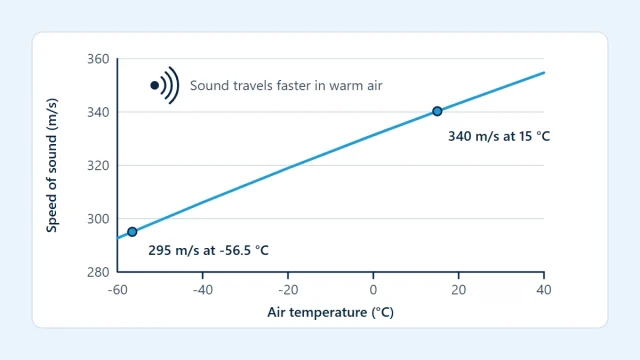
Sound travels through air as a pressure wave passed from molecule to molecule, and how quickly it is passed on depends on how fast those molecules are moving, which is to say on temperature. Pressure and density cancel out of the result. This calculator takes one air temperature and returns the speed of sound for dry air in five units.
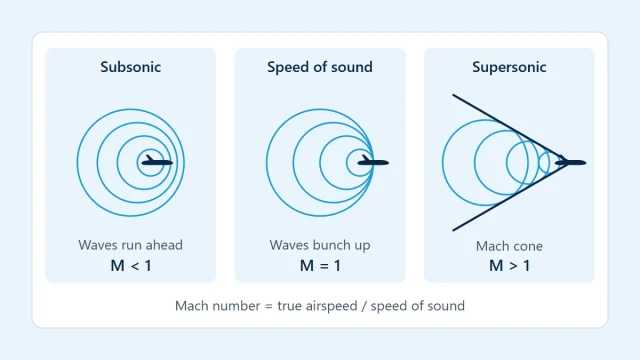
In aviation the value matters mainly as the denominator of Mach number. Because the upper air is cold, the speed of sound at cruising levels is well below its sea-level figure, so an aircraft reaches a given Mach number at a lower true airspeed there. Knowing the local value turns a Mach number into knots and back again.
How to use this calculator
- Enter Air temperature as a number.
- Choose °C, °F or K with the unit selector.
- Read the speed of sound in knots and m/s, then in km/h, mph and ft/s.
Temperature is the only input, so it deserves a moment's thought. It should be the static temperature of the air itself at the level you are interested in, not a surface temperature and not a reading inflated by airflow heating a probe. Negative Celsius values are entered with a minus sign. The calculator accepts 100 K to 500 K, which is −173.15 °C to 226.85 °C, a wider span than the atmosphere ever presents. For the standard temperature at a chosen altitude, see the standard atmosphere calculator.
Formula
a = √(γ × R × T)
a ≈ 38.9678 × √T knots
What the variables mean
- a
- speed of sound
- T
- air temperature in kelvin
- γ
- ratio of specific heats, 1.4 for air
- R
- specific gas constant for dry air, 287.05287 J/(kg·K)
Worked example
These example values are illustrative round numbers, not data for any particular aircraft. Select "Fill in the example" in the calculator to load them.
Inputs
- Air temperature: −56.5 °C
Working
- T = 216.65 K.
- a = √(1.4 × 287.05287 × 216.65) = 295.07 m/s.
- In knots: 295.07 × 3 600 ÷ 1 852 = 573.6 kt.
Result
- Speed of sound: 573.6 kt (295.1 m/s)
- In other units: 1,062.3 km/h (660.1 mph · 968.1 ft/s)
- Compared with sea-level standard: 86.7% (Sea-level standard: 661.5 kt at 15 °C)
Reading the result
Speed of sound is shown first in knots, with meters per second beside it. In other units repeats the same speed in km/h, mph and ft/s, so no further conversion is needed. Compared with sea-level standard expresses the result as a percentage of 661.5 kt, the value at 15 °C: a figure under 100% means the air is colder than the sea-level standard day and Mach 1 is reached at a lower true airspeed. Since the speed varies with the square root of absolute temperature, a large drop in temperature produces a noticeably smaller percentage drop in speed.
Assumptions and limitations
- Air is modelled as an ideal gas with a ratio of specific heats fixed at 1.4.
- The dry-air gas constant of 287.05287 J/(kg·K) is used, so the slight increase caused by humidity is left out.
- The ratio of specific heats is held constant even at the hot end of the accepted range, where in reality it begins to fall.
- Pressure and altitude have no direct effect in this model and are therefore not requested.
- The result is for still, uniform air; wind changes how fast sound travels over the ground but not through the air.
- The value applies to small pressure disturbances, not to strong shock waves, which move faster.
Common mistakes
- Taking the square root of a temperature in °C or °F instead of kelvin when using the formula by hand.
- Believing that the speed of sound falls with altitude because the air is thinner, when temperature is the only cause.
- Quoting a single figure such as 661 kt as the speed of sound without stating the temperature it belongs to.
- Expecting the speed to halve when the Celsius temperature halves.
- Using a ground-level temperature to convert a cruise Mach number into true airspeed.
- Entering a positive number for a temperature that is below zero.
References
- NASA Glenn Research Center, Speed of Sound Interactive.
- NOAA, NASA and the U.S. Air Force, U.S. Standard Atmosphere, 1976.
These public sources explain the formulas and definitions used here. Citing them does not mean they have reviewed, endorsed or certified AviationCalc.
Related calculators
Mach Number Calculator
Divide true airspeed by the local speed of sound to get Mach number.
Flight Speed and Distance
Standard Atmosphere Calculator
ISA temperature, pressure, density and speed of sound at any altitude up to 20 km.
Atmosphere and Altitude
True Airspeed Calculator
Convert calibrated airspeed to true airspeed from pressure altitude and outside air temperature.
Flight Speed and Distance
Air Density Calculator
Air density from pressure, temperature and optional relative humidity.
Atmosphere and Altitude
Guides that explain this calculation
Atmosphere and Altitude
Understanding the Speed of Sound
The speed of sound in air depends on temperature, not pressure or density. See the formula, a table of values and how it sets Mach number.
Flight Speed and Distance
Understanding Mach Number
Mach number is true airspeed divided by the local speed of sound. See why temperature alone sets that speed and how one airspeed gives two Mach numbers.

Atmosphere and Altitude
International Standard Atmosphere Explained
The ISA model fixes sea-level values, a 6.5 °C per km lapse rate and an 11 km tropopause. See the equations, a reference table and what ISA deviation means.