Altimeter Pressure Conversion Calculator
Altimeter settings are reported in inches of mercury in some countries and in hectopascals in most others, and the same pressure appears elsewhere as millibars, millimeters of mercury, kilopascals or pounds per square inch. This calculator takes a pressure in any one of those units and shows it in all the rest, so a setting from an unfamiliar weather report or flight simulator can be matched to the scale on the instrument in front of you.
It also places the value in context, showing how far it lies above or below the standard setting and which altitude in the standard atmosphere has that pressure. That makes it easier to judge whether a converted figure is plausible before using it.
How to use this calculator
- Enter the number in the Pressure field.
- Choose the unit it is in: inHg, hPa, mmHg, kPa or psi.
- Read the same pressure in the other units, followed by the difference from standard.
The unit selector does all the work here, so set it before reading anything. A four-digit value around 1000 is almost certainly hPa, a value near 30 is inHg, one near 760 is mmHg and one near 100 is kPa. Hectopascals and millibars are the same size, so a setting in millibars is entered as hPa unchanged. Weather reports often drop the decimal point, giving 3015 for 30.15 inHg; put it back when you type. Values from 60 to 1100 hPa (about 1.77 to 32.48 inHg) are accepted.
Formula
hPa = inHg × 33.86389
inHg = hPa ÷ 33.86389
1 hPa = 1 mbar = 0.1 kPa
What the variables mean
- inHg
- inches of mercury
- hPa
- hectopascals, identical to millibars
- 33.86389
- hectopascals in one inch of mercury (conventional value at 0 °C)
Worked example
These example values are illustrative round numbers, not data for any particular aircraft. Select "Fill in the example" in the calculator to load them.
Inputs
- Pressure: 30.15 inHg
Working
- Convert to pascals: 102,100 Pa.
- inHg = Pa ÷ 3 386.389 = 30.15.
- hPa = Pa ÷ 100 = 1,021.0.
Result
- Inches of mercury: 30.15 inHg
- Hectopascals / millibars: 1,021.0 hPa
- Other units: 765.8 mmHg (102.10 kPa · 14.808 psi)
- Difference from standard: +7.7 hPa (+0.23 inHg from 1013.25 hPa / 29.92 inHg)
- Standard-atmosphere altitude of this pressure: −211 ft (−64 m)
Reading the result
Inches of mercury and Hectopascals / millibars are the two rows that correspond to altimeter scales, rounded to two decimals and one decimal. Other units gives mmHg, kPa and psi. Difference from standard shows, with a sign, how much the pressure is above (+) or below (−) 1013.25 hPa and 29.92 inHg. Standard-atmosphere altitude of this pressure is the height at which the standard atmosphere has exactly this pressure; for a typical sea-level setting it is a small positive or negative number of feet, and it is not the pressure altitude of any airfield.
Assumptions and limitations
- The inch of mercury is the conventional one, defined as 3,386.389 Pa at 0 °C, with no adjustment for the temperature of a real mercury column.
- The conversion is pure unit arithmetic and knows nothing about where or when the pressure was observed.
- Altimeter scales are set in steps of 0.01 inHg or 1 hPa, so a converted value has to be rounded to the nearest step the instrument can show.
- The altitude row uses the standard atmosphere and ignores actual temperature.
- No distinction is made between a sea-level-adjusted setting and a pressure measured at field level; that depends on the source of your number.
- Inputs outside 60 to 1100 hPa are rejected, which covers pressures down to roughly the top of the atmosphere model used on this site.
Common mistakes
- Typing a setting reported without its decimal point, such as 2992, straight into the inHg field.
- Using a rough factor of 34 for hPa per inHg in place of 33.86, an error that grows to several hPa at normal settings.
- Confusing mmHg with inHg because both refer to a mercury column.
- Entering kPa when the source is in hPa, which differ by a factor of ten.
- Reading the standard-atmosphere altitude row as the correction to apply to an elevation.
- Rounding a converted setting in the direction that suits rather than to the nearest value.
References
- National Institute of Standards and Technology, Guide for the Use of the International System of Units (SI), Special Publication 811.
- Federal Aviation Administration, Pilot's Handbook of Aeronautical Knowledge (FAA-H-8083-25).
- Federal Aviation Administration, Aeronautical Information Manual.
These public sources explain the formulas and definitions used here. Citing them does not mean they have reviewed, endorsed or certified AviationCalc.
Related calculators
Pressure Altitude Calculator
Pressure altitude from elevation and the current altimeter setting.
Atmosphere and Altitude
Density Altitude Calculator
Density altitude from field elevation, altimeter setting and outside air temperature (dry air).
Atmosphere and Altitude
Aviation Unit Conversion Calculator
Convert the speed, distance, altitude, mass, volume, pressure and temperature units used in aviation.
Aviation Units and Conversions
Standard Atmosphere Calculator
ISA temperature, pressure, density and speed of sound at any altitude up to 20 km.
Atmosphere and Altitude
Guides that explain this calculation
Atmosphere and Altitude
Aviation Altimeter Settings Explained
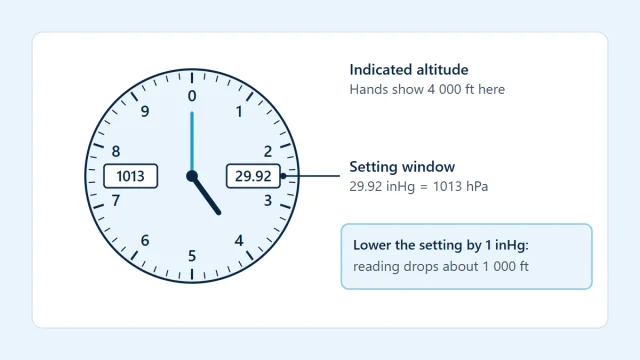
How an altimeter setting works, what QNH and the standard setting show, how inHg and hPa convert, and what a wrong setting does to indicated altitude.

Atmosphere and Altitude
Understanding Pressure Altitude
Pressure altitude is altitude measured from the 1013.25 hPa (29.92 inHg) standard datum. Learn how to read it, calculate it and where it is used.
Aviation Units and Conversions
Essential Aviation Unit Conversions
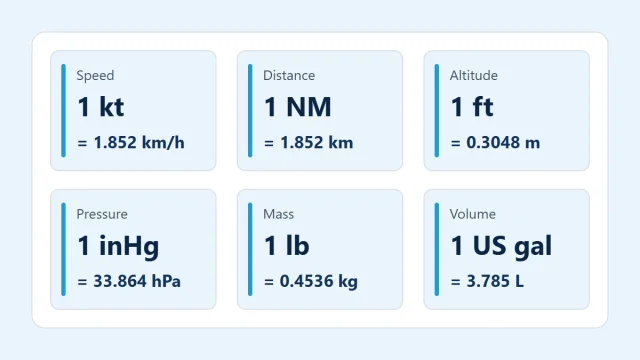
The speed, distance, altitude, pressure, temperature, mass and volume conversions aviation uses most, with exact factors and the shortcuts labelled.