Climb rate and climb gradient both describe a climb, and they are often confused because each can be read as “how well the aircraft is climbing”. They answer different questions. Climb rate says how quickly height is gained. Climb gradient says how much height is gained for the ground covered. An aircraft can have a healthy rate and a poor gradient at the same moment.
Two measurements side by side
| Climb rate | Climb gradient | |
|---|---|---|
| Definition | Height gained ÷ time | Height gained ÷ horizontal distance over the ground |
| Usual units | ft/min, m/s | ft/NM, percent, degrees |
| Answers | How long to reach an altitude | How high the aircraft will be at a given point along the ground |
| Read from | Vertical speed indicator, or altimeter and clock | Not shown directly; worked out from rate and ground speed |
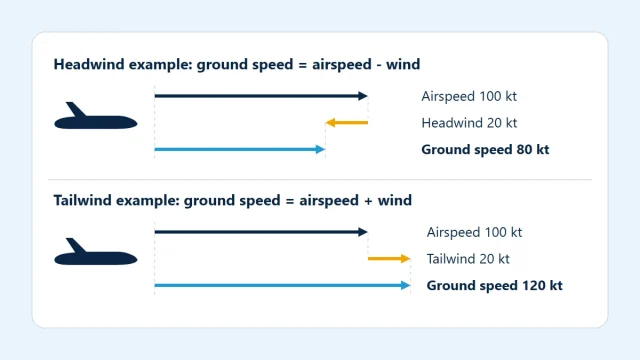
| Effect of a steady wind | None | Headwind steepens it, tailwind flattens it |
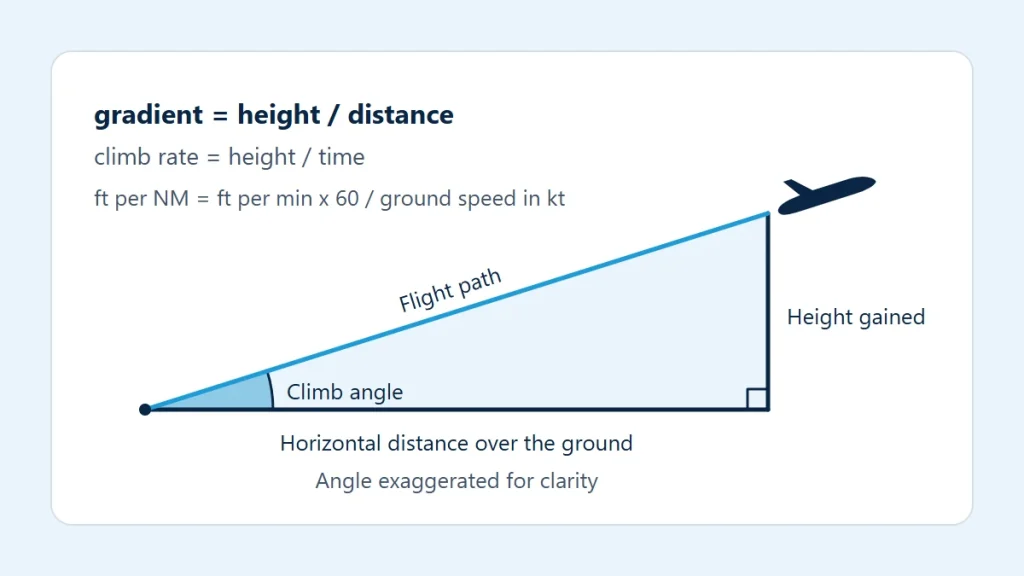
The diagram at the top of this page shows the gradient as the triangle formed by the flight path, the height gained and the horizontal distance over the ground. The angle in that drawing is exaggerated; real climb angles are only a few degrees.
The link is ground speed
Rate is height per unit of time. Ground speed is distance per unit of time. Dividing one by the other cancels time and leaves height per unit of distance:
gradient (ft/NM) = rate of climb (ft/min) × 60 ÷ ground speed (kt)
The factor of 60 converts knots, which are nautical miles per hour, into nautical miles per minute. To express the same gradient as a percentage, divide by the number of feet in a nautical mile:
gradient (%) = gradient (ft/NM) ÷ 6,076.12 × 100
The climb angle is the angle whose tangent is the gradient written as a fraction. As a reference point, a 5% gradient is 304 ft/NM, an angle of 2.86°.
The speed in the formula is ground speed, not airspeed. Gradient is measured against the ground, where the obstacles are, so the motion that counts is motion over the ground. The article on ground speed in aviation explains how it differs from what the airspeed indicator shows.
One climb rate, three gradients
Suppose, for illustration only, an aircraft is climbing at a steady 600 ft/min at a true airspeed of 90 kt. The numbers are round values, not the performance of any real aircraft. Running three wind cases through the climb gradient calculator gives:
| Wind along the climb path | Ground speed | Rate of climb | Gradient | Percent | Angle |
|---|---|---|---|---|---|
| 15 kt headwind | 75 kt | 600 ft/min | 480 ft/NM | 7.90% | 4.52° |
| Calm | 90 kt | 600 ft/min | 400 ft/NM | 6.58% | 3.77° |
| 15 kt tailwind | 105 kt | 600 ft/min | 343 ft/NM | 5.64% | 3.23° |
The rate of climb column does not change, because the aircraft has the same excess power in each case and is climbing through the air mass in the same way. The air mass itself is moving. In the headwind the aircraft covers less ground while it gains each 600 ft, so its path over the ground is steeper. In the tailwind it is carried further along before it has gained the same height, so the path is flatter. Here a 15 kt tailwind costs 57 ft of height in every nautical mile compared with calm air.
The headwind and tailwind calculator finds the along-track part of a wind that is not aligned with the climb path.
Speed works against gradient
Wind is not the only thing that changes ground speed. For the same 600 ft/min, a ground speed of 60 kt gives 600 ft/NM (9.87%), while 120 kt gives 300 ft/NM (4.94%). Doubling the ground speed halves the gradient.
This is why the speed for the best rate of climb and the speed for the best angle of climb are different. The best rate comes at the airspeed with the most excess power. The steepest path comes at a lower airspeed, where a little rate is given up but much less distance is covered. Understanding rate of climb covers where each comes from. Both speeds are specific to the aircraft and are published in its flight manual.
Altitude has a quieter effect of the same kind. At a constant indicated airspeed, true airspeed rises as the air thins, so ground speed rises and the gradient for a given rate of climb falls, at the same time as the rate itself is decreasing.
Turning a gradient into a rate
The vertical speed indicator shows rate, not gradient. A gradient therefore has to be converted before it can be compared with anything in the cockpit. Rearranging the formula:
rate of climb (ft/min) = gradient (ft/NM) × ground speed (kt) ÷ 60
The rate of climb calculator does this conversion. Taking the calm case from the table in reverse:
- Enter the ground speed, 90 kt.
- Enter the gradient, 400 ft/NM. Percent and degrees are also accepted.
- The required rate of climb is 400 × 90 ÷ 60 = 600 ft/min.
- With a height to gain of 3,000 ft entered, the time is 5.0 min and the ground distance covered is 7.5 NM.
The required rate scales with ground speed. A gradient of 5% needs 506 ft/min at 100 kt, and proportionally more at any higher ground speed. A tailwind on departure therefore raises the rate needed to hold a given gradient, at exactly the time it flattens the path.
Which one matters when
- Clearing terrain and obstacles is a gradient problem. The obstacle is at a fixed distance over the ground, and what matters is the height reached by that point.
- Reaching a cruising altitude or estimating time to climb is a rate problem.
- Instrument departure procedures express any climb requirement as a gradient. The required figures are published on the procedure charts and vary from one procedure to another, so they are read from the current chart, never assumed.
Limits of the conversion
The formula is exact arithmetic, but it describes a steady climb at one rate and one ground speed. Real climbs do not hold either. Rate of climb decays with altitude, wind usually changes with height, and a turn after takeoff changes both the rate and the wind component.
The conversion also says nothing about whether the aircraft can produce the rate in question. Achievable climb performance depends on weight, configuration, pressure altitude and temperature, and comes from the aircraft flight manual (POH/AFM). Required gradients come from current official charts and the applicable regulations, and the wind used should come from current weather information, not a guess. The calculators on this site show how the quantities relate; they do not establish that any departure will clear anything.