Rate of Climb Calculator
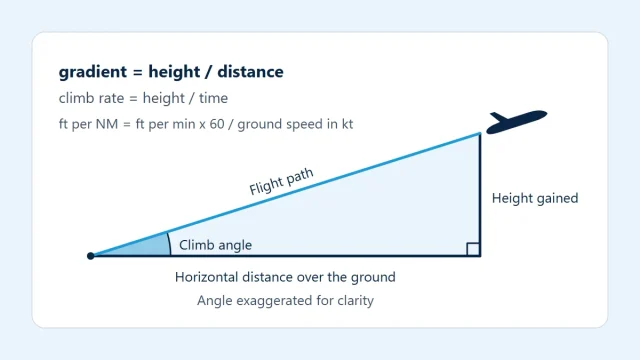
A climb gradient is height gained per distance over the ground; a vertical speed indicator shows height gained per minute. This calculator links the two: give it a ground speed and a gradient in feet per nautical mile, percent or degrees, and it returns the rate of climb that produces that gradient.
The link matters because gradients on charts and procedures are fixed to the ground, while the rate needed to meet them rises with ground speed. A faster climb speed or a tailwind means more feet per minute for the same gradient. Add a height to gain and the calculator also gives the time and the ground distance the climb takes.
How to use this calculator
- Enter the Ground speed for the climb, in knots, km/h or mph.
- Enter Climb gradient and set Gradient unit to feet per nautical mile (ft/NM), percent (%) or degrees (°).
- Optionally enter Height to gain in feet or meters to add the time and distance rows.
Use the ground speed expected during the climb, which is the climbing true airspeed adjusted for wind, not the cruise speed and not the indicated airspeed. Check that the gradient unit matches the number: 300 ft/NM, 4.94% and 2.83° are the same slope, and choosing the wrong unit changes the answer many times over. An angle has to be less than 90°. A gradient that has to be met comes from the current official chart or procedure.
Formula
rate of climb (ft/min) = gradient (ft/NM) × ground speed (kt) ÷ 60
gradient (ft/NM) = gradient (%) × 60.7612
time to climb = height to gain ÷ rate of climb
What the variables mean
- rate of climb
- vertical speed in feet per minute
- gradient
- height gained per horizontal distance over the ground
- ground speed
- speed over the ground in knots
- 60.7612
- feet per nautical mile (6 076.12) divided by 100
Worked example
These example values are illustrative round numbers, not data for any particular aircraft. Select "Fill in the example" in the calculator to load them.
Inputs
- Ground speed: 90 kt
- Climb gradient: 300
- Gradient unit: feet per nautical mile (ft/NM)
- Height to gain: 3000 ft
Working
- Gradient = 300.0 ft/NM (4.94%).
- Rate of climb = 300.0 × 90.0 ÷ 60 = 450 ft/min.
- Time = 3,000 ÷ 450 = 6.7 min; distance = 3,000 ÷ 300.0 = 10.0 NM.
Result
- Required rate of climb: 450 ft/min (2.29 m/s)
- Gradient: 300 ft/NM (4.94% · 2.83°)
- Time to gain 3,000 ft: 6.7 min
- Ground distance covered: 10.0 NM
Reading the result
Required rate of climb is in ft/min with m/s beside it. The Gradient row restates your entry in all three forms, which confirms the unit was read as you meant. With a height entered, Time to gain that height and Ground distance covered follow from holding the rate and ground speed constant. Required describes what the gradient demands at that ground speed; it says nothing about what an aircraft can deliver. That comparison needs the climb performance in the flight manual for the actual weight, configuration and density altitude.
Assumptions and limitations
- Ground speed and gradient are constant for the whole climb.
- A percent gradient is height gained divided by horizontal distance, and an angle is converted with its tangent.
- The speed entered is horizontal speed over the ground, which for ordinary climb angles is very close to the speed along the flight path.
- The fall in climb performance with altitude is not modeled, so the time to gain a large height is optimistic for a real aircraft.
- Wind enters only through the ground speed you type and is assumed not to change with height.
- The calculator does not know the terrain, the procedure or the aircraft; it only relates three quantities.
Common mistakes
- Using indicated or true airspeed where ground speed belongs, which ignores a tailwind that raises the rate required.
- Entering a percent value with ft/NM selected: 1% is about 61 ft/NM, so the result is wrong by that factor.
- Reading the required rate as a rate the aircraft will achieve.
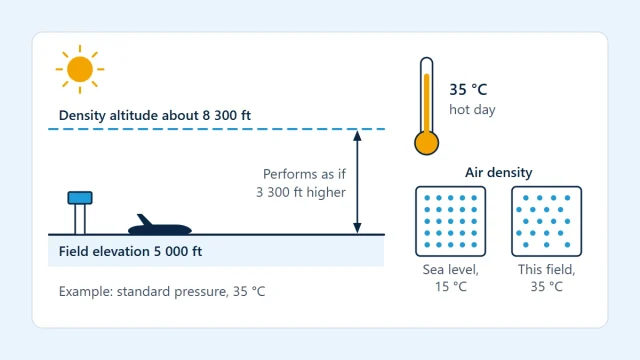
- Assuming a rate of climb seen near sea level will hold at a high, hot airfield.
- Measuring the height to gain from the wrong starting level, for example from sea level instead of from the airfield.
- Keeping the same target rate after the climb speed changes, when the rate required moves with ground speed.
References
- Federal Aviation Administration, Pilot's Handbook of Aeronautical Knowledge (FAA-H-8083-25).
- Federal Aviation Administration, Aeronautical Information Manual.
These public sources explain the formulas and definitions used here. Citing them does not mean they have reviewed, endorsed or certified AviationCalc.
Related calculators
Climb Gradient Calculator
Climb gradient in percent, feet per nautical mile and degrees from rate of climb and ground speed.
Aircraft Performance Concepts
Ground Speed Calculator
Find ground speed from true airspeed, course and wind using the wind triangle.
Flight Speed and Distance
Density Altitude Calculator
Density altitude from field elevation, altimeter setting and outside air temperature (dry air).
Atmosphere and Altitude
Thrust-to-Weight Ratio Calculator
Thrust divided by weight, with thrust and mass in the units you have.
Aircraft Performance Concepts
Guides that explain this calculation

Aircraft Performance Concepts
Understanding Rate of Climb
Rate of climb is height gained per minute, and it comes from excess power. See the formula, what reduces it, and why steady wind does not change it.
Aircraft Performance Concepts
Climb Gradient vs Climb Rate
Climb rate is height per minute; climb gradient is height per distance over the ground. Ground speed links them, so wind changes one and not the other.
Atmosphere and Altitude
What Is Density Altitude?
Density altitude is pressure altitude corrected for non-standard temperature. See the exact formula, the 120 ft per °C shortcut and a worked example.