Climb Gradient Calculator
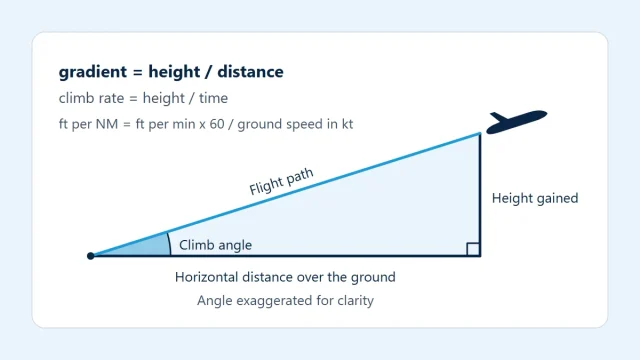
Rate of climb says how fast an aircraft gains height; climb gradient says how steeply it does so over the ground. This calculator turns a rate of climb and a ground speed into a gradient expressed three ways: as a percent, in feet per nautical mile and as an angle in degrees.
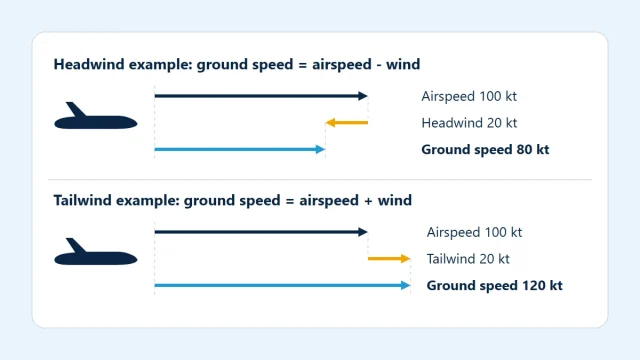
Gradient is the quantity that matters for terrain and obstacles ahead, because they sit at a fixed distance, not a fixed time, away. Two climbs at the same feet per minute can have very different gradients: the one that is slower over the ground is steeper. For the same reason a headwind steepens a climb and a tailwind flattens it.
How to use this calculator
- Enter Rate of climb in ft/min or m/s.
- Enter the Ground speed at which that rate is flown, choosing knots, km/h or mph.
- Read the gradient in its three forms.
A rate of climb for planning has to come from the aircraft's flight manual for the weight, configuration and density altitude in question; a rate you observed in flight describes only that day. For ground speed, start from the true airspeed in the climb and apply the wind along the departure path, which the headwind and tailwind calculator resolves. Both entries must be greater than zero, so descents are not handled.
Formula
gradient (ft/NM) = rate of climb (ft/min) × 60 ÷ ground speed (kt)
gradient (%) = gradient (ft/NM) ÷ 6 076.12 × 100
climb angle = atan( gradient (%) ÷ 100 )
What the variables mean
- rate of climb
- vertical speed in feet per minute
- ground speed
- speed over the ground in knots
- 6 076.12
- feet in one nautical mile
- climb angle
- angle of the flight path above the horizontal, relative to the ground
Worked example
These example values are illustrative round numbers, not data for any particular aircraft. Select "Fill in the example" in the calculator to load them.
Inputs
- Rate of climb: 700 ft/min
- Ground speed: 85 kt
Working
- Gradient = 700 ft/min × 60 ÷ 85.0 kt = 494.1 ft/NM.
- Percent = 494.1 ÷ 6 076.12 × 100 = 8.13%.
- Angle = atan(0.0813) = 4.65°.
Result
- Climb gradient: 8.13% (494 ft/NM)
- Climb angle: 4.65° (Relative to the ground)
- Height gained per 1 NM: 494 ft (151 m)
Reading the result
Climb gradient is given as a percent with ft/NM beside it. Climb angle is the angle of the path relative to the ground; it is not the pitch attitude shown on the attitude indicator, which also includes the angle of attack. Height gained per 1 NM repeats the ft/NM figure with meters. For illustration, 700 ft/min at a ground speed of 85 kt gives 8.13%, 494 ft/NM and 4.65°. To work the other way, from a gradient to the rate it demands, use the rate of climb calculator.
Assumptions and limitations
- The climb is steady, with rate of climb and ground speed both constant.
- The gradient is measured against the ground, so it includes the effect of whatever wind is in the ground speed.
- Percent gradient is vertical speed divided by horizontal ground speed, and the angle is the arctangent of that ratio.
- Turns, configuration changes and the fall in climb rate with altitude are not represented.
- The result is a slope only. It carries no information about obstacles or about any gradient a procedure calls for.
Common mistakes
- Entering airspeed where ground speed is asked for, which gives the gradient through the air mass and not over the ground.
- Taking the climb angle to be the pitch attitude to fly.
- Supposing that the speed for the best rate of climb also gives the steepest gradient.
- Comparing a result in percent with a published figure in ft/NM without converting one of them.
- Using a rate of climb from a cool, low airfield for a departure at high density altitude.
- Typing a rate in m/s while ft/min is selected.
References
- Federal Aviation Administration, Pilot's Handbook of Aeronautical Knowledge (FAA-H-8083-25).
- Federal Aviation Administration, Aeronautical Information Manual.
These public sources explain the formulas and definitions used here. Citing them does not mean they have reviewed, endorsed or certified AviationCalc.
Related calculators
Rate of Climb Calculator
The rate of climb that matches a climb gradient at a given ground speed.
Aircraft Performance Concepts
Ground Speed Calculator
Find ground speed from true airspeed, course and wind using the wind triangle.
Flight Speed and Distance
Headwind and Tailwind Calculator
Find the headwind or tailwind component of any wind along your track.
Wind Calculations
Density Altitude Calculator
Density altitude from field elevation, altimeter setting and outside air temperature (dry air).
Atmosphere and Altitude
Guides that explain this calculation
Aircraft Performance Concepts
Climb Gradient vs Climb Rate
Climb rate is height per minute; climb gradient is height per distance over the ground. Ground speed links them, so wind changes one and not the other.

Aircraft Performance Concepts
Understanding Rate of Climb
Rate of climb is height gained per minute, and it comes from excess power. See the formula, what reduces it, and why steady wind does not change it.
Wind Calculations
Understanding Headwinds and Tailwinds
How wind along the track changes ground speed and flight time, how to find the component with a cosine, and why wind never cancels on a round trip.