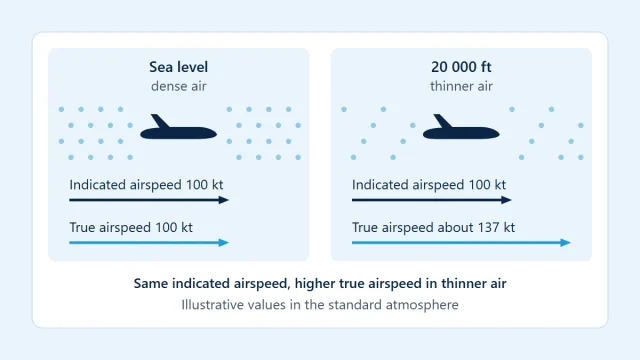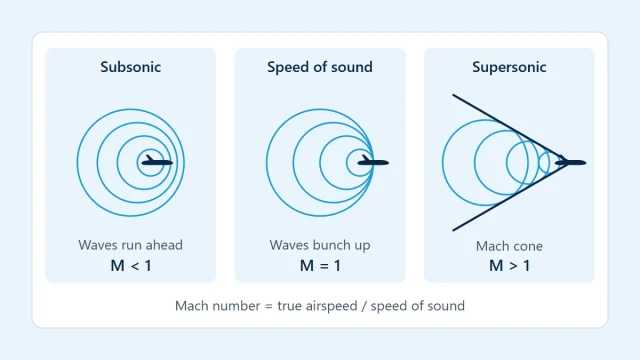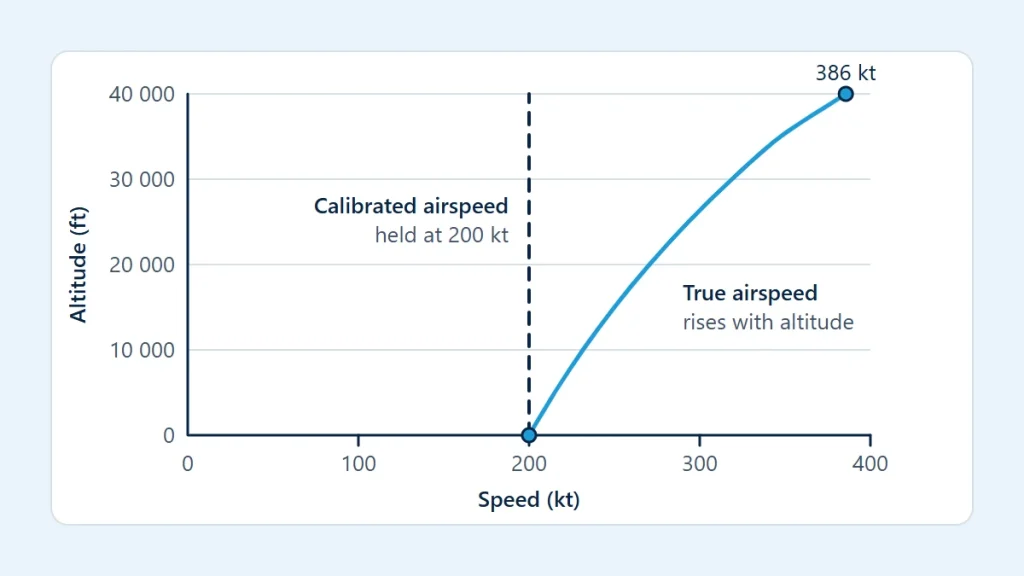
Hold the same number on the airspeed indicator through a long climb and the aircraft steadily speeds up. Its true airspeed rises, its Mach number rises faster still, and the only thing that stays put is the needle. Nothing is wrong with the instrument. The air is changing underneath it.
This page follows one fixed calibrated airspeed up through the standard atmosphere to show how the airspeeds and the Mach number drift apart. For what each airspeed is and how one is corrected into the next, see True Airspeed vs Indicated Airspeed.
Two things change as you climb
In the standard atmosphere, air density falls continuously with height. By 20,000 ft it is 53 percent of its sea-level value (a density ratio σ of 0.5328), and by 40,000 ft it is under 25 percent (σ = 0.2462).
Temperature falls as well, by 6.5 °C per kilometer (1.98 °C per 1,000 ft), until it reaches −56.5 °C at 11 km, which is 36,089 ft. Above that level the standard temperature stays constant for a considerable height. International Standard Atmosphere Explained describes the model, and the standard atmosphere calculator returns its values for any altitude.
Density controls the gap between calibrated and true airspeed. Temperature controls the speed of sound, and therefore the gap between true airspeed and Mach number. The two effects stack.
Why true airspeed rises at a fixed calibrated airspeed
The airspeed indicator responds to the pressure of the oncoming air, which at low speed is close to the dynamic pressure ½ × ρ × V². Holding a calibrated airspeed means holding that pressure. As the density ρ falls, the true speed V has to rise to keep the product the same. In its simplest form:
TAS = EAS ÷ √σ
EAS is the equivalent airspeed, which is calibrated airspeed with a small compressibility correction removed, and σ is the density ratio. Because of the square root, a density that has halved raises true airspeed by roughly 40 percent, not 100 percent.
One calibrated airspeed followed up through the atmosphere
The table holds a calibrated airspeed of 200 kt, an illustrative round figure that matches the diagram at the top of this page. Each row uses the standard temperature for that altitude from the standard atmosphere calculator, entered with the altitude into the true airspeed calculator.
| Pressure altitude | ISA temperature | Speed of sound | EAS | TAS | Mach number |
|---|---|---|---|---|---|
| Sea level | 15.00 °C | 661.5 kt | 200.0 kt | 200.0 kt | 0.302 |
| 5,000 ft | 5.09 °C | 650.0 kt | 199.6 kt | 215.0 kt | 0.331 |
| 10,000 ft | −4.81 °C | 638.3 kt | 199.0 kt | 231.6 kt | 0.363 |
| 20,000 ft | −24.62 °C | 614.3 kt | 197.5 kt | 270.5 kt | 0.440 |
| 30,000 ft | −44.44 °C | 589.3 kt | 195.1 kt | 318.9 kt | 0.541 |
| 40,000 ft | −56.50 °C | 573.6 kt | 191.3 kt | 385.6 kt | 0.672 |
Three patterns are visible:
- True airspeed nearly doubles. The same 200 kt on the instrument is 385.6 kt through the air at 40,000 ft. The increase also accelerates: the first 10,000 ft add 31.6 kt, the last 10,000 ft add 66.7 kt.
- Mach number more than doubles. It goes from 0.302 to 0.672, a larger proportional rise than the true airspeed, because the speed of sound is falling while the true airspeed climbs.
- Equivalent airspeed slips below calibrated airspeed. The compressibility correction is nothing at sea level, 1 kt at 10,000 ft and 8.7 kt at 40,000 ft. It grows with Mach number.
A common shortcut and how far off it is
A widely used approximation says that true airspeed exceeds calibrated airspeed by about 2 percent for every 1,000 ft of altitude. For 200 kt at 10,000 ft the shortcut gives a 20 percent increase, or 240 kt. The exact relationship used for the table gives 231.6 kt, so the shortcut is about 8 kt high in this case.
It is a rough mental check for low and moderate altitudes, nothing more. It ignores temperature completely and it does not follow the real curve, which the full pressure, Mach and temperature calculation does.
Temperature moves true airspeed but not Mach number
Real air is rarely at the standard temperature. Take the 20,000 ft row and make the air 20 °C warmer than standard, −4.62 °C instead of −24.62 °C. The true airspeed for 200 kt calibrated rises from 270.5 kt to 281.2 kt. The Mach number stays at 0.440.
The reason is in how the conversion works. Calibrated airspeed and pressure altitude together fix the ratio of impact pressure to static pressure, and that ratio fixes the Mach number with no reference to temperature. Temperature then sets the speed of sound, and true airspeed is the Mach number multiplied by it. Warmer air has a higher speed of sound, so the same Mach number is a higher true airspeed. Understanding Mach Number covers that relationship.
Climbing at a constant Mach number instead
Because Mach number keeps rising at a fixed calibrated airspeed, a fast aircraft climbing this way would eventually approach its Mach limit. High-altitude climbs are therefore typically flown at a constant calibrated airspeed lower down and at a constant Mach number higher up. The picture then reverses:
- At a constant Mach number, true airspeed falls during the climb as long as the air keeps getting colder, because true airspeed is Mach number times a decreasing speed of sound.
- Above 11 km in the standard atmosphere the temperature is constant, so the speed of sound stays at 573.6 kt and a constant Mach number means a constant true airspeed.
- Calibrated airspeed decreases throughout a constant-Mach climb, since the static pressure keeps falling.
The same link works in the other direction. For illustration, a true airspeed of 460 kt is Mach 0.781 at the standard temperature for 30,000 ft and Mach 0.802 at the standard temperature for 40,000 ft. The speed through the air is identical; the colder air makes it a larger fraction of the speed of sound. The Mach number calculator shows this for any true airspeed and temperature.
What these figures do not include
Every row in the table assumes the standard atmosphere, dry air and a calibrated airspeed that is already known. On an actual day the temperature at each level differs from standard, sometimes by a large margin, and the difference changes with altitude. The reading on the instrument must first be corrected to calibrated airspeed using the aircraft’s own calibration data, and the altitude must be pressure altitude rather than the altitude shown with a local altimeter setting.
The table also says nothing about what any aircraft can do. Whether a given airspeed or Mach number can be reached or held at an altitude, which climb speeds to use and what the limits are come from the aircraft flight manual (POH/AFM). Flight planning additionally requires current official weather information, including temperatures aloft, current charts and the applicable regulations.