Standard Atmosphere Calculator
The International Standard Atmosphere is an agreed model of how temperature, pressure and density change with height on an idealized average day. It starts from 15 °C and 1013.25 hPa at sea level, cools at a fixed rate up to 11 km and then holds a constant temperature. Nobody ever flies in exactly this atmosphere, but altimeters are calibrated to it and aircraft performance is published against it. This calculator returns the model's values for any altitude you enter.
Use it as a reference table that never needs interpolating: to see what standard conditions are at a given level, or to find the baseline a real temperature should be compared with.
How to use this calculator
- Enter Altitude as a number.
- Choose feet or meters with the unit selector.
- Read the temperature, pressure, density, speed of sound and the three ratios to sea level.
This calculator has a single input, so the only care needed is over what kind of altitude it is. The model is defined in geopotential altitude, which for practical purposes at these heights matches the pressure altitude an altimeter shows on the standard setting. The accepted range runs from −610 m to 20,000 m, about −2,000 ft to 65,617 ft. Above 11,000 m (36,089 ft) the calculation switches from the cooling layer to the constant-temperature layer.
Formula
below 11 km: T = 288.15 − 0.0065 × h and P = 101 325 × (T ÷ 288.15)^5.25588
11 to 20 km: T = 216.65 K and P = 22 632.06 × exp( −0.000157688 × (h − 11 000) )
ρ = P ÷ (R × T) and a = √(γ × R × T)
What the variables mean
- h
- geopotential altitude in meters
- T
- temperature in kelvin
- P
- pressure in pascals
- ρ
- density in kg/m³
- a
- speed of sound
- γ, R
- 1.4 and 287.05287 J/(kg·K) for dry air
Worked example
These example values are illustrative round numbers, not data for any particular aircraft. Select "Fill in the example" in the calculator to load them.
Inputs
- Altitude: 18000 ft
Working
- h = 5,486.4 m (18,000 ft), below the 11 km tropopause.
- T = 288.15 − 0.0065 × 5,486.4 = 252.49 K.
- P = 101 325 × (252.49 ÷ 288.15)^5.25588 = 50,600 Pa.
- ρ = 50,600 ÷ (287.05287 × 252.49) = 0.6981 kg/m³.
- a = √(1.4 × 287.05287 × 252.49) = 318.5 m/s.
Result
- Temperature: −20.66 °C (252.49 K · −5.2 °F)
- Pressure: 506.00 hPa (14.94 inHg)
- Density: 0.6981 kg/m³ (0.001355 slug/ft³)
- Speed of sound: 619.2 kt (318.5 m/s)
- Ratios to sea level: θ 0.8762 · δ 0.4994 · σ 0.5699 (Temperature, pressure and density ratios)
Reading the result
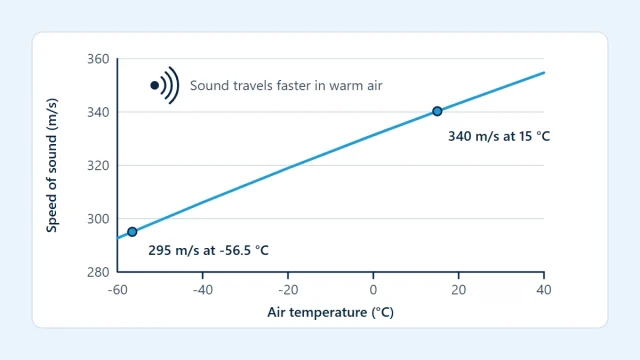
Temperature is shown in °C with kelvin and °F beside it; above 11 km it stays at −56.50 °C. Pressure is in hPa and inHg, and Density in kg/m³ and slug/ft³. Speed of sound follows temperature alone, so it also stops falling above 11 km. Ratios to sea level lists θ, δ and σ: temperature, pressure and density each divided by their sea-level standard values. A σ of 0.57, for instance, means the air has 57% of sea-level density. These ratios are the form in which the atmosphere usually enters performance equations.
Assumptions and limitations
- The values describe a model atmosphere; the real air on any day is warmer or colder and at a different pressure.
- The air is dry and behaves as an ideal gas with a gas constant of 287.05287 J/(kg·K).
- Temperature falls by exactly 6.5 K per km up to 11 km and is exactly 216.65 K from 11 km to 20 km.
- Altitude is geopotential altitude; the small difference from geometric height is not corrected.
- Only the first two layers of the standard atmosphere are modelled, so nothing above 20 km is available.
- Sea-level conditions are fixed at 288.15 K and 101,325 Pa, with no allowance for latitude or season.
Common mistakes
- Reading the ISA temperature at an altitude as a forecast of the actual outside air temperature.
- Extending the 2 °C per 1,000 ft cooling rate above the tropopause, where the standard temperature is constant.
- Assuming pressure falls in a straight line with height, when it roughly halves by about 18,000 ft and keeps falling by proportion.
- Entering a height above ground instead of an altitude above mean sea level.
- Mixing up the ratios, for example using the pressure ratio δ where the density ratio σ is required.
- Selecting meters and typing a figure in feet, which places the result in the wrong layer.
References
- NOAA, NASA and the U.S. Air Force, U.S. Standard Atmosphere, 1976.
- International Civil Aviation Organization, Manual of the ICAO Standard Atmosphere (Doc 7488).
- NASA Glenn Research Center, Earth Atmosphere Model.
These public sources explain the formulas and definitions used here. Citing them does not mean they have reviewed, endorsed or certified AviationCalc.
Related calculators
Air Density Calculator
Air density from pressure, temperature and optional relative humidity.
Atmosphere and Altitude
Speed of Sound Calculator
Speed of sound in air from temperature, in knots, m/s, km/h, mph and ft/s.
Atmosphere and Altitude
Pressure Altitude Calculator
Pressure altitude from elevation and the current altimeter setting.
Atmosphere and Altitude
Density Altitude Calculator
Density altitude from field elevation, altimeter setting and outside air temperature (dry air).
Atmosphere and Altitude
Guides that explain this calculation

Atmosphere and Altitude
International Standard Atmosphere Explained
The ISA model fixes sea-level values, a 6.5 °C per km lapse rate and an 11 km tropopause. See the equations, a reference table and what ISA deviation means.

Atmosphere and Altitude
Air Density and Aircraft Performance
Pressure, temperature and humidity set air density, and density sets how much lift, thrust and power an aircraft can produce. Here is how they connect.
Atmosphere and Altitude
Understanding the Speed of Sound
The speed of sound in air depends on temperature, not pressure or density. See the formula, a table of values and how it sets Mach number.