True Airspeed Calculator
An airspeed indicator measures the pressure of the air rammed into the pitot tube, not speed itself. In thin air the same pressure corresponds to a faster passage through the air, so the speed on the dial falls further behind the real one as altitude and temperature rise. This calculator converts calibrated airspeed to true airspeed using the compressible pitot relation, the standard-atmosphere pressure at your pressure altitude and the temperature you enter.
True airspeed is the speed that navigation is built on. It is the starting point for ground speed, wind correction and Mach number, and it explains why an aircraft cruising high covers ground faster than its indicator suggests.
How to use this calculator
- Enter Calibrated airspeed (CAS) and choose kt, km/h, mph or m/s.
- Enter Pressure altitude in feet or meters.
- Enter Outside air temperature in °C, °F or K.
- Read true airspeed, then the Mach number and equivalent airspeed below it.
Pressure altitude is the altitude shown with the altimeter set to 29.92 inHg (1013.25 hPa), not the altitude read on the local setting; the pressure altitude calculator converts one to the other. The temperature must be the static temperature of the surrounding air. At higher speeds a probe reads warmer than that because the air is compressed and heated against it. If you are starting from indicated airspeed, use the indicated airspeed conversion calculator, which applies your calibration correction first.
Formula
qc = P0 × [ (1 + 0.2 × (CAS ÷ a0)²)^3.5 − 1 ]
M = √( 5 × [ (qc ÷ P + 1)^(2/7) − 1 ] )
TAS = M × √(γ × R × T)
What the variables mean
- CAS
- calibrated airspeed
- qc
- impact pressure measured by the pitot-static system
- P0, a0
- sea-level standard pressure (101 325 Pa) and speed of sound (661.48 kt)
- P
- static pressure at the pressure altitude, from the standard atmosphere
- T
- outside air temperature in kelvin
- M
- Mach number
- γ, R
- 1.4 and 287.05287 J/(kg·K) for dry air
Worked example
These example values are illustrative round numbers, not data for any particular aircraft. Select "Fill in the example" in the calculator to load them.
Inputs
- Calibrated airspeed (CAS): 150 kt
- Pressure altitude: 10000 ft
- Outside air temperature: −5 °C
Working
- Static pressure at 10,000 ft pressure altitude (standard atmosphere): P = 696.82 hPa.
- Impact pressure from CAS: qc = 101 325 × [(1 + 0.2 × (150.0 ÷ 661.48)²)^3.5 − 1] = 3,694.4 Pa.
- M = √(5 × [(3,694.4 ÷ 69,682 + 1)^(2/7) − 1]) = 0.2727.
- Speed of sound at 268.15 K: a = 38.9678 × √268.15 = 638.1 kt.
- TAS = M × a = 0.2727 × 638.1 = 174.0 kt.
Result
- True airspeed: 174.0 kt (322.2 km/h)
- Mach number: 0.273
- Equivalent airspeed: 149.6 kt
- Temperature compared with ISA: −0.2 °C (ISA at this pressure altitude: −4.8 °C)
Reading the result
True airspeed appears in the unit you entered CAS in, with knots or km/h beside it. Mach number is that speed as a fraction of the local speed of sound. Equivalent airspeed is CAS with the compressibility effect removed; at low speed and altitude it sits within a fraction of a knot of CAS, and the gap widens as either grows. Temperature compared with ISA shows how many degrees warmer (+) or colder (−) the air is than the standard atmosphere at that pressure altitude, with the standard value printed beside it. Warmer than standard means a higher true airspeed for the same CAS.
Assumptions and limitations
- The subsonic pitot relation is used; inputs that produce Mach 1 or more are rejected because the formula no longer applies.
- Static pressure is taken from the standard atmosphere at the pressure altitude you enter, which is exactly what pressure altitude means.
- The air is treated as dry, with a ratio of specific heats of 1.4 and a gas constant of 287.05287 J/(kg·K).
- The input is assumed to be calibrated airspeed already, so no instrument or position error is removed.
- The temperature is assumed to be the true static air temperature, with no allowance for probe heating.
- Pressure altitude is accepted from −2,000 ft to 65,000 ft and temperature from −100 °C to 60 °C.
Common mistakes
- Entering indicated altitude on the local altimeter setting in place of pressure altitude.
- Using the temperature reported at the airport for a calculation at cruise altitude.
- Treating indicated airspeed as calibrated airspeed in a speed range or configuration where the aircraft's correction is several knots.
- Applying the rule of thumb of about 2% per 1,000 ft at high altitudes or speeds, where it drifts well away from the exact result.
- Entering a total air temperature reading from a fast aircraft as if it were the outside air temperature.
- Comparing true airspeed with speeds in an aircraft's documentation that are defined as indicated or calibrated values.
References
- Federal Aviation Administration, Pilot's Handbook of Aeronautical Knowledge (FAA-H-8083-25).
- NASA Glenn Research Center, Role of the Mach Number.
- NOAA, NASA and the U.S. Air Force, U.S. Standard Atmosphere, 1976.
These public sources explain the formulas and definitions used here. Citing them does not mean they have reviewed, endorsed or certified AviationCalc.
Related calculators
Indicated Airspeed Conversion Calculator
Step from indicated airspeed to calibrated, equivalent and true airspeed with your own position-error correction.
Flight Speed and Distance
Mach Number Calculator
Divide true airspeed by the local speed of sound to get Mach number.
Flight Speed and Distance
Ground Speed Calculator
Find ground speed from true airspeed, course and wind using the wind triangle.
Flight Speed and Distance
Pressure Altitude Calculator
Pressure altitude from elevation and the current altimeter setting.
Atmosphere and Altitude
Guides that explain this calculation
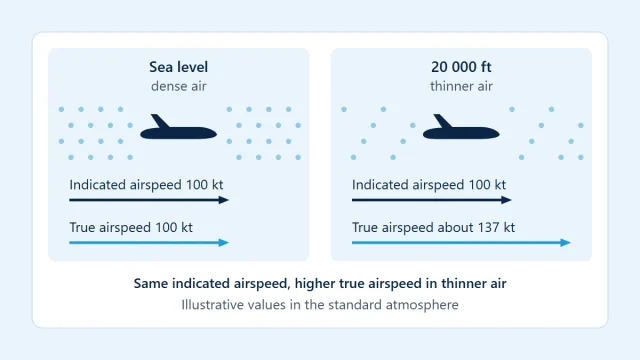
Flight Speed and Distance
True Airspeed vs Indicated Airspeed
Indicated, calibrated, equivalent and true airspeed are links in one chain of corrections. Learn what each one means and how one becomes the next.
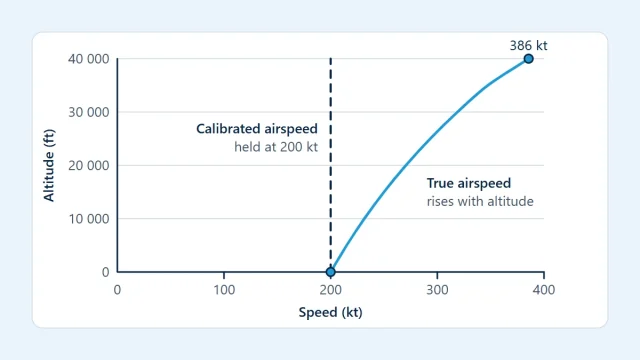
Flight Speed and Distance
How Airspeed Changes With Altitude
Hold one calibrated airspeed in a climb and true airspeed and Mach number both rise. A table for 200 kt in the standard atmosphere shows by how much.

Atmosphere and Altitude
Understanding Pressure Altitude
Pressure altitude is altitude measured from the 1013.25 hPa (29.92 inHg) standard datum. Learn how to read it, calculate it and where it is used.