Mach Number Calculator
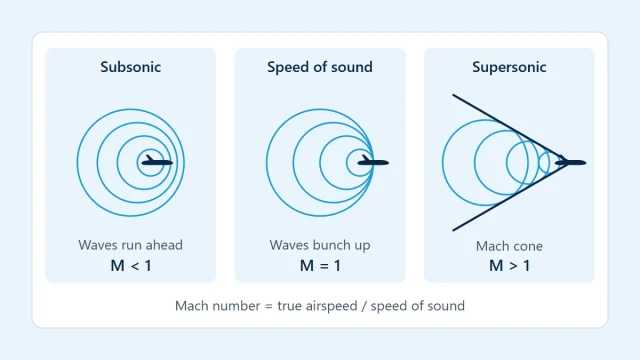
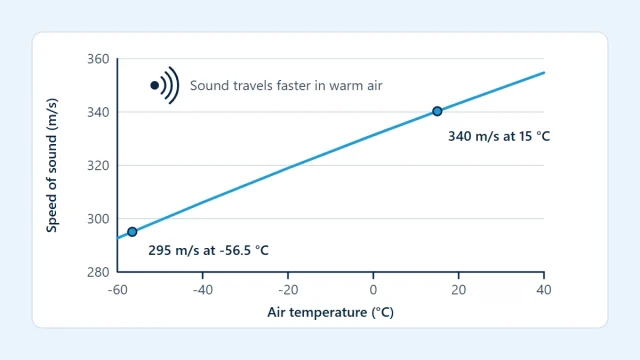
Mach number is a ratio: true airspeed divided by the speed of sound in the air the aircraft is flying through. Because the speed of sound depends on temperature alone, the same true airspeed is a higher Mach number in the cold air of the upper atmosphere than near a warm surface. This calculator computes the local speed of sound from the temperature you enter and divides your true airspeed by it.
The ratio is what governs how air behaves around a wing or fuselage. Compressibility effects, shock waves and the associated changes in drag and handling track Mach number rather than knots, which is why fast aircraft are flown by Mach at altitude.
How to use this calculator
- Type the True airspeed and set its unit to kt, km/h, mph or m/s.
- Type the Outside air temperature at the flight level and set its unit to °C, °F or K.
- Read the Mach number, the local speed of sound and the speed regime.
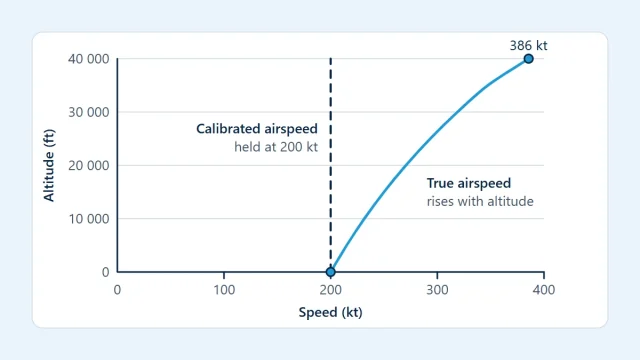
Two details matter. The speed must be true airspeed, not indicated or calibrated; the true airspeed calculator makes that conversion. The temperature must be the static temperature of the air at flight level, in the range −100 °C to 60 °C. If you do not have a measured value, the standard atmosphere calculator gives the standard temperature for an altitude, which is a reasonable stand-in for study purposes but not the temperature of any actual day.
Formula
a = √(γ × R × T)
M = TAS ÷ a
What the variables mean
- M
- Mach number (no units)
- TAS
- true airspeed
- a
- local speed of sound
- T
- outside air temperature in kelvin
- γ, R
- 1.4 and 287.05287 J/(kg·K) for dry air
Worked example
These example values are illustrative round numbers, not data for any particular aircraft. Select "Fill in the example" in the calculator to load them.
Inputs
- True airspeed: 450 kt
- Outside air temperature: −50 °C
Working
- T = 223.15 K.
- a = √(1.4 × 287.05287 × 223.15) = 299.5 m/s = 582.1 kt.
- M = TAS ÷ a = 450.0 ÷ 582.1 = 0.773.
Result
- Mach number: 0.773
- Local speed of sound: 582.1 kt (299.5 m/s)
- Speed regime: Subsonic (Conventional bands: below 0.8, 0.8 to 1.2, 1.2 to 5, above 5)
Reading the result
Mach number is given to three decimal places and has no unit; 0.773 means 77.3% of the speed of sound. Local speed of sound is shown in knots with m/s beside it, and is the figure your true airspeed was divided by. Speed regime places the result in one of four conventional bands: subsonic below 0.8, transonic from 0.8 to 1.2, supersonic from 1.2 to 5 and hypersonic above 5. The band edges are textbook conventions for describing airflow, not properties of any particular aircraft, and say nothing about what a given design can do.
Assumptions and limitations
- Air is treated as an ideal gas with a constant ratio of specific heats of 1.4 and the dry-air gas constant.
- Humidity is ignored; moist air has a very slightly higher speed of sound.
- The temperature entered is assumed to be the static temperature of the undisturbed air, not a reading warmed by compression at a probe.
- The result is the flight Mach number of the aircraft as a whole; local airflow over parts of the airframe can be faster.
- The regime boundaries are fixed conventional values and are not adjusted for aircraft shape.
- At very high Mach numbers real-gas effects change the ratio of specific heats, which this simple formula does not capture.
Common mistakes
- Dividing indicated airspeed by the speed of sound instead of true airspeed.
- Using the sea-level standard speed of sound of about 661 kt for a calculation at cruise altitude.
- Assuming altitude itself changes the speed of sound, when only temperature does.
- Forgetting to convert temperature to kelvin when working the formula by hand.
- Reading the transonic band as beginning exactly where shock waves first form on every aircraft.
References
- NASA Glenn Research Center, Role of the Mach Number.
- NASA Glenn Research Center, Speed of Sound Interactive.
- Federal Aviation Administration, Pilot's Handbook of Aeronautical Knowledge (FAA-H-8083-25).
These public sources explain the formulas and definitions used here. Citing them does not mean they have reviewed, endorsed or certified AviationCalc.
Related calculators
Speed of Sound Calculator
Speed of sound in air from temperature, in knots, m/s, km/h, mph and ft/s.
Atmosphere and Altitude
True Airspeed Calculator
Convert calibrated airspeed to true airspeed from pressure altitude and outside air temperature.
Flight Speed and Distance
Standard Atmosphere Calculator
ISA temperature, pressure, density and speed of sound at any altitude up to 20 km.
Atmosphere and Altitude
Indicated Airspeed Conversion Calculator
Step from indicated airspeed to calibrated, equivalent and true airspeed with your own position-error correction.
Flight Speed and Distance
Guides that explain this calculation
Flight Speed and Distance
Understanding Mach Number
Mach number is true airspeed divided by the local speed of sound. See why temperature alone sets that speed and how one airspeed gives two Mach numbers.
Atmosphere and Altitude
Understanding the Speed of Sound
The speed of sound in air depends on temperature, not pressure or density. See the formula, a table of values and how it sets Mach number.
Flight Speed and Distance
How Airspeed Changes With Altitude
Hold one calibrated airspeed in a climb and true airspeed and Mach number both rise. A table for 200 kt in the standard atmosphere shows by how much.