The airspeed indicator does not measure speed. It measures a pressure and displays that pressure as a speed, using a scale that is only exact in one set of conditions: standard air at sea level. Everywhere else, the number on the dial and the speed of the aircraft through the air are two different things.
Indicated airspeed and true airspeed are the two ends of a short chain of corrections. Each link has its own name, and each answers a different question.
What the airspeed indicator senses
A pitot tube faces the airflow and captures total pressure. Static ports sense the pressure of the undisturbed air around the aircraft. The instrument responds to the difference between them, called impact pressure. At low speeds impact pressure is very close to the dynamic pressure:
q = ½ × ρ × V²
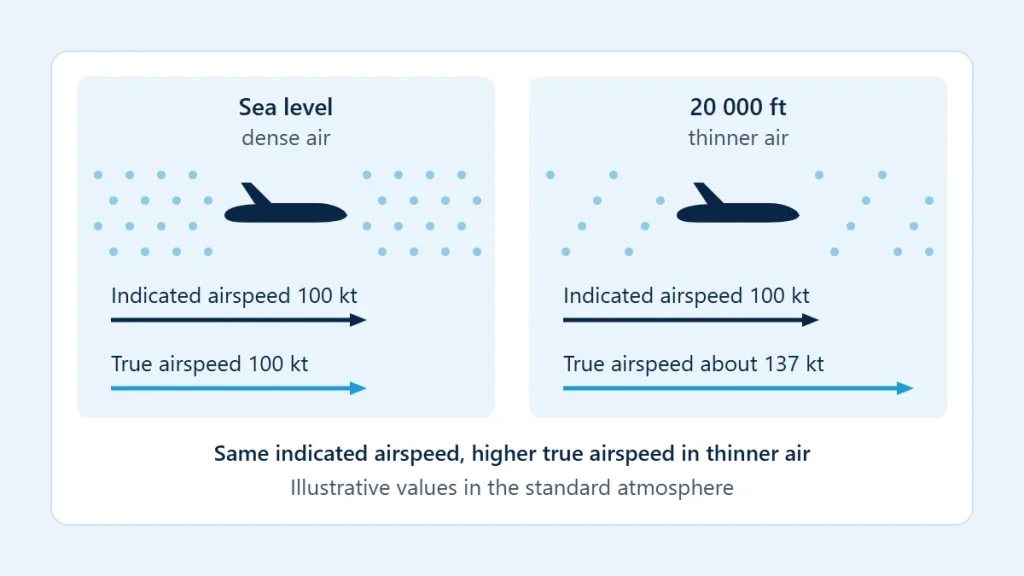
where ρ is the air density and V is the true airspeed. The instrument has no way to sense ρ, so its scale is built on the assumption that density is the sea-level standard value, 1.225 kg/m³. When the real air is thinner, the same true speed produces less pressure and the needle reads low. This is the effect shown in the diagram at the top of this page.
The four airspeeds
| Name | What it is | Correction applied to reach it |
|---|---|---|
| Indicated airspeed (IAS) | The reading on the airspeed indicator | None |
| Calibrated airspeed (CAS) | IAS with the errors of the instrument and its installation removed | Instrument and position error, from the aircraft’s own data |
| Equivalent airspeed (EAS) | CAS with the effect of air compressibility removed | Compressibility, which depends on speed and pressure altitude |
| True airspeed (TAS) | The actual speed of the aircraft relative to the air | Air density, which depends on pressure altitude and temperature |
Indicated to calibrated
The static ports and pitot tube sit in airflow that the aircraft itself disturbs, and the disturbance changes with speed, flap setting and attitude. The resulting position error, together with any error in the instrument, is published for each aircraft type as a calibration table or chart. There is no general formula for it. The correction is usually a few knots and tends to be largest at low speed.
Calibrated to equivalent
Air compresses as it is brought to rest in the pitot tube, which raises the measured pressure slightly above ½ρV². The instrument scale allows for this at sea level, but not for the different amount of compression at altitude. Equivalent airspeed removes that leftover. At light-aircraft speeds and altitudes the difference is a fraction of a knot; it becomes several knots for fast aircraft at high altitude.
Equivalent to true
The last step removes the sea-level density assumption:
TAS = EAS ÷ √σ
where σ is the density ratio, the actual air density divided by 1.225 kg/m³. Because σ falls as you climb and falls further when the air is warmer than standard, true airspeed is higher than equivalent airspeed everywhere except in dense, sea-level air.
How the calculators make the conversion
The true airspeed calculator takes calibrated airspeed, pressure altitude and outside air temperature and uses the subsonic compressible-flow relations, so the compressibility and density steps are handled together rather than approximated:
- Impact pressure from CAS, using sea-level standard pressure and speed of sound.
- Mach number from that impact pressure and the static pressure at the pressure altitude.
- TAS = Mach number × the local speed of sound, which depends on the outside air temperature.
The indicated airspeed conversion calculator adds the first link of the chain. It accepts an optional calibration correction, which you must take from your aircraft’s data, and then reports CAS, EAS, TAS and Mach number together. If no correction is entered it treats CAS as equal to IAS and says so.
An example through the whole chain
Suppose, purely for illustration, an indicated airspeed of 100 kt at a pressure altitude of 20,000 ft, an outside air temperature of −24.6 °C (the standard temperature for that altitude) and a calibration correction of −2 kt. The correction is an invented round number, not a value for any aircraft.
- CAS = 100 + (−2) = 98.0 kt
- EAS = 97.7 kt
- TAS = 133.8 kt
- Mach number = 0.218
The compressibility step moved the number by 0.3 kt. The density step moved it by 36 kt. With no calibration correction at all, the same 100 kt reading gives 99.7 kt EAS and 136.6 kt TAS, the “about 137 kt” in the diagram.
Temperature has its own effect. For a calibrated airspeed of 120 kt at 8,000 ft pressure altitude, the true airspeed is 135.2 kt at the standard temperature of −0.8 °C and 137.8 kt at 10 °C. Warmer air is less dense, so the same pressure on the instrument corresponds to a higher true speed.
Which speed is used for what
- Indicated and calibrated airspeed describe the air loads on the aircraft. Lift and drag depend on dynamic pressure, so the wing behaves the same way at a given calibrated airspeed whether the air is thick or thin. That is why the operating speeds in an aircraft flight manual are given as indicated or calibrated values.
- True airspeed describes motion. It is the speed that combines with wind to give ground speed, so it is the starting point for navigation, time and fuel planning. See Understanding Ground Speed in Aviation.
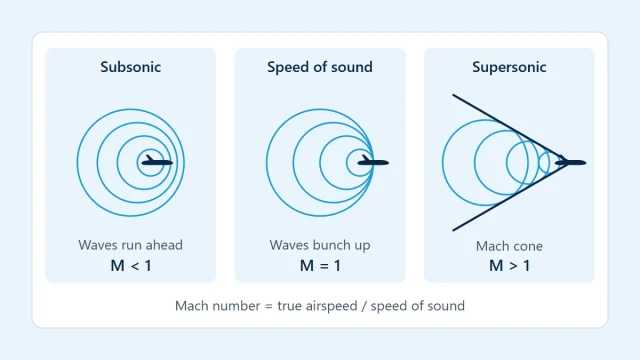
- Mach number is true airspeed compared with the local speed of sound, covered in Understanding Mach Number.
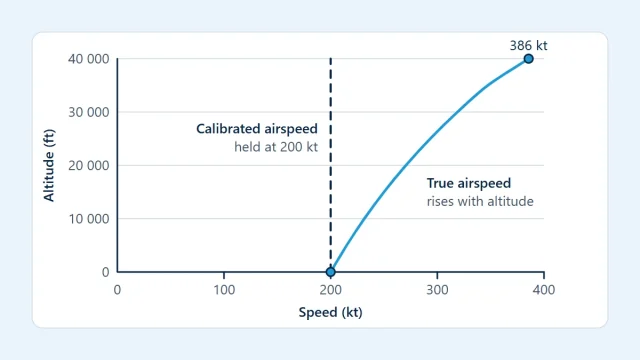
How the gap between these speeds widens during a climb is the subject of How Airspeed Changes With Altitude.
Limits of the conversion
The result is only as good as its inputs. The calibration correction is specific to an aircraft, its configuration and its speed, and must come from that aircraft’s documentation. The temperature must be the static air temperature; a probe on a fast aircraft reads warmer than the surrounding air because of the same compression that affects the pitot tube. The altitude must be pressure altitude, read with the altimeter set to 29.92 inHg (1013.25 hPa), not the altitude shown with a local setting.
The formulas also assume dry air and subsonic flight. None of this replaces the airspeed information, limitations and performance data in the aircraft flight manual (POH/AFM), and real flight planning also needs current official weather information, charts and the applicable regulations.