Mach number is a ratio, not a speed. It compares how fast an aircraft is moving through the air with how fast sound travels through that same air. Mach 0.8 means 80 percent of the local speed of sound, whatever that speed happens to be at the moment.
Because the speed of sound changes with air temperature, the same Mach number corresponds to different true airspeeds on different days and at different altitudes. That is the idea most often misunderstood, and the one this page concentrates on.
The definition
M = TAS ÷ a
M is the Mach number, TAS is the true airspeed and a is the speed of sound in the air the aircraft is flying through. Both speeds must be in the same unit, and the ratio itself has no unit.
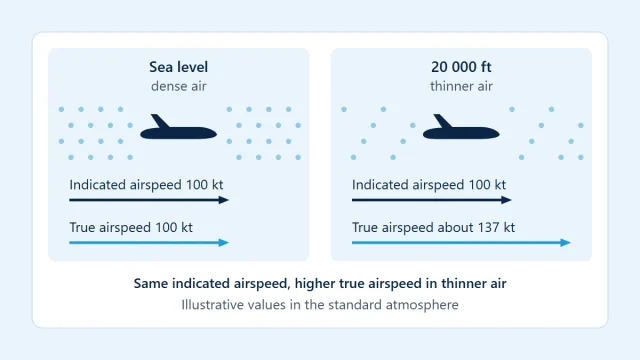
The speed in the formula is true airspeed. It is not indicated airspeed, which is a pressure reading, and it is not ground speed, which includes the wind. An aircraft in a strong tailwind has a high ground speed but its Mach number is unchanged, because the air it flies through is moving with it. True Airspeed vs Indicated Airspeed explains how the airspeeds differ.
The speed of sound depends on temperature
For air treated as an ideal gas, the speed of sound is:
a = √(γ × R × T)
γ is the ratio of specific heats (1.4 for air), R is the gas constant for dry air (287.05287 J/(kg K)) and T is the absolute temperature in kelvin. With those constants the formula reduces to a convenient form in knots:
a = 38.9678 × √T
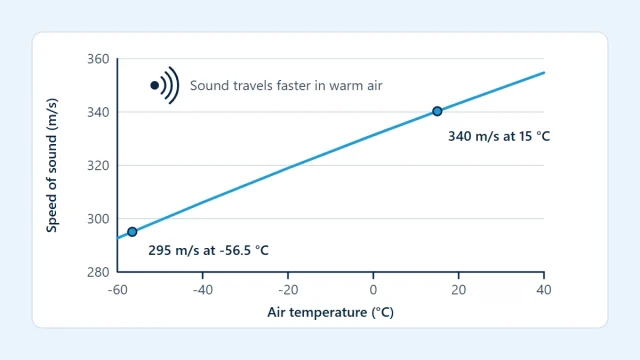
Pressure and density do not appear. Sound travels more slowly at altitude because the air there is colder, not because it is thinner. At the same temperature, the speed of sound at 30,000 ft would equal the speed of sound at sea level.
In the standard atmosphere the temperature falls from 15 °C at sea level to −56.5 °C at 11 km and then stays constant for some distance above. The speed of sound follows it, from 661.5 kt down to 573.6 kt, which is 86.7 percent of the sea-level value. The speed of sound calculator gives the figure for any temperature, and Understanding the Speed of Sound goes further into the physics.
One airspeed, two Mach numbers
For illustration, take a true airspeed of 450 kt and evaluate it in two air masses. The numbers are examples, not figures for any aircraft.
| Air temperature | Speed of sound | Mach number at 450 kt TAS |
|---|---|---|
| 15 °C (288.15 K) | 661.5 kt | 0.680 |
| −56.5 °C (216.65 K) | 573.6 kt | 0.785 |
The steps for the colder case are:
- Convert the temperature to kelvin: −56.5 + 273.15 = 216.65 K.
- Speed of sound: a = √(1.4 × 287.05287 × 216.65) = 295.1 m/s, which is 573.6 kt.
- Mach number: M = 450 ÷ 573.6 = 0.785.
The aircraft has not changed speed, yet its Mach number is about 15 percent higher in the cold air. Raise the true airspeed to 480 kt in the same cold air and the result is Mach 0.837. The Mach number calculator takes exactly these two inputs, true airspeed and outside air temperature, and returns the Mach number, the local speed of sound and the speed regime.
Speed regimes
Airflow behaves differently depending on the Mach number, and flight is conventionally divided into bands. The boundaries are conventions rather than sharp physical lines, and these are the ones the calculator uses:
| Regime | Mach number | Character of the flow |
|---|---|---|
| Subsonic | Below 0.8 | Flow over the whole aircraft is slower than sound |
| Transonic | 0.8 to 1.2 | Subsonic and supersonic flow exist together on the aircraft |
| Supersonic | 1.2 to 5 | Flow is faster than sound almost everywhere |
| Hypersonic | Above 5 | Heating and chemical effects in the air become important |
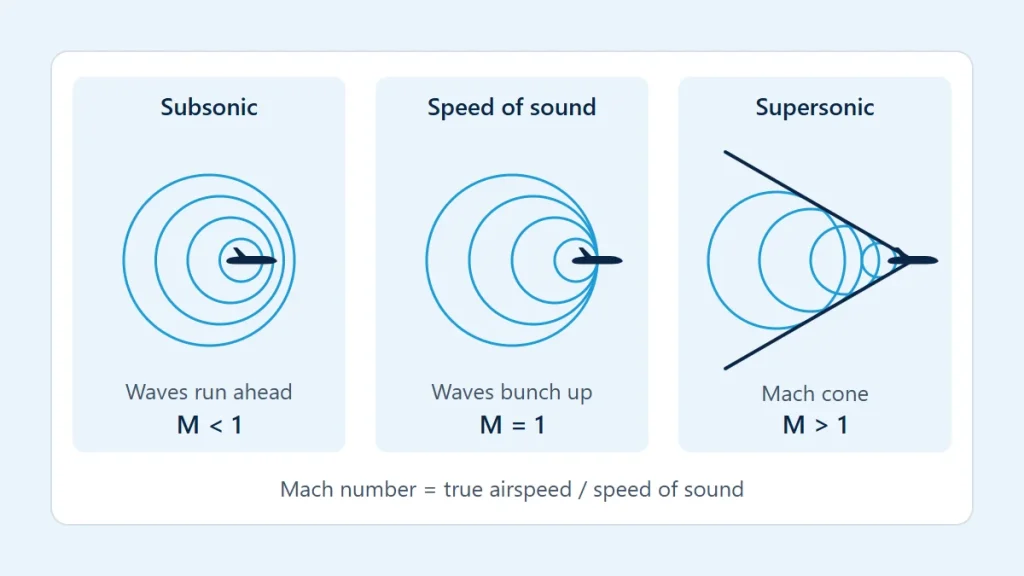
The diagram at the top of this page shows why Mach 1 is special. An aircraft continuously disturbs the air, and each disturbance spreads outward at the speed of sound. Below Mach 1 the disturbances travel ahead of the aircraft, so the air ahead begins to move aside before the aircraft arrives. At Mach 1 the aircraft keeps pace with its own disturbances and they pile up at the nose. Above Mach 1 it outruns them, and they are confined to a cone trailing behind. The half-angle μ of that cone follows sin μ = 1 ÷ M, so at Mach 2 it is 30°.
Why Mach matters below the speed of sound
Air speeds up as it passes over the curved upper surface of a wing. The local flow there is faster than the aircraft itself, so it can reach the speed of sound while the aircraft is still well below Mach 1. The flight Mach number at which this first happens is called the critical Mach number, and it is different for every design.
Beyond it, shock waves form on the wing, drag rises steeply and the handling of the aircraft can change. For this reason the limiting speed of a fast aircraft at high altitude is expressed as a Mach number rather than as an airspeed. The aerodynamic problem is tied to the ratio, and the ratio is what the Mach number tracks as the temperature changes.
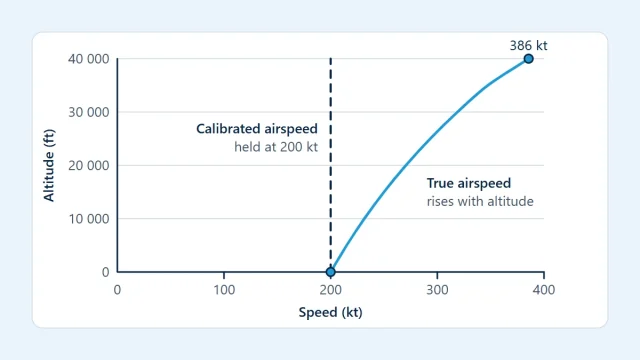
At light-aircraft speeds none of this arises. A true airspeed of 120 kt in sea-level standard air is Mach 0.181, and the air behaves as if it were incompressible. How Mach number, true airspeed and calibrated airspeed drift apart during a climb is covered in How Airspeed Changes With Altitude.
Limits of the simple calculation
The formula treats air as a dry ideal gas with a constant γ of 1.4. Humidity changes the speed of sound only slightly, and γ itself drifts at the very high temperatures met in hypersonic flight, which this model does not cover.
The temperature must be the static temperature of the undisturbed air. A probe on a fast aircraft reads higher than that, because the air is compressed and warmed as it is brought to rest against the probe, and using the uncorrected reading would understate the Mach number. In an actual aircraft, Mach number is not computed from temperature at all: it is derived from the ratio of the pressures sensed by the pitot-static system.
The regime bands say nothing about what any particular aircraft may do. Mach limits and the procedures that go with them come from the aircraft flight manual (POH/AFM), and flight operations also depend on current official weather information, charts and the applicable regulations.