Indicated Airspeed Conversion Calculator
Four airspeeds describe the same moment of flight. Indicated airspeed is the raw reading on the instrument. Calibrated airspeed removes the errors of the instrument and of where the pitot and static ports sit on the airframe. Equivalent airspeed removes the effect of air being compressed in the pitot tube. True airspeed finally accounts for air density. This calculator walks down that chain in one pass and shows every stage.
Seeing the stages side by side makes it clear where each difference comes from: the first step depends on the individual aircraft, the second on speed and altitude, and the third on how thin the air is.
How to use this calculator
- Enter Indicated airspeed (IAS) in kt, km/h or mph.
- Enter Calibration correction (from your aircraft data), or leave it blank to treat CAS as equal to IAS.
- Give the Pressure altitude at which the reading was taken, in feet or meters.
- Add the Outside air temperature at that level and select °C, °F or K.
The correction is the one input this page cannot supply. It comes from the airspeed calibration table or chart in the aircraft's own flight manual and changes with speed and flap setting, so look it up for the condition you are working on. The sign convention is: positive when CAS is higher than IAS, negative when it is lower. The field accepts values from −50 kt to 50 kt and has its own unit selector, which may differ from the IAS unit.
Formula
CAS = IAS + correction
M = √( 5 × [ (qc ÷ P + 1)^(2/7) − 1 ] ), with qc = P0 × [ (1 + 0.2 × (CAS ÷ a0)²)^3.5 − 1 ]
EAS = a0 × M × √(P ÷ P0)
TAS = M × √(γ × R × T)
What the variables mean
- IAS
- indicated airspeed read from the instrument
- correction
- the position and instrument error correction for that speed and configuration, taken from the aircraft's own airspeed calibration data; enter 0 if you have none
- CAS
- calibrated airspeed
- EAS
- equivalent airspeed, CAS corrected for compressibility
- TAS
- true airspeed
- P, T
- static pressure at the pressure altitude and outside air temperature in kelvin
Worked example
These example values are illustrative round numbers, not data for any particular aircraft. Select "Fill in the example" in the calculator to load them.
Inputs
- Indicated airspeed (IAS): 110 kt
- Calibration correction (from your aircraft data): 2 kt
- Pressure altitude: 6000 ft
- Outside air temperature: 10 °C
Working
- CAS = IAS + correction = 110.0 + (2.0) = 112.0 kt.
- Static pressure at 6,000 ft pressure altitude: P = 812.00 hPa.
- Mach number from CAS and P (subsonic pitot relation): M = 0.1890.
- EAS = 661.48 × M × √(P ÷ P0) = 661.48 × 0.1890 × √(0.8014) = 111.9 kt.
- TAS = M × a = 0.1890 × 655.7 = 123.9 kt.
Result
- Calibrated airspeed (CAS): 112.0 kt
- Equivalent airspeed (EAS): 111.9 kt
- True airspeed (TAS): 123.9 kt (229.5 km/h)
- Mach number: 0.189
Reading the result
All three speeds are shown in the unit you chose for IAS. Calibrated airspeed (CAS) is simply IAS plus your correction. Equivalent airspeed (EAS) will be slightly below CAS; the gap is tiny at light-aircraft speeds and altitudes and becomes significant only when both are high. True airspeed (TAS) is normally the largest of the four above sea level and has knots or km/h beside it. Mach number is TAS divided by the local speed of sound. A note under the results says whether a correction was applied or CAS was taken as equal to IAS.
Assumptions and limitations
- The calibration correction is a single number you supply; the calculator has no aircraft data and cannot check it.
- A blank correction is treated as zero, which is a simplification and not a statement about any real aircraft.
- The conversion from CAS onward uses the subsonic compressible pitot relation with standard-atmosphere static pressure at the pressure altitude entered.
- Dry air is assumed, and the temperature entered is taken as the static temperature of the outside air.
- Instrument lag, a blocked pitot or static port, and errors that vary with sideslip or angle of attack are not modelled.
- Inputs that would give a calibrated airspeed of zero or less, or Mach 1 or more, are rejected.
Common mistakes
- Reversing the sign of the correction, subtracting it when the calibration data says to add it.
- Reading the correction for one flap setting and applying it to another.
- Leaving the correction blank and then quoting the CAS row as if it were a calibrated value.
- Assuming EAS and CAS are always interchangeable, which stops being true at high speed and altitude.
- Entering field elevation as pressure altitude when the altimeter setting is well away from standard.
- Expecting TAS to equal IAS at altitude because the reading on the instrument has not changed.
References
- Federal Aviation Administration, Pilot's Handbook of Aeronautical Knowledge (FAA-H-8083-25).
- NASA Glenn Research Center, Role of the Mach Number.
These public sources explain the formulas and definitions used here. Citing them does not mean they have reviewed, endorsed or certified AviationCalc.
Related calculators
True Airspeed Calculator
Convert calibrated airspeed to true airspeed from pressure altitude and outside air temperature.
Flight Speed and Distance
Mach Number Calculator
Divide true airspeed by the local speed of sound to get Mach number.
Flight Speed and Distance
Density Altitude Calculator
Density altitude from field elevation, altimeter setting and outside air temperature (dry air).
Atmosphere and Altitude
Ground Speed Calculator
Find ground speed from true airspeed, course and wind using the wind triangle.
Flight Speed and Distance
Guides that explain this calculation
Flight Speed and Distance
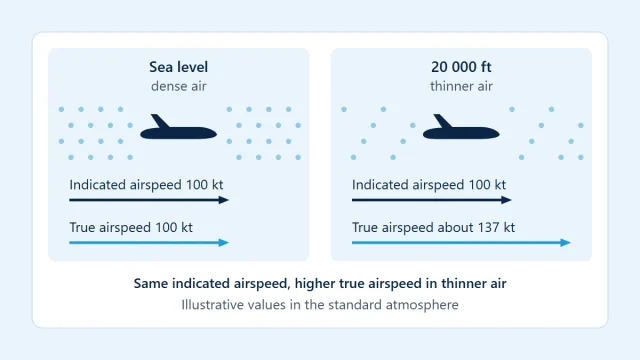
True Airspeed vs Indicated Airspeed
Indicated, calibrated, equivalent and true airspeed are links in one chain of corrections. Learn what each one means and how one becomes the next.
Flight Speed and Distance
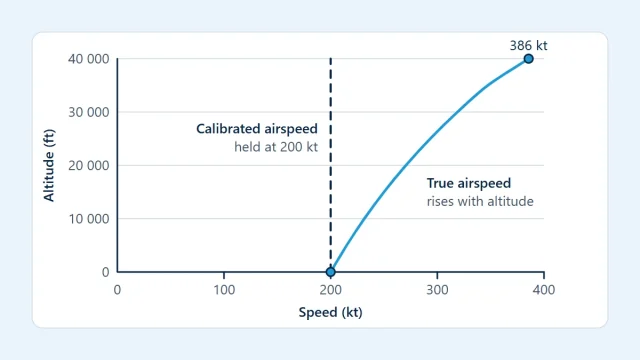
How Airspeed Changes With Altitude
Hold one calibrated airspeed in a climb and true airspeed and Mach number both rise. A table for 200 kt in the standard atmosphere shows by how much.
Aviation Navigation
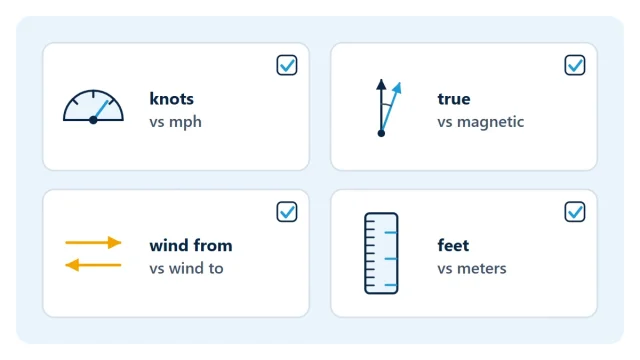
Common Aviation Calculation Mistakes
Unit mix-ups, true versus magnetic, wind from versus to, and airspeed used as ground speed: the common errors, with the size of each shown.