Density Altitude Calculator
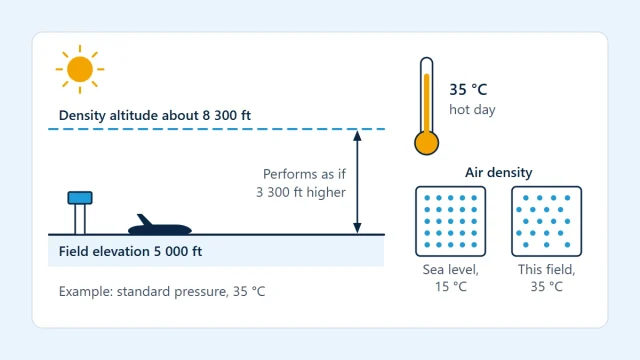
Density altitude answers a single question: at what altitude in the standard atmosphere would the air be as thin as it is here, now? Wings, propellers and engines respond to the density of the air, not to the number painted on the airport sign, so a field at a modest elevation can behave like a much higher one on a hot afternoon. This calculator finds the pressure altitude from the elevation and altimeter setting, computes the density of dry air at the temperature you enter, and converts that density back to an altitude.
It is the number that links weather to performance charts, and the reason the same aircraft feels different in summer and winter.
How to use this calculator
- Enter Field elevation in feet or meters.
- Enter Altimeter setting and choose inHg or hPa.
- Enter Outside air temperature in °C or °F.
- Read the density altitude and the supporting rows beneath it.
The altimeter setting is the value reported for the airfield (QNH), not the actual pressure measured at the station; the accepted range is 850 to 1100 hPa, about 25.10 to 32.48 inHg. Make sure the unit selector matches the number, since 29.92 and 1013 are the same setting in different units. The temperature should be the current air temperature at the field, measured in the shade. If you already know the pressure altitude, enter it as the elevation with a setting of 1013.25 hPa.
Formula
PA = elevation + 145 442.16 × [ 1 − (setting ÷ 1013.25)^0.190263 ]
ρ = P ÷ (R × T)
DA = 145 442.16 × [ 1 − (ρ ÷ ρ0)^0.234969 ]
What the variables mean
- PA
- pressure altitude in feet
- setting
- altimeter setting (QNH) in hPa
- P
- standard-atmosphere pressure at the pressure altitude
- T
- outside air temperature in kelvin
- ρ, ρ0
- air density and the sea-level standard value, 1.225 kg/m³
- DA
- density altitude in feet
Worked example
These example values are illustrative round numbers, not data for any particular aircraft. Select "Fill in the example" in the calculator to load them.
Inputs
- Field elevation: 5000 ft
- Altimeter setting: 29.92 inHg
- Outside air temperature: 30 °C
Working
- PA = 5,000 + 145 442.16 × [1 − (1,013.21 ÷ 1013.25)^0.190263] = 5,001 ft.
- Standard pressure at that pressure altitude: P = 843.04 hPa.
- ρ = P ÷ (R × T) = 84,304 ÷ (287.05287 × 303.15) = 0.9688 kg/m³.
- DA = 145 442.16 × [1 − (0.9688 ÷ 1.225)^0.234969] = 7,802 ft.
Result
- Density altitude: 7,802 ft (2,378 m)
- Pressure altitude: 5,001 ft
- Temperature compared with ISA: +24.9 °C (ISA at this pressure altitude: 5.1 °C)
- Air density: 0.9688 kg/m³ (79.1% of sea-level standard)
- Rule-of-thumb estimate: 7,990 ft (Pressure altitude + 120 ft per °C above ISA)
Reading the result
Density altitude is the headline figure, in feet with meters beside it. Pressure altitude shows the elevation corrected for the altimeter setting. Temperature compared with ISA tells you how far the air is from standard at that pressure altitude; every degree above standard pushes density altitude up. Air density is given in kg/m³ and as a percentage of the sea-level standard value. Rule-of-thumb estimate applies 120 ft per °C above ISA to the pressure altitude so you can see how close the mental shortcut comes; it is an approximation and the first row is the computed value.
Assumptions and limitations
- The air is treated as completely dry; humidity lowers density a little further, so on a humid day the real density altitude is somewhat higher than shown.
- Pressure at the field is derived from the altimeter setting through the standard-atmosphere pressure-altitude relation, not measured directly.
- The standard atmosphere used has a sea-level density of 1.225 kg/m³ and a lapse rate of 6.5 K per km.
- The temperature entered is assumed to represent the air over the whole runway, although temperature above sun-heated pavement can be higher than the reported value.
- The result describes the air only; it does not translate into a takeoff distance or climb rate for any aircraft.
- The 120 ft per °C figure in the last row is a linear approximation that drifts from the exact value as the temperature deviation grows.
Common mistakes
- Typing a setting in hPa while the unit selector still shows inHg, or the reverse.
- Using a temperature from a forecast issued hours earlier instead of the current reading at the field.
- Adding the temperature correction to field elevation instead of to pressure altitude.
- Comparing the outside temperature with 15 °C instead of with the standard temperature at that pressure altitude.
- Assuming density altitude only matters at mountain airports, when heat alone can raise it by thousands of feet at low elevations.
- Reading density altitude as a height the altimeter will show or as a height above terrain.
References
- Federal Aviation Administration, Pilot's Handbook of Aeronautical Knowledge (FAA-H-8083-25).
- U.S. National Weather Service, Density Altitude Calculator (formulas).
- NOAA, NASA and the U.S. Air Force, U.S. Standard Atmosphere, 1976.
These public sources explain the formulas and definitions used here. Citing them does not mean they have reviewed, endorsed or certified AviationCalc.
Related calculators
Pressure Altitude Calculator
Pressure altitude from elevation and the current altimeter setting.
Atmosphere and Altitude
Air Density Calculator
Air density from pressure, temperature and optional relative humidity.
Atmosphere and Altitude
Standard Atmosphere Calculator
ISA temperature, pressure, density and speed of sound at any altitude up to 20 km.
Atmosphere and Altitude
True Airspeed Calculator
Convert calibrated airspeed to true airspeed from pressure altitude and outside air temperature.
Flight Speed and Distance
Guides that explain this calculation
Atmosphere and Altitude
What Is Density Altitude?
Density altitude is pressure altitude corrected for non-standard temperature. See the exact formula, the 120 ft per °C shortcut and a worked example.

Atmosphere and Altitude
Understanding Pressure Altitude
Pressure altitude is altitude measured from the 1013.25 hPa (29.92 inHg) standard datum. Learn how to read it, calculate it and where it is used.

Atmosphere and Altitude
Air Density and Aircraft Performance
Pressure, temperature and humidity set air density, and density sets how much lift, thrust and power an aircraft can produce. Here is how they connect.