Load factor is the lift a wing is producing divided by the weight of the aircraft. In steady straight flight the two are equal and the load factor is 1, usually written 1 g. Any maneuver that curves the flight path, whether a turn, a pull-up or a gust that does the curving for you, changes that number, and with it the stress on the structure and the speed at which the wing stalls.
What the number measures
n = L ÷ W
L is lift and W is weight. At n = 2 the wing is producing twice the aircraft’s weight in lift, every part of the structure carries twice its normal load and the occupants feel twice as heavy. At n = 0 the wing produces no lift and everything on board is weightless. Negative values mean the lift acts toward the underside of the aircraft, as in a sharp push-over.
Load factor is a ratio, so it has no units. The “g” attached to it is a convention that compares the load with the one felt in level flight.
Why a level turn raises it
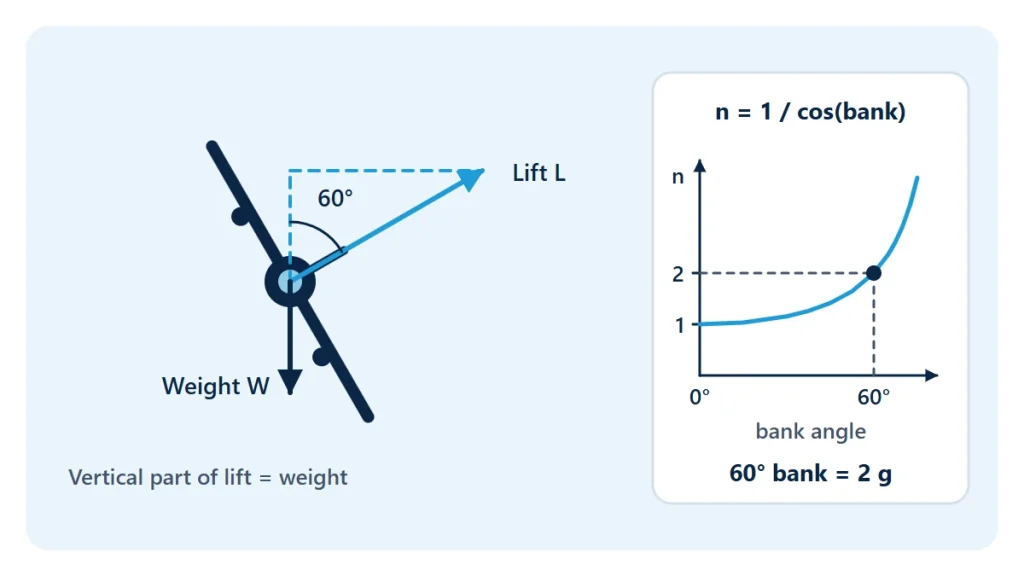
Banking tilts the lift force. Only its vertical part opposes weight, so to keep the turn level the total lift has to grow until that vertical part equals the weight again, as the diagram at the top of this page shows:
L × cos(bank) = W, so n = 1 ÷ cos(bank)
The result depends on bank angle and nothing else. Speed, weight and aircraft type do not enter. Any aircraft holding altitude in a coordinated 60° bank is at 2 g. The relationship is far from linear: the first 30° of bank add very little, and beyond 60° each extra degree adds a great deal.
| Bank angle | Load factor | Stall speed multiplier | Increase in stall speed |
|---|---|---|---|
| 0° | 1.00 g | × 1.000 | 0.0% |
| 15° | 1.04 g | × 1.017 | 1.7% |
| 30° | 1.15 g | × 1.075 | 7.5% |
| 45° | 1.41 g | × 1.189 | 18.9% |
| 60° | 2.00 g | × 1.414 | 41.4% |
| 70° | 2.92 g | × 1.710 | 71.0% |
| 75° | 3.86 g | × 1.966 | 96.6% |
| 80° | 5.76 g | × 2.400 | 140.0% |
The values are from the load factor calculator. Between 60° and 80° the load factor nearly triples.
Stall speed follows the square root
A wing stalls at a particular angle of attack, where its lift coefficient reaches a maximum. The lift available at that point is proportional to the square of airspeed. If a maneuver demands n times the weight in lift, the speed at which the wing runs out of lift coefficient goes up by the square root of n:
Vstall in maneuver = Vstall level × √n
The same reasoning underlies the lift equation described in basic principles of aircraft lift. The consequence is that a published level stall speed is not a floor. The stall is tied to angle of attack, and an aircraft can stall at any airspeed if enough load factor is applied.
One turn, step by step
For illustration, suppose a level stall speed of 50 kt. This is a round number chosen for easy arithmetic, not a figure for any aircraft. The calculator takes the bank angle and, optionally, the level stall speed.
- At 30° of bank the load factor is 1.15 g and the stall speed becomes 53.7 kt, less than 4 kt above the level value.
- At 45° the load factor is 1.41 g and the stall speed is 59.5 kt.
- At 60° the load factor is 2.00 g and the stall speed is 70.7 kt.
- At 75° the load factor is 3.86 g and the stall speed is 98.3 kt, almost double.
An aircraft flying this example at 75 kt is 25 kt above the stall with the wings level, only about 4 kt above it in a level 60° bank, and well below it at 75°. Nothing about the airspeed indicator changed; the margin was used up by load factor alone.
Other ways to load the wing
The 1 ÷ cos(bank) formula applies only to a level, coordinated turn. Load factor appears in other maneuvers through different mechanisms:
- Pull-ups and dive recoveries. Curving the flight path upward needs lift greater than weight. The load factor depends on speed and how sharply the path curves, and at high speed a modest control movement can produce a large value.
- Push-overs. Curving the path downward reduces load factor below 1 and can make it negative.
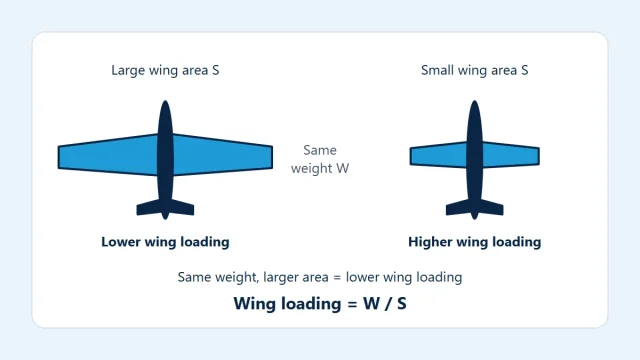
- Turbulence. A vertical gust changes the angle of attack abruptly and so changes lift. The faster the aircraft is flying, the larger the load a given gust produces. Aircraft with low wing loading respond more strongly, as discussed in wing loading explained.
- Climbing and descending turns. If the aircraft is not holding altitude, the vertical part of lift no longer has to equal weight exactly, and the level-turn formula no longer gives the load factor.
Steeper bank also tightens the turn. The turn radius calculator shows radius and rate of turn alongside load factor, and understanding aircraft turn radius covers how speed and bank trade against each other. More lift brings more induced drag as well, which is why a steep turn needs extra power to hold speed; see understanding aerodynamic drag.
Structural limits and where they come from
Every aircraft is designed and certified to withstand load factors up to stated positive and negative limits, which differ between aircraft and between the categories they are approved in, and may change with weight and flap setting. The calculator on this site does not compare its result with any limit, and this article deliberately quotes none. The limit load factors for a particular aircraft are published in its flight manual and on its placards, and those are the only figures that apply to it.
Two points follow from the physics above. At low speed the wing stalls before a high load factor can be reached, so the stall protects the structure. At high speed the wing can generate more lift than the structure is designed to carry, so the pilot or a gust can exceed the limit. Flight manuals publish the speeds that mark those regions for the specific aircraft and weight.
Limits of the calculation
The formulas assume a steady, level, coordinated turn in smooth air. They ignore the roll into the turn, slipping or skidding, changes of altitude, gusts added on top of the maneuver, and the effect of power and configuration on stall speed. The stall speed result simply scales the number you enter, so it is only as valid as that input for the actual weight and configuration.
Use the numbers to understand why steep turns demand respect, not to decide how an aircraft may be flown. Stall speeds, maneuvering limits and approved maneuvers come from the aircraft flight manual (POH/AFM), and real flying also depends on current weather information, official charts and the applicable regulations.