Load Factor Calculator
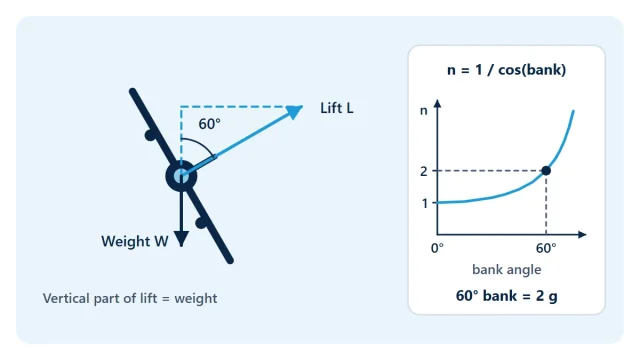
Load factor is lift divided by weight, counted in g. In a level, coordinated turn it depends on bank angle alone: the wing has to make enough lift for the vertical part to keep holding the aircraft up while the horizontal part pulls it around the turn. This calculator returns that load factor for any bank angle up to 85°.
Because the wing is working harder, the speed at which it stalls rises with the square root of the load factor. The calculator shows that multiplier and, if you enter a level stall speed, applies it. The steep rise at high bank angles is the thing to notice: 60° of bank already doubles the load.
How to use this calculator
- Enter Bank angle in degrees, from 0 to 85.
- Optionally enter Level stall speed in knots, km/h or mph.
- Read the load factor and the stall speed multiplier, and the stall speed in the turn if you gave a level value.
Level stall speed has to come from your own aircraft's data for the weight and configuration you have in mind; this site does not supply one. Whatever kind of airspeed the source uses, indicated or calibrated, the result is in the same terms. A bank angle of 0 is straight and level flight and returns 1.00 g.
Formula
n = 1 ÷ cos φ
stall speed in the turn = level stall speed × √n
What the variables mean
- n
- load factor, lift divided by weight, in g
- φ
- bank angle in a level coordinated turn
- level stall speed
- the wings-level stall speed for the same weight and configuration, from the aircraft's own data
Worked example
These example values are illustrative round numbers, not data for any particular aircraft. Select "Fill in the example" in the calculator to load them.
Inputs
- Bank angle: 60°
- Level stall speed: 50 kt
Working
- cos(60.0°) = 0.5000.
- n = 1 ÷ 0.5000 = 2.00.
- √n = 1.414.
- Stall speed in the turn = 50.0 × 1.414 = 70.7 kt.
Result
- Load factor: 2.00 g
- Stall speed multiplier: × 1.414 (Stall speed is 41.4% higher than in level flight)
- Stall speed in the turn: 70.7 kt (From the level stall speed you entered)
Reading the result
Load factor is in g. Stall speed multiplier is its square root, with the same thing as a percentage increase beside it. Stall speed in the turn appears only when a level stall speed was entered. For illustration, 60° of bank gives 2.00 g and a multiplier of 1.414, so stall speed is 41.4% higher; suppose a level stall speed of 50 kt, and the row shows 70.7 kt. The page does not compare any of this with a structural limit, which is found in the aircraft flight manual.
Assumptions and limitations
- Altitude is constant; a climbing or descending turn at the same bank has a different load factor.
- The turn is coordinated and steady, with no slip, skid or change in bank.
- Gusts and abrupt control inputs, which add load on top of the turn, are not included.
- The stall speed scaling assumes the same weight, configuration and maximum lift coefficient as the level figure you entered.
- Airspeed and aircraft type do not enter the load factor in a level turn, so no speed is asked for unless you want the stall row.
Common mistakes
- Expecting load factor to grow evenly with bank, when most of the rise comes at steep angles.
- Multiplying the level stall speed by the load factor itself instead of by its square root.
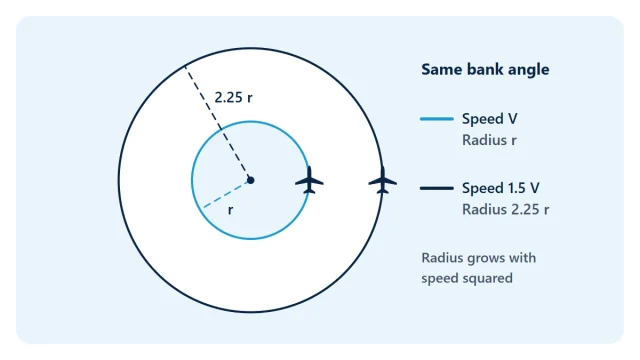
- Thinking a faster aircraft pulls more g at the same bank in a level turn.
- Entering a stall speed for a different weight or flap setting from the case being studied.
- Applying the result to a turn in which back pressure is relaxed and the aircraft descends.
- Regarding stall as tied to one airspeed when it is tied to angle of attack, which is why the speed shifts with load.
References
- Federal Aviation Administration, Pilot's Handbook of Aeronautical Knowledge (FAA-H-8083-25).
- Federal Aviation Administration, Airplane Flying Handbook (FAA-H-8083-3).
These public sources explain the formulas and definitions used here. Citing them does not mean they have reviewed, endorsed or certified AviationCalc.
Related calculators
Turn Radius Calculator
Radius and rate of a level coordinated turn from true airspeed and bank angle.
Aerodynamics
Wing Loading Calculator
Wing loading from aircraft mass and wing area, in kg/m², lb/ft² and N/m².
Aerodynamics
Lift Force Calculator
Lift from air density, true airspeed, wing area and a lift coefficient you supply.
Aerodynamics
True Airspeed Calculator
Convert calibrated airspeed to true airspeed from pressure altitude and outside air temperature.
Flight Speed and Distance
Guides that explain this calculation
Aerodynamics
Load Factor and Aircraft Maneuvers
Load factor is lift divided by weight. In a level turn it equals 1 ÷ cos(bank), and stall speed rises with its square root.
Aerodynamics
Understanding Aircraft Turn Radius
Turn radius depends only on true airspeed and bank angle. See why doubling the speed quadruples the radius and what steeper bank costs.

Aerodynamics
Basic Principles of Aircraft Lift
How a wing produces lift by turning the air and creating a pressure difference, and what each term in the lift equation does to the result.