Turn Radius Calculator
In a level, coordinated turn the size of the circle depends on only two things: true airspeed and bank angle. This calculator takes both and returns the turn radius, the rate of turn in degrees per second, the time for a full 360° and the load factor that goes with the bank.
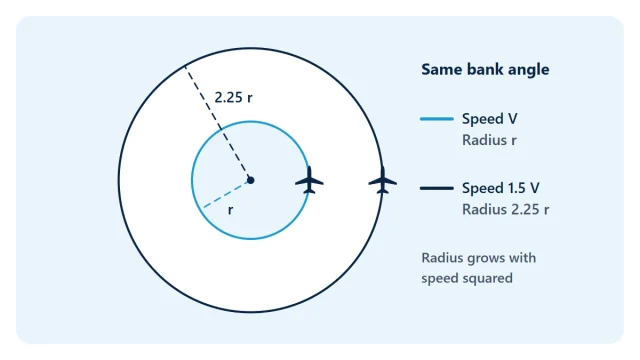
Aircraft type does not appear in the formula: any two aircraft at the same true airspeed and bank angle fly the same circle. What stands out is the effect of speed. Radius grows with the square of true airspeed, so a modest increase in speed widens the turn noticeably, and the same indicated airspeed gives a wider turn at altitude than near sea level.
How to use this calculator
- Enter True airspeed in knots, km/h, mph or m/s.
- Enter Bank angle in degrees, greater than 0 and no more than 85.
- Read the radius, rate of turn, time for a full circle and load factor.
The speed must be true airspeed, not indicated; the true airspeed calculator converts one to the other. Bank angle is the bank actually held, with no slip or skid. The form accepts steep angles because the geometry is defined for them, not because an aircraft may be flown there: bank limits and the stall margin in a turn come from the aircraft's flight manual.
Formula
r = V² ÷ ( g × tan φ )
rate of turn = g × tan φ ÷ V
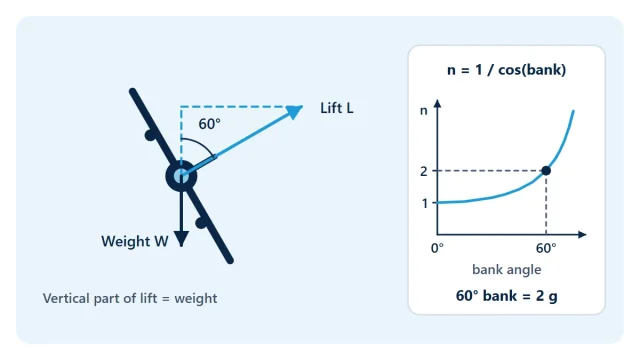
n = 1 ÷ cos φ
What the variables mean
- r
- turn radius
- V
- true airspeed in m/s
- φ
- bank angle
- g
- standard gravity, 9.80665 m/s²
- n
- load factor in the turn
Worked example
These example values are illustrative round numbers, not data for any particular aircraft. Select "Fill in the example" in the calculator to load them.
Inputs
- True airspeed: 120 kt
- Bank angle: 30°
Working
- V = 61.73 m/s, tan(30.0°) = 0.5774.
- r = 61.73² ÷ (9.80665 × 0.5774) = 673 m = 2,208 ft.
- Rate of turn = 9.80665 × 0.5774 ÷ 61.73 = 0.0917 rad/s = 5.25°/s.
Result
- Turn radius: 2,208 ft (673 m · 0.36 NM)
- Rate of turn: 5.25° per second (A standard-rate turn is defined as 3° per second)
- Time for a full 360°: 69 s (1.14 min)
- Load factor: 1.15 g
Reading the result
Turn radius is given in feet, with meters and nautical miles beside it; the width needed to reverse course is the diameter, twice that figure. Rate of turn is in degrees per second, next to a reminder that a standard-rate turn is 3° per second. Time for a full 360° follows directly from the rate. Load factor depends on bank angle alone. For illustration, 120 kt at 30° of bank gives 2,208 ft, 5.25° per second, 69 s and 1.15 g. In wind, the track over the ground is not this circle.
Assumptions and limitations
- The turn is level, with no climb or descent.
- The turn is coordinated, so there is no slip or skid and lift is the only force turning the aircraft.
- True airspeed and bank angle are constant all the way round.
- The air is still. Wind leaves the turn through the air unchanged but distorts the path over the ground.
- Rolling into and out of the bank takes no time or distance.
- Gravity is the standard value of 9.80665 m/s².
Common mistakes
- Entering indicated airspeed at altitude, which understates the radius.
- Believing a heavier aircraft turns wider at the same true airspeed and bank angle.
- Using the radius where the diameter is needed.
- Forgetting that a tailwind during part of the turn carries the ground track wider on the downwind side.
- Assuming twice the bank angle halves the radius, when radius follows the tangent of the bank.
- Steepening the bank to tighten a turn without considering the rise in load factor and stall speed that comes with it.
References
- Federal Aviation Administration, Pilot's Handbook of Aeronautical Knowledge (FAA-H-8083-25).
- Federal Aviation Administration, Airplane Flying Handbook (FAA-H-8083-3).
These public sources explain the formulas and definitions used here. Citing them does not mean they have reviewed, endorsed or certified AviationCalc.
Related calculators
Load Factor Calculator
Load factor in a level turn from bank angle, and the matching rise in stall speed.
Aerodynamics
Wing Loading Calculator
Wing loading from aircraft mass and wing area, in kg/m², lb/ft² and N/m².
Aerodynamics
True Airspeed Calculator
Convert calibrated airspeed to true airspeed from pressure altitude and outside air temperature.
Flight Speed and Distance
Lift Force Calculator
Lift from air density, true airspeed, wing area and a lift coefficient you supply.
Aerodynamics
Guides that explain this calculation
Aerodynamics
Understanding Aircraft Turn Radius
Turn radius depends only on true airspeed and bank angle. See why doubling the speed quadruples the radius and what steeper bank costs.
Aerodynamics
Load Factor and Aircraft Maneuvers
Load factor is lift divided by weight. In a level turn it equals 1 ÷ cos(bank), and stall speed rises with its square root.

Aerodynamics
Basic Principles of Aircraft Lift
How a wing produces lift by turning the air and creating a pressure difference, and what each term in the lift equation does to the result.