An aircraft turns by banking, so that part of the wing’s lift points toward the inside of the turn. How much room the turn takes depends on just two things: how fast the aircraft is flying and how steeply it is banked. Weight, wing size and engine power do not appear in the result at all.
Where the formula comes from
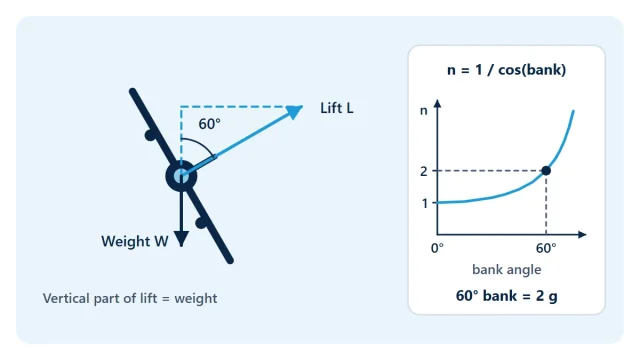
In a level, coordinated turn the lift force is tilted by the bank angle. Its vertical part still has to hold the aircraft up, and its horizontal part pulls the aircraft around the circle:
- Vertical: L × cos(bank) = m × g
- Horizontal: L × sin(bank) = m × V² ÷ r
Divide the second line by the first. Lift and mass both cancel, leaving tan(bank) = V² ÷ (g × r). Rearranged:
r = V² ÷ (g × tan(bank))
Rate of turn = g × tan(bank) ÷ V
V is the true airspeed in m/s, g is 9.80665 m/s², r is the radius in meters and the rate of turn comes out in radians per second (multiply by 57.3 for degrees per second). Because mass cancelled, a light trainer and a heavy transport flying the same true airspeed at the same bank angle follow the same circle.
Speed counts twice
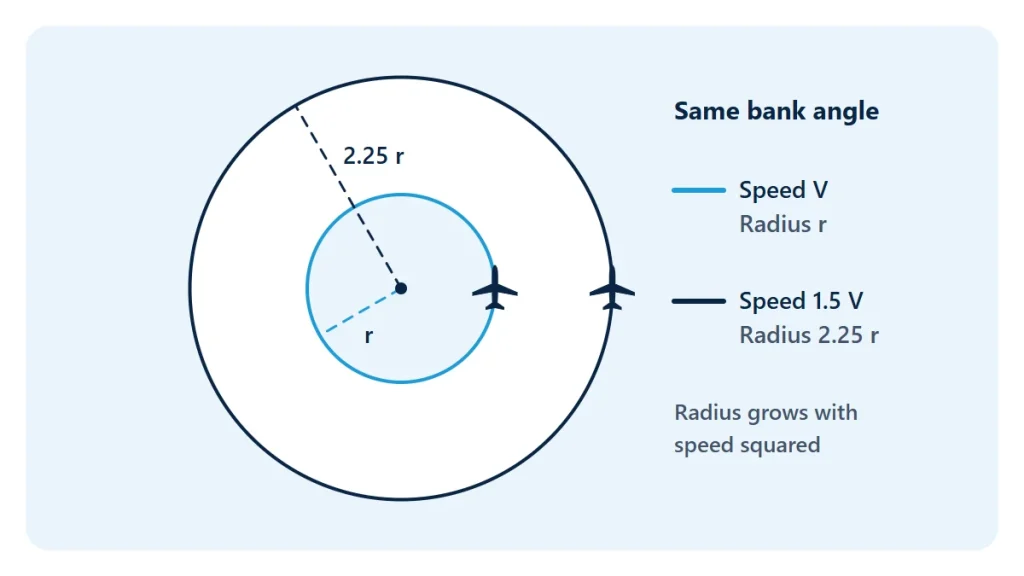
Speed is squared in the radius formula. At a fixed bank angle, flying 1.5 times as fast makes the radius 2.25 times as large, which is what the diagram at the top of this page shows. Doubling the speed quadruples the radius.
Rate of turn has speed on the bottom, so a faster aircraft at the same bank also takes longer to change heading. The turn radius calculator gives these values for a 30° bank, with speeds chosen purely for illustration:
| True airspeed | Radius | Rate of turn | Time for 360° |
|---|---|---|---|
| 120 kt | 2,208 ft (0.36 NM) | 5.25° per second | 69 s |
| 180 kt | 4,969 ft (0.82 NM) | 3.50° per second | 103 s |
| 240 kt | 8,833 ft (1.45 NM) | 2.63° per second | 137 s |
This is why fast aircraft need so much airspace to reverse course, and why slowing down is the most effective way to tighten a turn without steepening the bank.
Bank angle and its price
The other lever is bank. Holding 120 kt and changing only the bank angle gives:
| Bank angle | Radius | Rate of turn | Load factor |
|---|---|---|---|
| 15° | 4,758 ft | 2.44° per second | 1.04 g |
| 30° | 2,208 ft | 5.25° per second | 1.15 g |
| 45° | 1,275 ft | 9.10° per second | 1.41 g |
| 60° | 736 ft | 15.76° per second | 2.00 g |
Steeper bank shrinks the circle quickly, but the last column shows the cost. To keep the turn level the wing must produce more lift than the aircraft weighs, and the ratio of the two is the load factor, 1 ÷ cos(bank). Higher load factor raises the stall speed by its square root and adds induced drag, so a steep turn needs more power to hold altitude and has a smaller margin above the stall. The load factor calculator works out that multiplier for any bank angle, and load factor and aircraft maneuvers explains it in full.
In practice, then, the tightest turn an aircraft can fly is not set by the formula on this page. It is set by how slowly the aircraft can fly at the load factor the bank demands, and by the limits in its flight manual.
Standard-rate turns
Instrument flying uses a standard-rate turn, defined as 3° per second, which completes a full circle in two minutes. Since rate depends on speed, the bank needed for it grows with true airspeed. The exact relationship is the rate formula solved for bank:
tan(bank) = rate × V ÷ g
with the rate in radians per second. A widely taught approximation is to divide the true airspeed in knots by 10 and add 7. For 120 kt that suggests 19°, and the calculator returns 3.13° per second for 19° and 2.96° per second for 18°, so the estimate lands within a degree. It is a rule of thumb for light-aircraft speeds, not an exact result, and it drifts as speed increases.
Airspeed, not ground speed
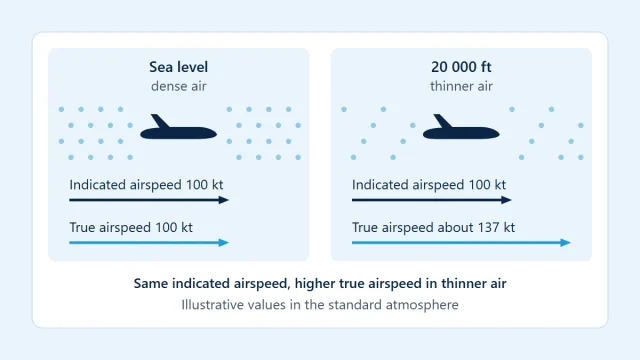
The formulas describe the aircraft’s path through the air mass, so the speed to use is true airspeed. Indicated airspeed understates it more and more as altitude increases; the true airspeed calculator makes the conversion, and true airspeed vs indicated airspeed explains the difference. An aircraft holding the same indicated airspeed and bank at high altitude flies a noticeably wider turn than it does near sea level.
Wind does not change the radius through the air, but it moves the whole circle downwind while the turn is in progress. Seen from the ground the path is stretched on the downwind side and compressed on the upwind side. The effect of wind on speed over the ground is covered in understanding ground speed in aviation.
What the simple model leaves out
The radius formula assumes a level turn at constant true airspeed, perfectly coordinated, in still air, already established at the bank angle. A real turn takes time to roll into and out of, which adds distance. A climbing or descending turn, a slipping or skidding turn, and a turn in which speed is bleeding off all follow different paths. The formula also has no knowledge of whether the aircraft can sustain the turn: it will return a radius for a bank angle that would stall the wing or exceed a structural limit.
For those reasons the numbers are for understanding, not for planning a maneuver near terrain, obstacles or airspace boundaries. Turning performance, bank and load limits and stall speeds for a real aircraft come from the aircraft flight manual (POH/AFM), and published procedures, current official charts, weather information and the applicable regulations govern how turns are flown in practice.