Air Density Calculator
Air density is the mass of air in each cubic meter. It rises with pressure, falls with temperature and falls a little further when water vapor replaces some of the heavier nitrogen and oxygen. This calculator applies the ideal-gas law to the pressure and temperature you enter and, if you add a relative humidity, treats the air as a mixture of dry air and water vapor.
Density sits inside every aerodynamic force: lift, drag and propeller thrust all scale with it, and so does the mass of air an engine can draw in. Working it out directly shows how much each of the three inputs actually contributes, and why humidity is the smallest of them.
How to use this calculator
- Enter Absolute pressure and choose hPa, inHg, kPa, psi or mmHg.
- Enter Air temperature in °C, °F or K.
- Optionally enter Relative humidity as a percentage from 0 to 100, or leave it blank for dry air.
- Read the density, the density ratio and the equivalent density altitude.
The pressure field needs the actual pressure of the air at the location, sometimes called station pressure. It is not the altimeter setting, which has been adjusted to sea level and at any elevated field is higher than the pressure really present. If the setting and elevation are all you have, the density altitude calculator is the right starting point. Humidity can only be included between −40 °C and 60 °C, the range in which the vapor-pressure formula is valid.
Formula
dry air: ρ = P ÷ (Rd × T)
humid air: ρ = (P − Pv) ÷ (Rd × T) + Pv ÷ (Rv × T)
Pv = RH × 610.94 × exp( 17.625 × t ÷ (t + 243.04) )
What the variables mean
- ρ
- air density in kg/m³
- P
- absolute (station) pressure in pascals
- T, t
- temperature in kelvin and in °C
- Pv
- partial pressure of water vapor
- RH
- relative humidity as a fraction
- Rd, Rv
- 287.05287 and 461.495 J/(kg·K)
Worked example
These example values are illustrative round numbers, not data for any particular aircraft. Select "Fill in the example" in the calculator to load them.
Inputs
- Absolute pressure: 1013.25 hPa (mbar)
- Air temperature: 30 °C
- Relative humidity: 60%
Working
- T = 303.15 K, P = 101,325 Pa.
- Saturation vapor pressure = 610.94 × exp(17.625 × 30.0 ÷ (30.0 + 243.04)) = 4,237 Pa.
- Pv = 60% of that = 2,542 Pa.
- ρ = (101,325 − 2,542) ÷ (287.05287 × 303.15) + 2,542 ÷ (461.495 × 303.15) = 1.1533 kg/m³.
Result
- Air density: 1.1533 kg/m³ (0.002238 slug/ft³)
- Density ratio (σ): 0.9415 (94.2% of sea-level standard)
- Water-vapor pressure: 25.42 hPa (Dry-air density would be 1.1644 kg/m³)
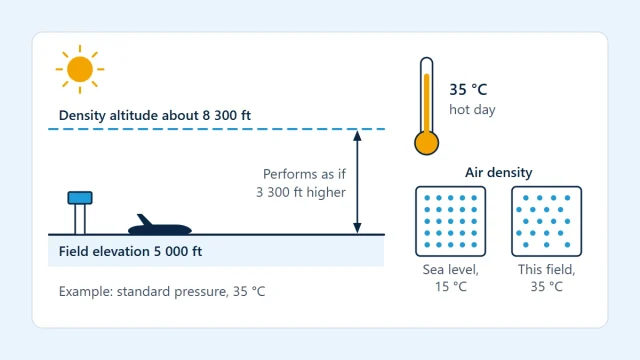
- Equivalent density altitude: 2,045 ft (623 m in the standard atmosphere)
Reading the result
Air density is given in kg/m³ with slug/ft³ beside it. Density ratio (σ) divides that by the sea-level standard value and repeats it as a percentage. Water-vapor pressure is the share of the total pressure exerted by water vapor; when humidity is entered, the density dry air would have under the same conditions is printed next to it so the humidity effect is visible. Equivalent density altitude is the height in the standard atmosphere that has the same density, in feet and meters. It reads “Outside the 20 km model” when the density falls beyond the range the atmosphere model covers.
Assumptions and limitations
- Dry air and water vapor are each treated as ideal gases, with gas constants of 287.05287 and 461.495 J/(kg·K).
- Saturation vapor pressure comes from a Magnus-type approximation over liquid water, which is why humidity is limited to −40 °C to 60 °C.
- The pressure entered is taken to be the true absolute pressure at the point of interest; no conversion from an altimeter setting is made.
- Composition is assumed to be standard air, with no allowance for dust, smoke, liquid droplets or ice crystals.
- Temperature, pressure and humidity are single values for one point, not an average over a runway or a climb.
- A humidity that would make the vapor pressure exceed the total pressure is rejected as physically impossible.
Common mistakes
- Entering the altimeter setting in the Absolute pressure field at an airport well above sea level.
- Expecting humid air to be denser than dry air, when water vapor is lighter than the air it displaces.
- Using the temperature in °C or °F directly in the gas law when working by hand, instead of kelvin.
- Overestimating the humidity effect, which is small beside the effect of temperature or pressure.
- Entering the dew point where relative humidity is asked for.
- Choosing kPa and typing a value in hPa, which is ten times too large and falls outside the accepted range.
References
- NASA Glenn Research Center, Earth Atmosphere Model.
- NOAA, NASA and the U.S. Air Force, U.S. Standard Atmosphere, 1976.
- Federal Aviation Administration, Pilot's Handbook of Aeronautical Knowledge (FAA-H-8083-25).
These public sources explain the formulas and definitions used here. Citing them does not mean they have reviewed, endorsed or certified AviationCalc.
Related calculators
Density Altitude Calculator
Density altitude from field elevation, altimeter setting and outside air temperature (dry air).
Atmosphere and Altitude
Standard Atmosphere Calculator
ISA temperature, pressure, density and speed of sound at any altitude up to 20 km.
Atmosphere and Altitude
Lift Force Calculator
Lift from air density, true airspeed, wing area and a lift coefficient you supply.
Aerodynamics
Drag Force Calculator
Drag from air density, true airspeed, reference area and a drag coefficient you supply.
Aerodynamics
Guides that explain this calculation

Atmosphere and Altitude
Air Density and Aircraft Performance
Pressure, temperature and humidity set air density, and density sets how much lift, thrust and power an aircraft can produce. Here is how they connect.
Atmosphere and Altitude
What Is Density Altitude?
Density altitude is pressure altitude corrected for non-standard temperature. See the exact formula, the 120 ft per °C shortcut and a worked example.

Atmosphere and Altitude
International Standard Atmosphere Explained
The ISA model fixes sea-level values, a 6.5 °C per km lapse rate and an 11 km tropopause. See the equations, a reference table and what ISA deviation means.