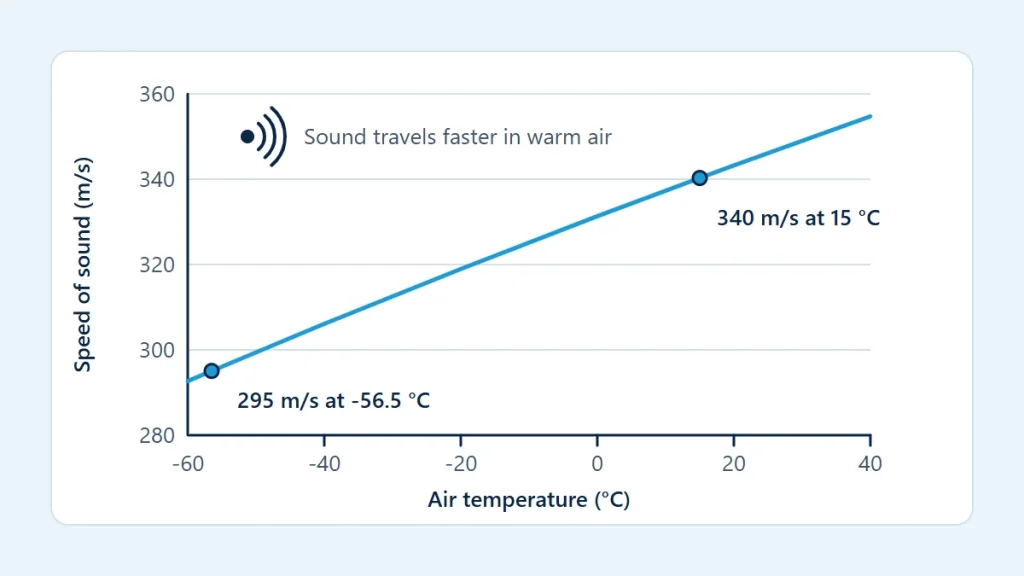
Sound is a pressure disturbance passed from one air molecule to the next. The speed of sound is how fast that disturbance travels, and in air it is set by one thing: temperature. At 15 °C it is 661.5 kt, or 340.3 m/s. At −56.5 °C, the temperature of the lower stratosphere in the standard atmosphere, it is 573.6 kt, or 295.1 m/s.
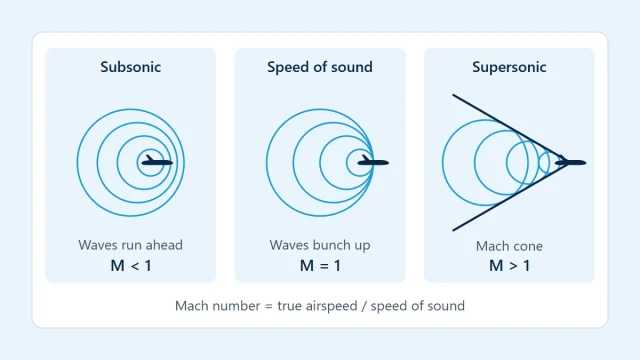
The number matters in aviation because it is the yardstick for Mach number, and because the way air flows around an aircraft changes as its speed approaches the speed at which the air can pass pressure signals ahead of it.
The formula
For air treated as an ideal gas:
a = √(γ × R × T)
- a is the speed of sound in m/s.
- γ (gamma) is the ratio of specific heats, 1.4 for air at ordinary temperatures.
- R is the gas constant for dry air, 287.05287 J/(kg K).
- T is the absolute temperature in kelvin, which is °C + 273.15.
Because γ and R are constants, the formula collapses to a single multiplier. In knots:
a (kt) = 38.9678 × √T
The square root means the speed of sound changes more slowly than temperature does. The temperature must be absolute: using °C directly gives nonsense, and gives nothing at all below zero.
Why pressure and density drop out
It is natural to expect sound to travel more slowly in thin air. The more basic form of the formula shows why it does not:
a = √(γ × P ÷ ρ)
Pressure P acts as the stiffness of the air, the tendency of a compressed parcel to spring back. Density ρ acts as its inertia. Sound moves faster through a stiffer medium and slower through a heavier one. In a gas at a fixed temperature the two change together: halve the pressure and the density halves as well, so the ratio P ÷ ρ is untouched. The ideal-gas law states this directly, since P ÷ ρ = R × T. Temperature is the only thing left.
Physically, temperature measures how fast the molecules themselves are moving, and a disturbance cannot be handed along faster than the molecules that carry it.
Values across the temperature range
These figures are from the speed of sound calculator, which takes air temperature as its only input.
| Air temperature | Speed of sound (kt) | Speed of sound (m/s) | Compared with 15 °C |
|---|---|---|---|
| 40 °C | 689.6 | 354.7 | 104.2% |
| 30 °C | 678.5 | 349.0 | 102.6% |
| 15 °C | 661.5 | 340.3 | 100.0% |
| 0 °C | 644.0 | 331.3 | 97.4% |
| −20 °C | 620.0 | 319.0 | 93.7% |
| −40 °C | 595.0 | 306.1 | 90.0% |
| −56.5 °C | 573.6 | 295.1 | 86.7% |
In other units the 15 °C value is 1,225.1 km/h, 761.2 mph or 1,116.5 ft/s.
What happens with altitude
Altitude affects the speed of sound only through the temperature found there. In the International Standard Atmosphere, temperature falls steadily up to the tropopause at 11 km, so the speed of sound falls with it: 661.5 kt at sea level, 638.3 kt at 10,000 ft and 589.3 kt at 30,000 ft. Above 11 km (36,089 ft) the standard temperature is constant at −56.5 °C, and the speed of sound holds at 573.6 kt all the way to 20 km, even though the pressure at 20 km is only about a quarter of its value at the tropopause.
The standard atmosphere calculator lists the speed of sound for any altitude in that range. On a real day the value at a given altitude depends on the actual outside air temperature, which is why the calculators ask for temperature and not altitude.
Same true airspeed, different Mach number
Mach number is true airspeed divided by the local speed of sound:
M = TAS ÷ a
Suppose, for illustration, an aircraft has a true airspeed of 450 kt. The Mach number calculator gives:
- In air at 15 °C: a = 661.5 kt, so M = 450.0 ÷ 661.5 = 0.680.
- In air at −56.5 °C: a = 573.6 kt, so M = 450.0 ÷ 573.6 = 0.785.
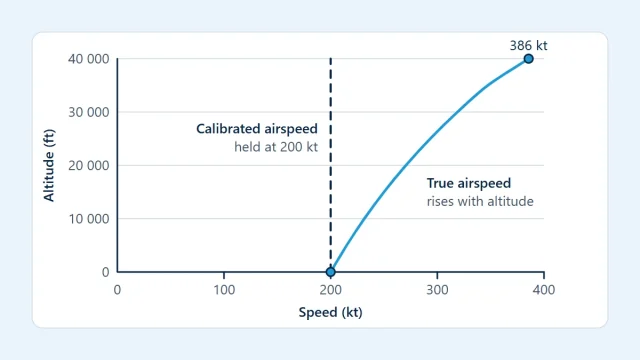
Nothing about the aircraft’s speed through the air has changed, but in the cold air it is flying at a noticeably larger fraction of the speed of sound. This is the reason high-altitude flight is managed by Mach number: the airflow effects that appear near the speed of sound depend on that fraction, not on knots. Understanding Mach Number covers the speed regimes and what changes in each, and How Airspeed Changes With Altitude shows how indicated airspeed, true airspeed and Mach number diverge in a climb.
Common misunderstandings
- “The sound barrier is a fixed speed.” Mach 1 is a different true airspeed at every temperature, as the table shows.
- “Sound is slower up high because the air is thin.” It is slower because the air is cold. In the isothermal layer the air keeps thinning and the speed of sound does not move.
- “Use the temperature shown on the gauge.” The formula needs the static temperature of the undisturbed air. A probe on a fast aircraft reads higher than that because the air is heated as it is brought to rest against the probe.
Limits of the simple formula
The calculation assumes dry air that behaves as an ideal gas with γ fixed at 1.4. Humidity raises the speed of sound slightly, and γ drifts at very high temperatures; neither effect is modelled, and neither is significant for ordinary flight conditions. The result is the speed of sound relative to the air, so wind does not enter into it.
The larger uncertainty is the temperature itself, which varies along a route and differs from the standard value on most days. A Mach number worked out from a forecast or assumed temperature is an estimate. In an aircraft, Mach number comes from the certified instruments and air data system, and any speed or Mach limits come from the aircraft flight manual (POH/AFM), used with current official weather information and the applicable regulations.