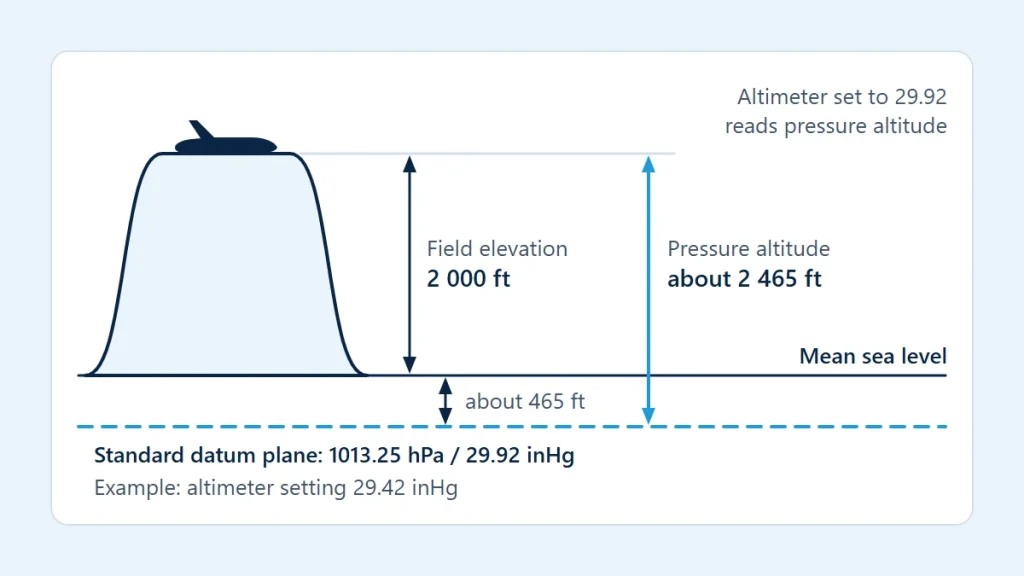
Pressure altitude is the altitude an altimeter shows when its pressure setting is 1013.25 hPa (29.92 inHg). Put another way, it is the height above the standard datum plane, the imaginary level where the pressure is exactly 1013.25 hPa. That level sits at mean sea level only when the sea-level pressure happens to be standard; on other days it lies somewhat above or below it.
Because the reference never changes, pressure altitude describes the air pressure itself, re-labelled as an altitude. Two places with the same pressure altitude have the same ambient pressure, whatever their elevations are.
A pressure reading written in feet
The International Standard Atmosphere assigns one pressure to every altitude. An altimeter runs that table backward: it senses pressure and displays the altitude that the standard atmosphere pairs with it, shifted by whatever setting is in the window. With the standard setting there is no shift, so the display is a direct statement of pressure. A pressure altitude of 5,000 ft means the ambient pressure is 843.07 hPa, and a pressure altitude of 10,000 ft means 696.82 hPa.
This is why pressure altitude, not height above the ground or above sea level, is the starting point for anything that depends on the air itself.
Two ways to find it
- Read it. Set 29.92 inHg or 1013.25 hPa on the altimeter and read the altitude. On the ground this gives the pressure altitude of the field; the setting is then returned to the local value.
- Calculate it. Start from the field elevation, or from an indicated altitude, and correct for the difference between the current altimeter setting and standard.
The correction is the standard-atmosphere altitude of the altimeter setting:
Pressure altitude (ft) = elevation + 145,442.16 × [1 − (setting in hPa ÷ 1013.25)0.190263]
The constants come straight from the standard atmosphere: 145,442.16 ft is the sea-level temperature divided by the lapse rate, and the exponent combines the gas constant, the lapse rate and gravity. The pressure altitude calculator uses this formula and accepts the setting in inHg or hPa. If a setting is in the wrong unit for your instrument, the altimeter pressure conversion calculator converts it.
Example: a low-pressure day at a 2,000 ft field
As an illustration, take a field elevation of 2,000 ft and an altimeter setting of 29.42 inHg, half an inch below standard.
- Convert the setting: 29.42 inHg = 996.28 hPa.
- Correction = 145,442.16 × [1 − (996.28 ÷ 1013.25)0.190263] = 467 ft.
- Pressure altitude = 2,000 + 467 = 2,467 ft.
The pressure at the field is 926.1 hPa, the same as the standard atmosphere has at 2,467 ft. The air is as thin, in pressure terms, as if the field were 467 ft higher.
Reverse the situation with a setting of 30.42 inHg and the correction is −458 ft, giving a pressure altitude of 1,542 ft. A setting above standard gives a pressure altitude below the elevation; a setting below standard gives one above it.
The 1,000 ft per inch shortcut
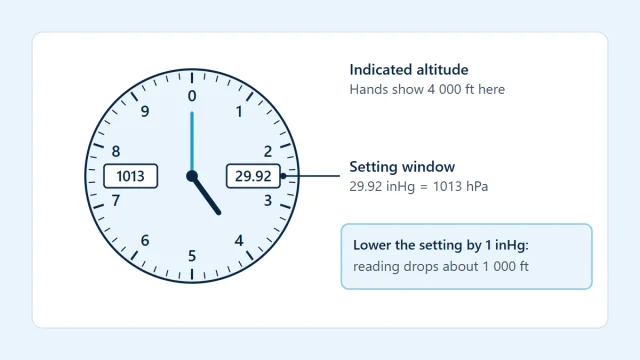
A common mental estimate is 1,000 ft of pressure altitude for each inch of mercury away from 29.92, or roughly 27 to 30 ft per hectopascal near sea level. It is an approximation of the formula above, and for settings within an inch of standard it overstates the correction by up to about a tenth.
| Altimeter setting | Exact correction | Rule-of-thumb correction |
|---|---|---|
| 30.92 inHg | −911 ft | −1,000 ft |
| 30.42 inHg | −458 ft | −500 ft |
| 1013.25 hPa (29.92 inHg) | 0 ft | 0 ft |
| 1003.25 hPa | +274 ft | +294 ft |
| 29.42 inHg | +467 ft | +500 ft |
| 28.92 inHg | +939 ft | +1,000 ft |
The exact corrections are not symmetrical: an inch below standard is worth 939 ft and an inch above is worth 911 ft. Pressure does not fall in a straight line with altitude, so each hectopascal spans a little more height as the pressure drops. A single hectopascal next to the standard value is worth 27 ft.
Where pressure altitude is used
- Performance data. Aircraft performance charts are commonly entered with pressure altitude and temperature, because together they fix the air density.
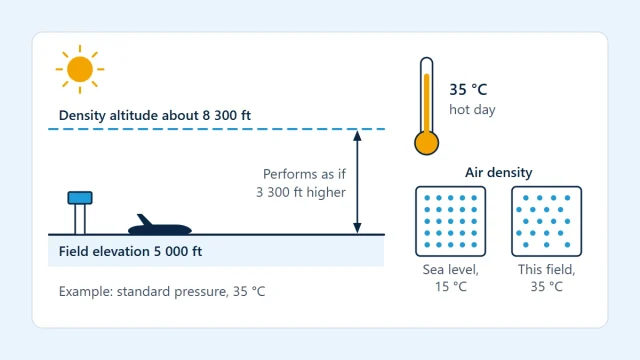
- Density altitude. Pressure altitude is the first step; the temperature correction comes second. See What Is Density Altitude? for that step.
- Airspeed conversions. Converting calibrated airspeed to true airspeed needs the ambient pressure, which is why the true airspeed calculator asks for pressure altitude and not for altitude above sea level.
- Flight levels. A flight level is a pressure altitude expressed in hundreds of feet. Aircraft flying on the standard setting share the same reference, so they stay vertically separated from one another even though none of them is reading true height. Aviation Altimeter Settings Explained covers when each setting is used.
What pressure altitude is not
Pressure altitude is not true altitude. It ignores the local sea-level pressure by design, and it ignores temperature completely. In air that is colder than standard, the layers of the atmosphere are compressed, and an aircraft is closer to the ground than the same pressure reading would suggest in warm air. Pressure altitude can also be negative, which simply means the ambient pressure is higher than 1013.25 hPa.
Limits of a calculated value
The calculation is exact for the standard-atmosphere model, but its inputs are not exact. An altimeter setting is reported for a particular station at a particular time and is rounded; pressure changes with the weather and from one airfield to the next. The published field elevation refers to one point on the airfield. Altimeters themselves have instrument and installation errors that the formula knows nothing about.
For anything beyond learning how the numbers relate, use a current official altimeter setting and weather report, published airport data, and the procedures in the aircraft flight manual (POH/AFM), which defines how pressure altitude is to be determined for its performance charts. Terrain and obstacle clearance are never judged from pressure altitude; that requires current official charts and the applicable regulations.