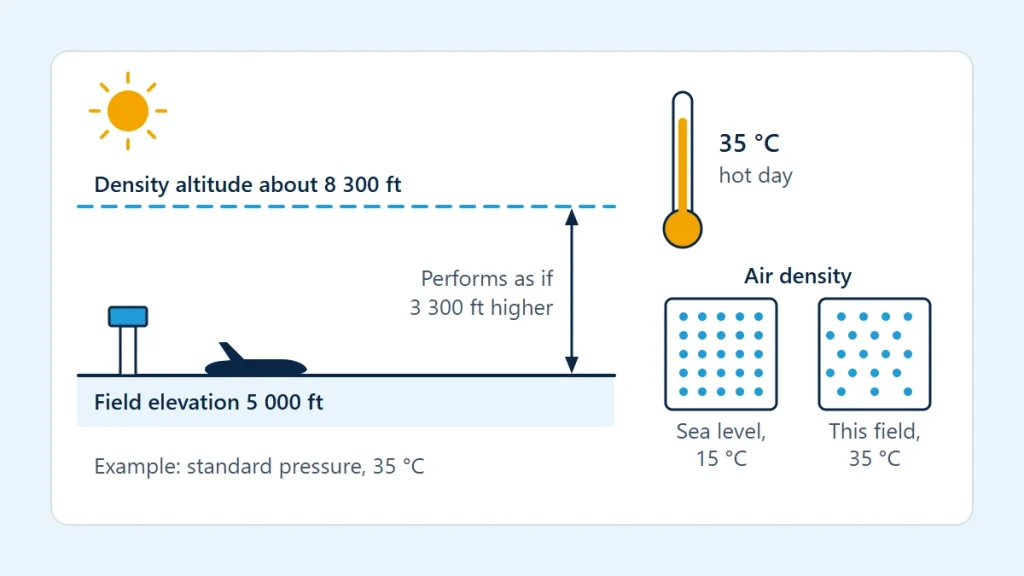
Density altitude is the altitude in the International Standard Atmosphere at which the air has the same density as the air around you right now. It is not a height above anything. It is a way of describing how thin the air is, expressed in feet so that it can be compared with the altitudes used in aircraft performance data.
On a day that exactly matches the standard atmosphere, density altitude equals pressure altitude. Warm the air or lower the pressure and the density falls, so the density altitude climbs above the field, even though the runway has not moved.
Three inputs, one number
Air density depends on pressure and temperature, and to a smaller extent on humidity. A density altitude calculation collects those effects in two stages:
- Pressure. Field elevation and the altimeter setting give the pressure altitude, which is the standard-atmosphere altitude that has the same pressure as the air at the field. Understanding Pressure Altitude covers that step.
- Temperature. The outside air temperature is compared with the standard temperature for that pressure altitude. Warmer than standard means less dense air and a higher density altitude; colder than standard means the opposite.
Density altitude is therefore pressure altitude corrected for non-standard temperature. Humidity is a third, smaller correction that the simple formula leaves out; it is discussed below.
The exact relationship and the shortcut
For dry air, density comes from the ideal-gas law, using the actual pressure P in pascals and the actual temperature T in kelvin:
ρ = P ÷ (R × T), with R = 287.05287 J/(kg K)
The standard atmosphere is then searched for the altitude with that density. Below the tropopause this has a closed form:
Density altitude (ft) = 145,442.16 × [1 − (ρ ÷ ρ0)0.234969], with ρ0 = 1.225 kg/m³
This is what the density altitude calculator evaluates. A widely taught approximation skips the density step altogether:
Density altitude ≈ pressure altitude + 120 ft × (OAT − ISA temperature), in °C
The 120 ft per °C figure is a rule of thumb, not a physical constant. It is close near standard conditions and drifts as the temperature moves further from standard, as the table in the next section shows.
A hot afternoon at a 5,000 ft field
For illustration, suppose a field at 5,000 ft elevation, an altimeter setting of 1013.25 hPa and an outside air temperature of 35 °C. The numbers below come from the calculator.
- With the standard setting, pressure altitude equals elevation: 5,000 ft. Standard pressure there is 843.07 hPa.
- ISA temperature at 5,000 ft is 5.1 °C, so the air is 29.9 °C warmer than standard.
- ρ = 84,307 ÷ (287.05287 × 308.15) = 0.9531 kg/m³, which is 77.8% of the sea-level standard value.
- Density altitude = 145,442.16 × [1 − (0.9531 ÷ 1.225)0.234969] = 8,329 ft.
The air at this field is as thin as standard air more than 3,300 ft higher up, which is the situation drawn in the diagram at the top of this page. The rule of thumb gives 8,589 ft for the same inputs, about 260 ft more than the exact result.
Holding the pressure altitude at 5,000 ft and changing only the temperature shows how strongly temperature drives the answer and how the shortcut behaves:
| Outside air temperature | Compared with ISA | Density altitude (exact) | Rule-of-thumb estimate |
|---|---|---|---|
| −10 °C | −15.1 °C | 3,147 ft | 3,189 ft |
| 5 °C | −0.1 °C | 4,989 ft | 4,989 ft |
| 20 °C | +14.9 °C | 6,712 ft | 6,789 ft |
| 35 °C | +29.9 °C | 8,329 ft | 8,589 ft |
Pressure matters too. Keep 35 °C but lower the altimeter setting to 1000 hPa and the pressure altitude becomes 5,364 ft and the density altitude 8,767 ft.
Where humidity fits
Water vapor is lighter than the nitrogen and oxygen it displaces, so humid air is less dense than dry air at the same pressure and temperature. The density altitude calculator on this site is a dry-air calculation and says so in its notes. To see the size of the effect, the air density calculator accepts an optional relative humidity and reports an equivalent density altitude.
Using the example above (843.07 hPa and 35 °C), dry air gives 0.9531 kg/m³ and 8,329 ft. At 60% relative humidity the density is 0.9387 kg/m³ and the equivalent density altitude is 8,819 ft. Humidity is a real but secondary effect: in this example it adds a few hundred feet, while the temperature added more than three thousand.
Why the number matters
Wings, propellers and engines all work on the mass of air they handle. Thinner air means an aircraft needs a higher true airspeed to produce the same lift, a propeller or jet engine produces less thrust, and a normally aspirated piston engine produces less power. The combined result is a longer takeoff run and a weaker climb, and how much longer and weaker depends entirely on the aircraft. Air Density and Aircraft Performance explains each of those links.
High density altitude does not require a high airfield. A hot day with low pressure can produce a density altitude thousands of feet above a field that sits close to sea level, and a cold, high-pressure day can produce a density altitude below the field elevation, sometimes below zero.
Limits of the calculation
The formula assumes dry air that behaves as an ideal gas and a temperature reading that represents the air over the runway. A thermometer in the shade can read lower than the air above sun-heated pavement, and conditions change through the day. The result is also only as good as the altimeter setting and elevation entered.
More importantly, a density altitude figure is an input, not an answer. Converting it into a takeoff distance, a climb rate or a decision needs the performance section of the aircraft flight manual (POH/AFM) for the specific aircraft, weight and configuration, together with current weather information, official airport data and the applicable regulations. Some flight manuals take pressure altitude and temperature as separate chart inputs instead of density altitude, and the manual’s own method always takes priority over a general calculator.


