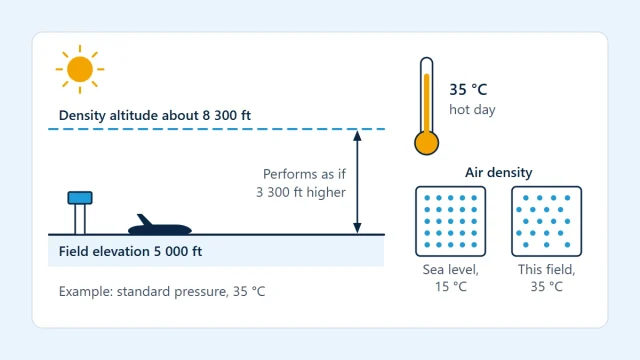
Air density is the mass of air in a given volume, measured in kilograms per cubic meter. An aircraft flies by pushing on air: the wing deflects it, the propeller or jet accelerates it and the engine burns fuel with it. Each of those depends on how much air mass is available, so density is the one property of the atmosphere that connects directly to performance.
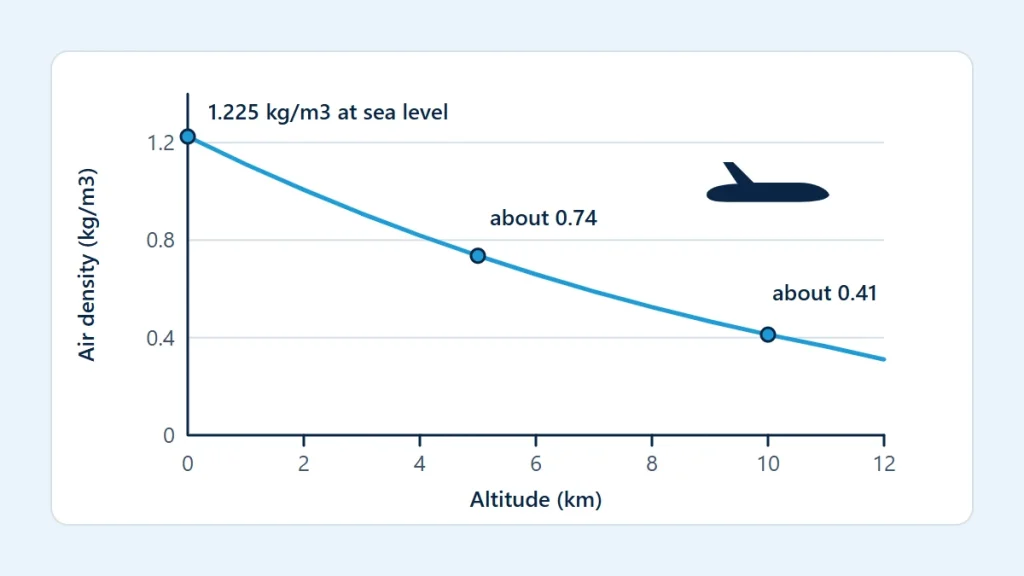
At sea level in the standard atmosphere the density is 1.225 kg/m³. This article looks at what moves that number and why an aircraft notices.
What sets the density of air
For dry air, density follows from the ideal-gas law:
ρ = P ÷ (R × T)
Here ρ is density in kg/m³, P is the absolute pressure in pascals, T is the absolute temperature in kelvin and R is the gas constant for dry air, 287.05287 J/(kg K). Three things follow from it.
- Lower pressure, lower density. Pressure is in the numerator. Air at a high airfield, or under a low-pressure weather system, has fewer molecules in each cubic meter.
- Higher temperature, lower density. Temperature is in the denominator. Heated air expands, so the same volume holds less mass.
- Higher humidity, lower density. This one is not in the dry-air formula and often surprises people, because damp air feels heavy. A water molecule has less mass than the nitrogen and oxygen molecules that make up most of the air. At a given pressure and temperature a volume of gas holds a fixed number of molecules, so each water molecule that joins the mix takes the place of a heavier one.
To include humidity, the air is treated as a mixture: the water vapor’s share of the pressure is worked out from the relative humidity and temperature, and the dry-air and vapor densities are added. The air density calculator does this when a relative humidity is entered and gives the dry-air result when it is left blank.
One pressure, three days
The following comparison is an illustration that holds pressure at 1000 hPa and changes the other two factors one at a time. The figures are from the air density calculator.
| Conditions at 1000 hPa | Density | Share of sea-level standard | Equivalent density altitude |
|---|---|---|---|
| 15 °C, dry | 1.2090 kg/m³ | 98.7% | 449 ft |
| 30 °C, dry | 1.1492 kg/m³ | 93.8% | 2,168 ft |
| 30 °C, 80% relative humidity | 1.1344 kg/m³ | 92.6% | 2,601 ft |
Warming the air by 15 °C removed about 5% of its density. Adding 80% humidity at that temperature removed a little over 1% more. Humidity is the smallest of the three effects, and it matters most when the air is hot, because warm air can hold far more water vapor than cold air.
The last column restates each density as the altitude where the standard atmosphere is equally thin. That is the idea behind density altitude, which is the form in which density usually reaches a pilot.
How density changes with height
Climbing reduces pressure quickly and temperature slowly, and the pressure effect wins. In the International Standard Atmosphere, density falls from 1.2250 kg/m³ at sea level to 0.7361 kg/m³ at 5 km and 0.4127 kg/m³ at 10 km, which is the curve drawn in the diagram at the top of this page. The standard atmosphere calculator gives the value for any altitude up to 20 km.
The curve is steepest near the ground. The first few thousand feet cost more density than the same height change further up, which is why differences in elevation and temperature between low-level airfields are not a detail.
Where an aircraft feels it
The wing
Lift is proportional to density and to the square of true airspeed:
L = ½ × ρ × V² × S × CL
The group ½ × ρ × V² is the dynamic pressure. As an example, at a true airspeed of 100 kt the dynamic pressure is 1,621.0 Pa in sea-level standard air and 1,261.2 Pa in air of 0.9531 kg/m³, a drop of about 22% that matches the drop in density. To carry the same weight at the same lift coefficient in thinner air, the wing has to move faster through it. Basic Principles of Aircraft Lift goes through the equation term by term, and the lift force calculator lets you change density on its own.
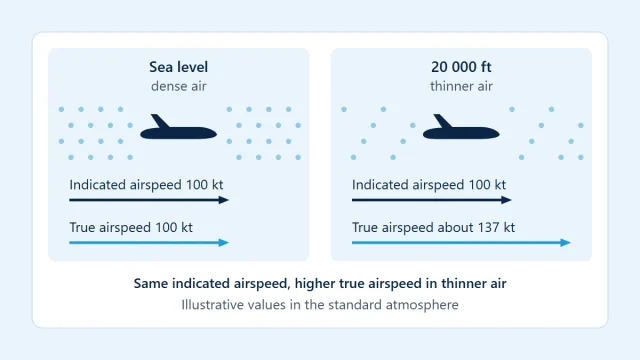
The airspeed indicator measures dynamic pressure, not speed, so it hides this. An aircraft lifts off and stalls at close to the same indicated airspeed in thin air as in dense air, but the true airspeed and therefore the ground speed behind that indication are higher. True Airspeed vs Indicated Airspeed explains the difference.
The engine and propeller
A piston engine without a turbocharger draws in a fixed volume of air on each intake stroke. Thinner air means less oxygen per stroke, less fuel that can be burned and less power. A propeller is a rotating wing and produces thrust by accelerating air mass rearward, so it also loses effectiveness. Jet engines are affected in the same direction because they too are limited by the mass of air passing through them. Turbocharging can hold a piston engine’s intake pressure up to a certain altitude, but it does nothing for the wing or the propeller.
The combined effect
On takeoff, lower density means the aircraft must reach a higher true airspeed with less thrust available to accelerate it, so the ground run is longer. In the climb, the excess power that produces a rate of climb shrinks. Drag at a given true airspeed also falls with density, which is why cruising high can be efficient, but that benefit does not help an aircraft trying to leave a short runway. The size of each effect is different for every aircraft and cannot be estimated from density alone.
What this picture leaves out
The formulas here treat air as an ideal gas and describe humidity with an approximation for saturation vapor pressure, which the calculator applies only between −40 °C and 60 °C. A single density value also assumes the air is uniform, while real air near a runway varies with surface heating, time of day and height above the ground.
Density explains the direction of every performance change, never the amount. Takeoff and landing distances, climb performance and engine limits for the actual weight, configuration, runway and conditions come only from the aircraft flight manual (POH/AFM). Real operations also need current official weather information, published airport data and charts, and the applicable regulations. Nothing in a density calculation indicates whether a particular takeoff is possible.