Drag Force Calculator
Drag is calculated with the same form as lift: dynamic pressure times an area times a coefficient. This calculator takes air density, true airspeed, a reference area and a drag coefficient and returns the drag force, the dynamic pressure and the drag per unit of reference area.
The number helps explain why speed is expensive. With the coefficient held fixed, drag rises with the square of speed, and the power needed to overcome it with the cube. In a real aircraft the coefficient is not fixed, because part of it depends on how much lift the wing is making, so the result here is only as good as the coefficient you enter.
How to use this calculator
- Give the Air density for the altitude and temperature of interest, as kg/m³ or slug/ft³.
- Type the True airspeed and select knots, m/s, km/h, mph or ft/s.
- Enter Reference area in m² or ft².
- Enter Drag coefficient (CD).
Drag coefficient (CD) and Reference area are a pair. A coefficient quoted against wing area gives the wrong drag if you enter a frontal area, and the reverse is just as wrong. Take both from the same set of test or design data for the actual aircraft, in the configuration you are studying, since landing gear and flaps change the coefficient a great deal. Values from 0 to 5 are accepted and none is checked for realism.
Formula
q = ½ × ρ × V²
D = q × S × CD
What the variables mean
- D
- drag force
- q
- dynamic pressure
- ρ
- air density
- V
- true airspeed in m/s
- S
- reference area the coefficient is based on
- CD
- drag coefficient, from wind-tunnel or flight-test data for the shape and conditions
Worked example
These example values are illustrative round numbers, not data for any particular aircraft. Select "Fill in the example" in the calculator to load them.
Inputs
- Air density: 1.225 kg/m³
- True airspeed: 100 kt
- Reference area: 16 m²
- Drag coefficient (CD): 0.03
Working
- V = 51.44 m/s, ρ = 1.2250 kg/m³, S = 16.00 m².
- q = ½ × 1.2250 × 51.44² = 1,621.0 Pa.
- D = 1,621.0 × 16.00 × 0.030 = 778 N.
Result
- Drag: 778 N (175 lbf · 79 kgf)
- Dynamic pressure (q): 1,621.0 Pa (33.86 lb/ft²)
- Drag per unit area: 48.6 N/m²
Reading the result
Drag is given in newtons with lbf and kgf. Dynamic pressure (q) is the same quantity a lift calculation would use at this speed and density. Drag per unit area is q multiplied by the coefficient. In steady level flight thrust equals drag, so the first row is also the thrust needed to hold that speed with that coefficient. For illustration, 1.225 kg/m³, 100 kt, 16 m² and a coefficient of 0.03 give 778 N. Changing only the speed shows the square law, though a real coefficient would shift as well.
Assumptions and limitations
- The coefficient entered is the total for the aircraft; the calculator does not split it into parasite and lift-dependent parts.
- That coefficient stays the same whatever speed you type, although in level flight it changes as the lift coefficient changes.
- Compressibility and Reynolds number effects are not calculated and must already be reflected in the coefficient.
- Ground effect, propeller slipstream and interference between components are outside the model.
- The flow is steady and the density uniform.
Common mistakes
- Combining a coefficient based on wing area with a frontal area, or the other way round.
- Entering a zero-lift or parasite coefficient and reading the answer as total drag.
- Holding one coefficient across a wide speed range to draw a drag curve, which removes the rise in drag at low speed.
- Using a clean-configuration coefficient for a case with gear or flaps extended.
- Mixing indicated airspeed with actual density at altitude.
- Reading the drag force as power; power is drag multiplied by speed.
References
- NASA Glenn Research Center, The Drag Equation.
- NASA Glenn Research Center, Beginner's Guide to Aeronautics.
- Federal Aviation Administration, Pilot's Handbook of Aeronautical Knowledge (FAA-H-8083-25).
These public sources explain the formulas and definitions used here. Citing them does not mean they have reviewed, endorsed or certified AviationCalc.
Related calculators
Lift Force Calculator
Lift from air density, true airspeed, wing area and a lift coefficient you supply.
Aerodynamics
Air Density Calculator
Air density from pressure, temperature and optional relative humidity.
Atmosphere and Altitude
Thrust-to-Weight Ratio Calculator
Thrust divided by weight, with thrust and mass in the units you have.
Aircraft Performance Concepts
Wing Loading Calculator
Wing loading from aircraft mass and wing area, in kg/m², lb/ft² and N/m².
Aerodynamics
Guides that explain this calculation
Aerodynamics
Understanding Aerodynamic Drag
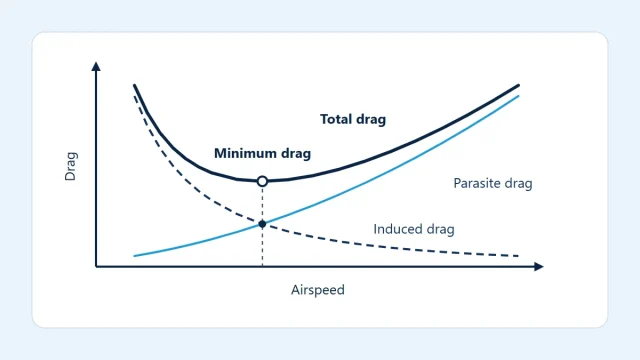
Parasite drag rises with the square of speed and induced drag falls with it. See how the two add up to a total drag curve with a minimum.

Aerodynamics
Basic Principles of Aircraft Lift
How a wing produces lift by turning the air and creating a pressure difference, and what each term in the lift equation does to the result.

Atmosphere and Altitude
Air Density and Aircraft Performance
Pressure, temperature and humidity set air density, and density sets how much lift, thrust and power an aircraft can produce. Here is how they connect.