Lift Force Calculator
The lift equation ties together four things: how dense the air is, how fast the wing moves through it, how big the wing is and how effectively it turns airflow into lift. This calculator multiplies them out and gives the lift force in newtons, pounds-force and kilograms-force, along with the dynamic pressure.
It is most useful for seeing proportions. Lift grows with the square of speed, so doubling the airspeed quadruples it, and it falls in step with density as altitude or temperature rises. In steady level flight lift equals weight, which is why a wing in thin air has to fly faster or at a higher lift coefficient.
How to use this calculator
- Enter Air density in kg/m³ or slug/ft³.
- Enter True airspeed and choose its unit.
- Enter Wing area in m² or ft².
- Enter Lift coefficient (CL).
Standard sea-level density is 1.225 kg/m³; for other conditions the air density calculator gives a value from pressure and temperature. The speed has to be true airspeed because it is paired with the actual density. The lift coefficient is not a fixed property of an aircraft. It changes with angle of attack, flap setting and Mach number, so it has to come from data for the actual wing in the condition you are studying. The calculator accepts any value from 0 to 10 and cannot tell you whether the one you typed is realistic.
Formula
q = ½ × ρ × V²
L = q × S × CL
What the variables mean
- L
- lift force
- q
- dynamic pressure
- ρ
- air density
- V
- true airspeed in m/s
- S
- reference wing area
- CL
- lift coefficient, from wind-tunnel or flight-test data for the wing and angle of attack
Worked example
These example values are illustrative round numbers, not data for any particular aircraft. Select "Fill in the example" in the calculator to load them.
Inputs
- Air density: 1.225 kg/m³
- True airspeed: 100 kt
- Wing area: 16 m²
- Lift coefficient (CL): 0.5
Working
- V = 51.44 m/s, ρ = 1.2250 kg/m³, S = 16.00 m².
- q = ½ × 1.2250 × 51.44² = 1,621.0 Pa.
- L = 1,621.0 × 16.00 × 0.500 = 12,968 N.
Result
- Lift: 12,968 N (2,915 lbf · 1,322 kgf)
- Dynamic pressure (q): 1,621.0 Pa (33.86 lb/ft²)
- Lift per unit area: 810.5 N/m²
Reading the result
Lift is shown in newtons with lbf and kgf beside it. Dynamic pressure (q), in pascals and lb/ft², is the ½ρV² part of the equation and depends only on the air and the speed, not on the wing. Lift per unit area is q multiplied by the coefficient; in steady level flight it equals the wing loading expressed as a pressure. For illustration, 1.225 kg/m³, 100 kt, 16 m² and a coefficient of 0.5 give 12,968 N of lift at a dynamic pressure of 1,621.0 Pa.
Assumptions and limitations
- One lift coefficient represents the whole wing, with no variation along the span.
- The flow is steady, with constant density and speed; gusts and maneuvers are not represented.
- Compressibility is not calculated separately, so any Mach effect has to be inside the coefficient already.
- The stall is not modeled: a coefficient higher than the wing can reach still produces a number, but not one that could occur.
- The wing area is assumed to be the reference area the coefficient was defined against.
- Only zero or positive coefficients are accepted, so negative lift cannot be explored.
Common mistakes
- Pairing indicated airspeed with the actual density at altitude, or true airspeed with sea-level density.
- Expecting lift to rise in proportion to speed when it follows speed squared.
- Putting knots straight into a hand calculation that needs meters per second.
- Treating a lift coefficient as a constant for an aircraft when it changes with angle of attack and flap setting.
- Taking a coefficient defined on one reference area and multiplying by a different area.
- Comparing lift in newtons with a mass in kilograms without multiplying the mass by 9.80665.
References
- NASA Glenn Research Center, The Lift Equation.
- NASA Glenn Research Center, Beginner's Guide to Aeronautics.
- Federal Aviation Administration, Pilot's Handbook of Aeronautical Knowledge (FAA-H-8083-25).
These public sources explain the formulas and definitions used here. Citing them does not mean they have reviewed, endorsed or certified AviationCalc.
Related calculators
Drag Force Calculator
Drag from air density, true airspeed, reference area and a drag coefficient you supply.
Aerodynamics
Wing Loading Calculator
Wing loading from aircraft mass and wing area, in kg/m², lb/ft² and N/m².
Aerodynamics
Air Density Calculator
Air density from pressure, temperature and optional relative humidity.
Atmosphere and Altitude
Load Factor Calculator
Load factor in a level turn from bank angle, and the matching rise in stall speed.
Aerodynamics
Guides that explain this calculation

Aerodynamics
Basic Principles of Aircraft Lift
How a wing produces lift by turning the air and creating a pressure difference, and what each term in the lift equation does to the result.

Atmosphere and Altitude
Air Density and Aircraft Performance
Pressure, temperature and humidity set air density, and density sets how much lift, thrust and power an aircraft can produce. Here is how they connect.
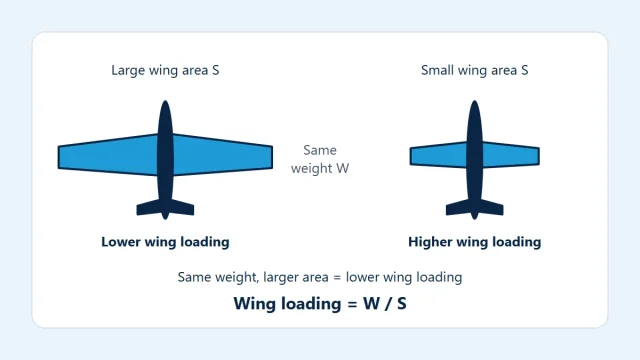
Aerodynamics
Wing Loading Explained
Wing loading is aircraft weight divided by wing area. Learn how that one ratio shapes stall speed, turning ability and the ride in rough air.