Wing Loading Calculator
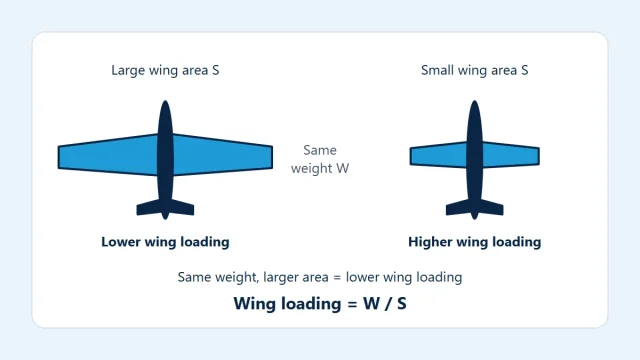
Wing loading is an aircraft's mass divided by its wing area: how much each square meter or square foot of wing has to carry. This calculator works it out in kg/m² and lb/ft², and also expresses it as a pressure in N/m² using standard gravity.
It is a compact way to compare designs. For the same maximum lift coefficient, a higher wing loading means higher stall, takeoff and landing speeds and a wider turn at a given load factor, along with a smaller response to gusts. A lower wing loading gives the opposite. The figure describes a design trade-off; on its own it does not predict the speeds of any particular aircraft.
How to use this calculator
- Enter Aircraft mass in kilograms or pounds.
- Enter the reference Wing area, choosing m² or ft².
- Read the wing loading in both unit systems and as a pressure.
Use the mass at the moment you are interested in, such as the loaded mass from a weight and balance calculation for that flight, not an empty mass or a headline figure. Wing area should be the reference wing area given in the aircraft's documentation. That area normally includes the part of the wing planform that passes through the fuselage, so measuring only the exposed panels gives a different and non-comparable result.
Formula
wing loading = W ÷ S
What the variables mean
- W
- aircraft mass (or weight) at the moment of interest
- S
- reference wing area
- wing loading
- mass or weight carried per unit of wing area
Worked example
These example values are illustrative round numbers, not data for any particular aircraft. Select "Fill in the example" in the calculator to load them.
Inputs
- Aircraft mass: 1100 kg
- Wing area: 16 m²
Working
- Mass = 1,100.0 kg, wing area = 16.00 m².
- Wing loading = 1,100.0 ÷ 16.00 = 68.8 kg/m².
- In lb/ft²: 68.8 × 0.204816 = 14.08.
Result
- Wing loading: 68.8 kg/m² (14.08 lb/ft²)
- As a pressure: 674 N/m² (Weight per unit area at standard gravity)
Reading the result
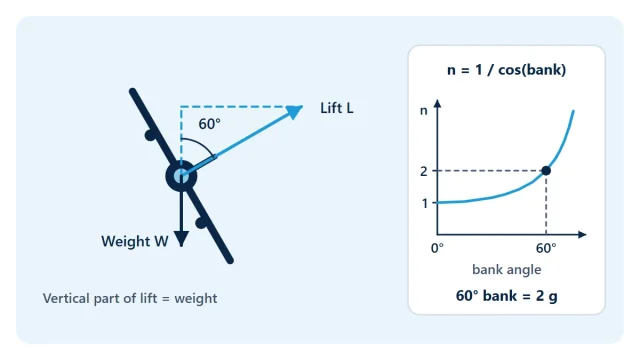
Wing loading is shown in kg/m² with lb/ft² beside it. As a pressure multiplies the mass figure by 9.80665 to give N/m², the average pressure difference the wing has to sustain in 1 g flight; it matches the lift per unit area in the lift force calculator for steady level flight. In a turn or pull-up the wing carries this loading multiplied by the load factor. For illustration, 1,100 kg on 16 m² gives 68.8 kg/m², 14.08 lb/ft² and 674 N/m².
Assumptions and limitations
- The result is an average over the whole reference area and says nothing about how lift is spread along the span.
- Standard gravity is used for the pressure row, and the aircraft is taken to be in 1 g flight.
- All the lift is attributed to the wing reference area; lift or download from the fuselage and tail is ignored.
- The value is a snapshot, because mass falls as fuel is burned.
- Pounds are treated as pounds of mass and converted with the exact definition of the pound.
Common mistakes
- Using empty mass or maximum mass when the question is about a particular loaded flight.
- Dividing pounds by square meters, or kilograms by square feet, in a hand calculation.
- Comparing two published wing loadings that were quoted at different masses.
- Confusing wing loading with span loading or power loading, which divide by different things.
- Reading lb/ft² as psi; there are 144 square inches in a square foot.
- Assuming wing loading alone fixes stall speed, when the maximum lift coefficient matters just as much.
References
- NASA Glenn Research Center, Beginner's Guide to Aeronautics.
- Federal Aviation Administration, Pilot's Handbook of Aeronautical Knowledge (FAA-H-8083-25).
These public sources explain the formulas and definitions used here. Citing them does not mean they have reviewed, endorsed or certified AviationCalc.
Related calculators
Lift Force Calculator
Lift from air density, true airspeed, wing area and a lift coefficient you supply.
Aerodynamics
Load Factor Calculator
Load factor in a level turn from bank angle, and the matching rise in stall speed.
Aerodynamics
Turn Radius Calculator
Radius and rate of a level coordinated turn from true airspeed and bank angle.
Aerodynamics
Thrust-to-Weight Ratio Calculator
Thrust divided by weight, with thrust and mass in the units you have.
Aircraft Performance Concepts
Guides that explain this calculation
Aerodynamics
Wing Loading Explained
Wing loading is aircraft weight divided by wing area. Learn how that one ratio shapes stall speed, turning ability and the ride in rough air.

Aerodynamics
Basic Principles of Aircraft Lift
How a wing produces lift by turning the air and creating a pressure difference, and what each term in the lift equation does to the result.
Aerodynamics
Load Factor and Aircraft Maneuvers
Load factor is lift divided by weight. In a level turn it equals 1 ÷ cos(bank), and stall speed rises with its square root.