Thrust-to-Weight Ratio Calculator
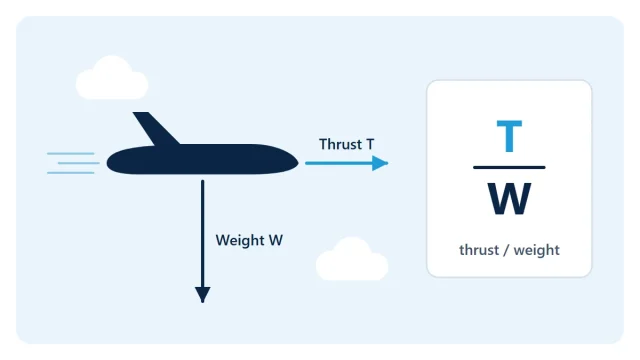
Thrust-to-weight ratio compares the force pushing an aircraft forward with the force of gravity on its mass. This calculator converts the thrust you enter to newtons, turns the mass into a weight using standard gravity, and divides one by the other to give a ratio with no units.
The ratio is a quick indicator of how much thrust is on hand for acceleration and climb. A value below 1 is normal for airplanes, which rely on wings for lift; a value above 1 means thrust alone exceeds weight. It is a snapshot. Both thrust and weight change during a flight, and the ratio changes with them.
How to use this calculator
- Enter Total thrust and choose N, kN, lbf or kgf.
- Enter the Aircraft mass at the moment that thrust applies, in kilograms or pounds.
- Read the ratio and the two forces behind it.
Total thrust is the sum for all engines, not the figure for one. Published thrust ratings are generally static values for standard sea-level conditions, and thrust in flight at speed and altitude is lower. Propeller aircraft are rated by power, not thrust, so a thrust value for one has to come from propeller data at a stated speed. Take the thrust from the manufacturer's data for the engine and condition you are studying, and the mass from the loading of the flight in question.
Formula
weight = m × g0
T/W = thrust ÷ weight
What the variables mean
- T/W
- thrust-to-weight ratio (no units)
- thrust
- total thrust in newtons
- m
- aircraft mass in kilograms
- g0
- standard gravity, 9.80665 m/s²
Worked example
These example values are illustrative round numbers, not data for any particular aircraft. Select "Fill in the example" in the calculator to load them.
Inputs
- Total thrust: 20 kN
- Aircraft mass: 8000 kg
Working
- Weight = 8,000.0 kg × 9.80665 = 78,453 N.
- T/W = 20,000 ÷ 78,453 = 0.255.
Result
- Thrust-to-weight ratio: 0.255 (Thrust is less than weight)
- Weight: 78,453 N (17,637 lbf)
- Thrust: 20,000 N (4,496 lbf)
Reading the result
Thrust-to-weight ratio is given to three decimals with a plain remark beside it: thrust is less than, equal to or greater than weight. Weight is the mass multiplied by 9.80665, in newtons and lbf, and Thrust is your entry in the same two units. Those rows are a check on the unit choices: a mass typed in pounds shows the same number of lbf in the weight row. A ratio below 1 does not mean an aircraft cannot climb, because the wing carries the weight and thrust only has to exceed drag.
Assumptions and limitations
- Weight is mass multiplied by standard gravity, 9.80665 m/s².
- Thrust is exactly the number entered, with no reduction for speed, altitude or temperature.
- All the thrust is taken to act along the direction of flight.
- Drag is not part of the calculation, so the ratio alone gives neither a rate of climb nor an acceleration.
- The result holds for one instant: fuel burn lowers the weight and changing conditions alter the thrust.
Common mistakes
- Entering the thrust of one engine for an aircraft that has several.
- Treating a static sea-level rating as the thrust available in cruise.
- Dividing pounds-force by kilograms in a hand calculation and getting a ratio that is wrong by a factor of about 2.2.
- Comparing ratios for two aircraft when one is quoted at empty mass and the other fully loaded.
- Concluding that a ratio below 1 means the aircraft cannot climb.
- Using engine power in horsepower or kilowatts as if it were thrust.
References
- NASA Glenn Research Center, Beginner's Guide to Aeronautics.
- Federal Aviation Administration, Pilot's Handbook of Aeronautical Knowledge (FAA-H-8083-25).
These public sources explain the formulas and definitions used here. Citing them does not mean they have reviewed, endorsed or certified AviationCalc.
Related calculators
Wing Loading Calculator
Wing loading from aircraft mass and wing area, in kg/m², lb/ft² and N/m².
Aerodynamics
Rate of Climb Calculator
The rate of climb that matches a climb gradient at a given ground speed.
Aircraft Performance Concepts
Drag Force Calculator
Drag from air density, true airspeed, reference area and a drag coefficient you supply.
Aerodynamics
Lift Force Calculator
Lift from air density, true airspeed, wing area and a lift coefficient you supply.
Aerodynamics
Guides that explain this calculation
Aircraft Performance Concepts
Thrust-to-Weight Ratio in Aviation
Thrust-to-weight ratio is a dimensionless comparison of two forces, and it changes throughout a flight as thrust varies and fuel burns off.

Aircraft Performance Concepts
Understanding Rate of Climb
Rate of climb is height gained per minute, and it comes from excess power. See the formula, what reduces it, and why steady wind does not change it.
Aerodynamics
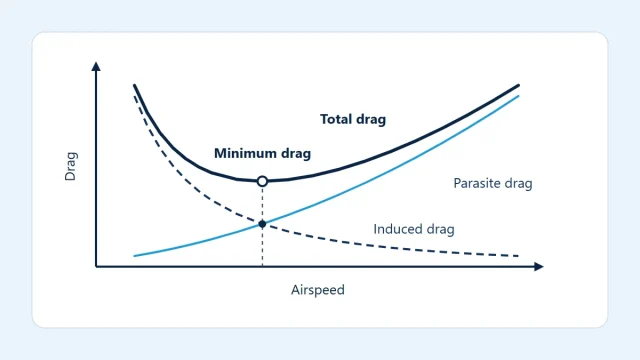
Understanding Aerodynamic Drag
Parasite drag rises with the square of speed and induced drag falls with it. See how the two add up to a total drag curve with a minimum.