Aviation Units and Conversions
Essential Aviation Unit Conversions
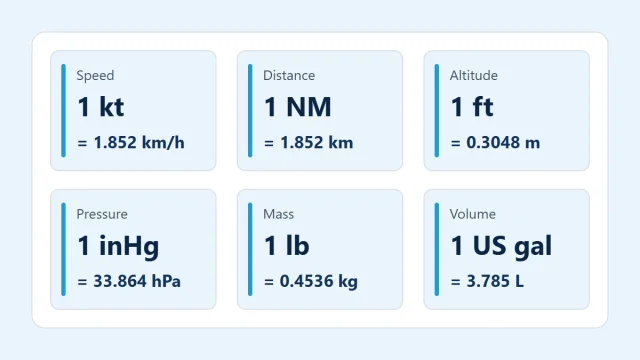
The speed, distance, altitude, pressure, temperature, mass and volume conversions aviation uses most, with exact factors and the shortcuts labelled.
Aviation Units and Conversions
The speed, distance, altitude, pressure, temperature, mass and volume conversions aviation uses most, with exact factors and the shortcuts labelled.
Aviation Units and Conversions
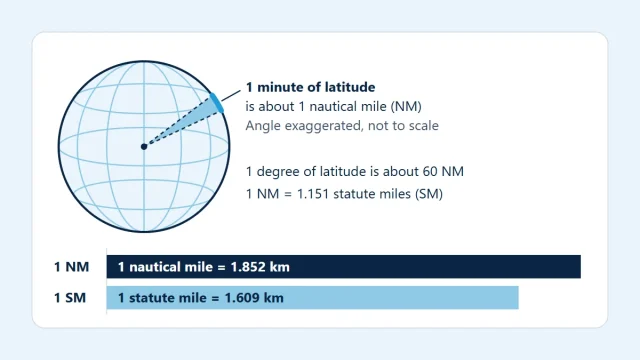
A nautical mile is exactly 1,852 m and about one minute of latitude; a statute mile is 1,609.344 m. See why aviation uses one and how to convert.
Aviation Navigation
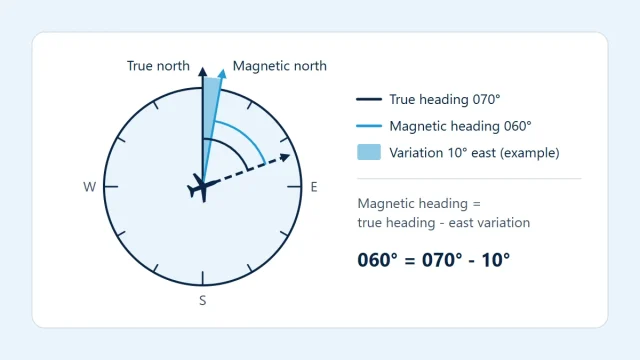
True, magnetic and compass headings differ by variation and deviation. Learn the sign convention and follow a worked conversion with example values.
Aviation Navigation
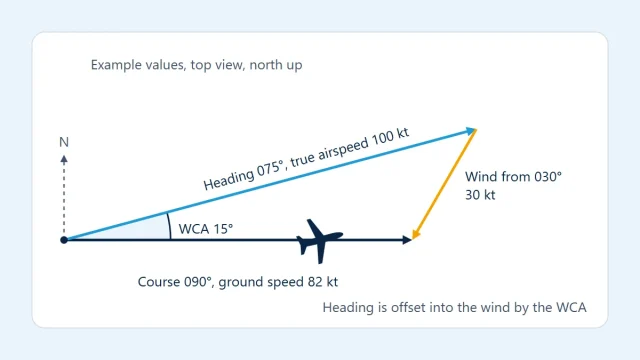
Why an aircraft has to point into a crosswind to hold its course, how the wind triangle gives the angle, and how airspeed changes the answer.
Wind Calculations
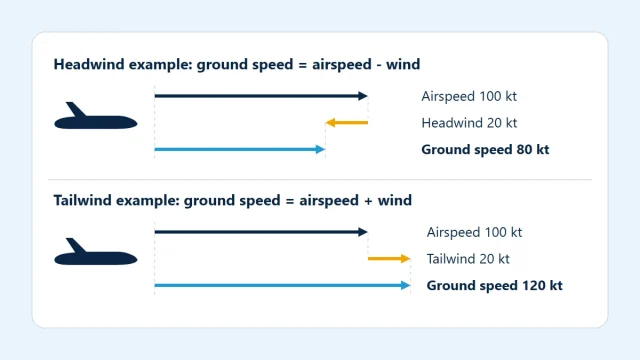
How wind along the track changes ground speed and flight time, how to find the component with a cosine, and why wind never cancels on a round trip.
Wind Calculations
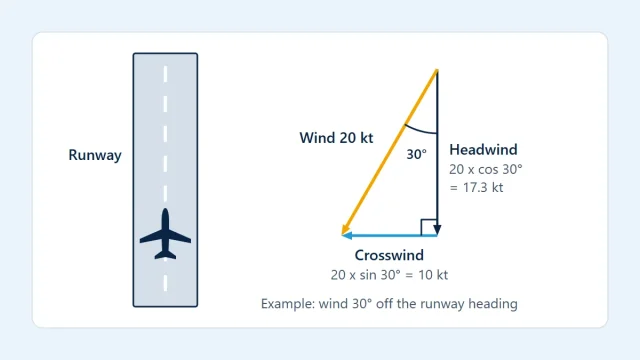
Split any wind into crosswind and headwind parts with sine and cosine, then see how the clock method and sixths rule compare with the exact values.
Atmosphere and Altitude
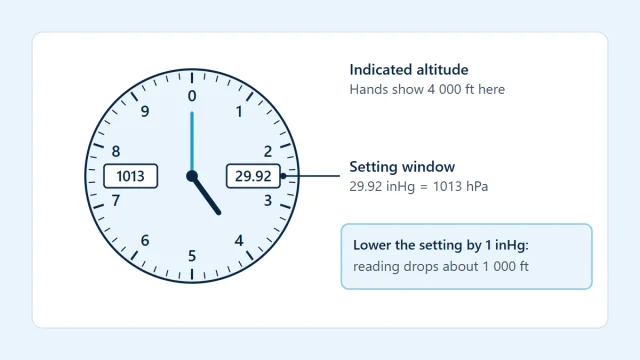
How an altimeter setting works, what QNH and the standard setting show, how inHg and hPa convert, and what a wrong setting does to indicated altitude.
Atmosphere and Altitude
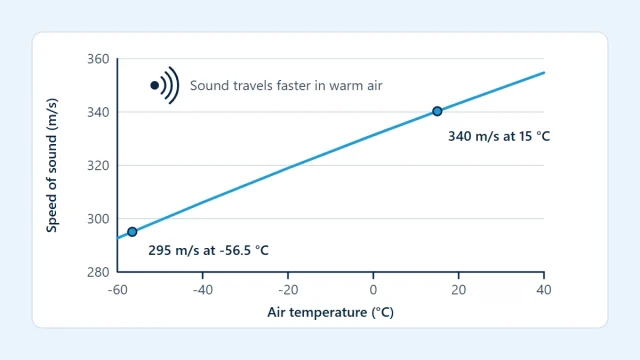
The speed of sound in air depends on temperature, not pressure or density. See the formula, a table of values and how it sets Mach number.
Atmosphere and Altitude
Pressure, temperature and humidity set air density, and density sets how much lift, thrust and power an aircraft can produce. Here is how they connect.
Atmosphere and Altitude
The ISA model fixes sea-level values, a 6.5 °C per km lapse rate and an 11 km tropopause. See the equations, a reference table and what ISA deviation means.
Atmosphere and Altitude
Pressure altitude is altitude measured from the 1013.25 hPa (29.92 inHg) standard datum. Learn how to read it, calculate it and where it is used.
Atmosphere and Altitude
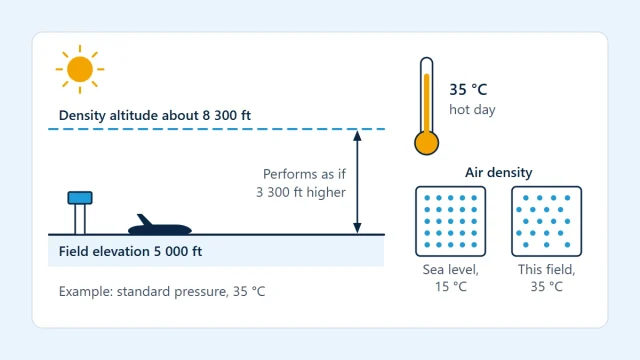
Density altitude is pressure altitude corrected for non-standard temperature. See the exact formula, the 120 ft per °C shortcut and a worked example.